
University applications drop as tuition fees soar: get the data. The number of UK-born students applying to university for autumn 2012 has dropped by 7.6% according to official figures published today.

Wwwdocs.fce.unsw.edu.au/fce/EDU/harvard_ref_guide.pdf. Harvard Referencing for Electronic Sources. Harvard author-date style, Citing and referencing tutorial, Monash University Library. Harvard System of Referencing Guide. Any in-text reference should include the authorship and the year of the work.

Depending on the nature of the sentence/paragraph that is being written, references to sources may be cited in the text as described below: Additional support on how to introduce such references is available from Student Support in their guide. When making reference to an author's whole work in your text, it is sufficient to give the name followed by the year of publication of their work: When writing for a professional publication, it is good practice to make reference to other relevant published work.
This view has been supported by Cormack (1994). However, where you are mentioning a particular part of the work, and making direct or indirect reference to this, a page reference should be included: Cormack (1994, pp.32-33) states that "when writing for a professional readership, writers invariably make reference to already published works". For more examples, see page numbers section. Maps/Jamie Nast - A Whole New Mind.pdf. Itunes.apple. Small Job Listings in All categories on Coffee & Power. Human-based genetic algorithm. In evolutionary computation, a human-based genetic algorithm (HBGA) is a genetic algorithm that allows humans to contribute solution suggestions to the evolutionary process.
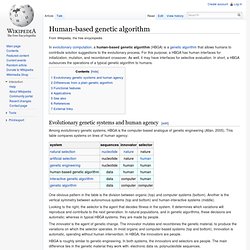
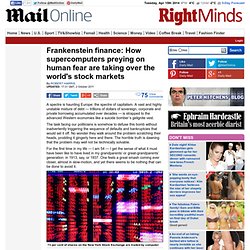
For this purpose, a HBGA has human interfaces for initialization, mutation, and recombinant crossover. As well, it may have interfaces for selective evaluation. In short, a HBGA outsources the operations of a typical genetic algorithm to humans. Evolutionary genetic systems and human agency[edit] Among evolutionary genetic systems, HBGA is the computer-based analogue of genetic engineering (Allan, 2005). One obvious pattern in the table is the division between organic (top) and computer systems (bottom). How supercomputers preying on human fear are taking over the world's stock markets. By Robert HarrisUPDATED: 17:31 GMT, 2 October 2011.
Module descriptions. Inside the Y Combinator Experience With the Founders of Codecademy. Since Zach Sims and Ryan Bubinsky left Columbia University to join Y Combinator, their startup, Codecademy, has attracted close to 1 million users and $2.5 million in funding from elite tech investors like Fred Wilson’s Union Square Ventures, Ron Conway’s SV Angel fund and Yuri Milner.
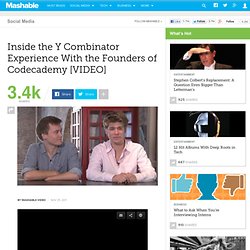
In our latest episode of Venture Studio, the founders talk about the Y Combinator experience and what it takes to launch a company with the huge vision of teaching the world how to code. Codecademy turns learning to code into a fresh, game-like experience. The face of education is changing (or so we hope!).
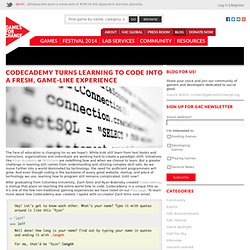
While kids still learn from text books and instructors, organizations and individuals are working hard to create a paradigm shift. Initiatives like Khan Academy or Skillshare are redefining how and when we choose to learn. But a greater challenge in learning still comes from understanding and utilizing complex skill sets. As we move further into a world dominated by technology, the need for proficient programmers will grow. And even though coding is the backbone of every great website, startup, and piece of technology we use, learning how to program still remains complicated. After graduating from Columbia University, Zach Sims and Ryan Bubinsky created Codecademy, a startup that plans on teaching the entire world how to code.
Codecademy was born simply through frustration. Like traditional education, Codecademy breaks up learning by courses and lessons. To get started with Codecademy, visit their game profile on our website. Watch. Www.clexchange.org/ftp/documents/Roadmaps/RM10/D-2926-7.pdf. Www.uis.unesco.org/Library/Documents/global_education_digest_2011_en.pdf. Where Good Ideas Come From: The Natural History of Innovation - Steven Johnson. Invisibility cloak gives sound performance. By drilling holes in a piece of PVC and then filling them with soft plastic, scientists in Germany have built a device that can effectively make objects invisible to sound waves.

The performance of the acoustic "invisibility cloak" exceeds that of existing electromagnetic devices and could open up new ways of manipulating waves, including the development of shields against seismic waves. Invisibility cloaks are designed to hide objects from view by causing waves that would otherwise scatter off an object to instead pass around it as if it were not there. First Demonstration of Time Cloaking Physicists have created a “hole in time” using the temporal equivalent of an invisibility cloak.

July 14, 2011 Invisibility cloaks are the result of physicists’ newfound ability to distort electromagnetic fields in extreme ways. The idea is steer light around a volume of space so that anything inside this region is essentially invisible. The effect has generated huge interest. Experts test cloaking technology.
A US-British team of scientists has successfully tested a cloak of invisibility in the laboratory.
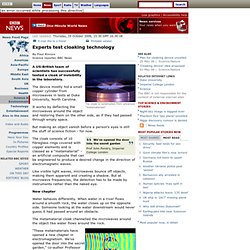
The device mostly hid a small copper cylinder from microwaves in tests at Duke University, North Carolina.