
Yale team discovers how stress and depression can shrink the brain. Related images(click to enlarge) Courtesy Yale University Major depression or chronic stress can cause the loss of brain volume, a condition that contributes to both emotional and cognitive impairment.
Now a team of researchers led by Yale scientists has discovered one reason why this occurs -- a single genetic switch that triggers loss of brain connections in humans and depression in animal models. The findings, reported in the Aug. 12 issue of the journal Nature Medicine, show that the genetic switch known as a transcription factor represses the expression of several genes that are necessary for the formation of synaptic connections between brain cells, which in turn could contribute to loss of brain mass in the prefrontal cortex.
"We wanted to test the idea that stress causes a loss of brain synapses in humans," said senior author Ronald Duman, the Elizabeth Mears and House Jameson Professor of Psychiatry and professor of neurobiology and of pharmacology. Source: Yale University. Ecstasy Drug Harms Memory, Study Reveals. Recreational use of the club drug Ecstasy could cause memory problems, new research finds.

A “lifeline” of flowers and stones. “During therapy the patient describes the traumatic event in a safe setting, while re-experiencing his or her emotions. In the process, the patient learns that the memories are not dangerous in themselves. The event was threatening when it occurred, but the memory the patient has today is not,” explains Håkon Stenmark, a specialist in clinical psychology. The method, called Narrative Exposure Therapy (NET), is an intervention aimed at reducing symptoms of post-traumatic stress. In an on-going Norwegian study, exposure therapy has been used with asylum seekers and refugees who have survived the ordeal of torture. “According to previous studies, these patients do not benefit from traditional psychological therapy. Ouija board helps psychologists probe the subconscious. Clare Wilson, medical features editor.

Child prodigies autistic? New study suggests a link between autism and child prodigies. Wikipedia A new, in-depth study of eight super-talented children, published in the journal Intelligence, suggests that autism runs in the family for prodigies.

Four out of eight of the children—musical virtuosos, painting geniuses, and chess stars—reported relatives with a diagnosis. (To put that number in perspective: In the United States, one out of 88 kids has been diagnosed with autism). Prodigies reach stunning levels of achievement in non-verbal, rule-bound domains at a young age. They’re different from savants, or people who also demonstrate extraordinary gifts but have social or mental impairments. In Hannibal's head. Behind the Hannibal mask, we find tenderness and pain, deep emotions and empathy.

(Photo: United International Pictures) I am meeting a psychologist at Brøset, a division of St. Olavs Hospital in Trondheim. The psychologist has studied criminal psychopaths and may shed light on what we have so far only seen as dark-minded insensitive killing machines. We're supposed to meet at the entrance. The building houses a variety of specialized services related to mental health care, courts, prisons, corrections and rehabilitation.
Wildmind Buddhist Meditation - Learn Meditation Online. Mental Health - Mental Health - extensive information about our publications in the field of mental health including psychiatry and clinical psychology. Stress Blocks Gene That Guards Brain Against Depression. Chronic stress appears to block a gene that guards against brain atrophy associated with depression, according to a study in rats that may help guide new treatments for mood disorders.
The gene, called neuritin, appears to be responsible for keeping healthy neuron connections in certain parts of the brain, according to the study published in the Proceedings of the National Academy of Sciences. Rats whose genes were suppressed were more anxious and depressed than those whose genes weren’t, an experiment found. Further, activating the gene led to an antidepressant response. Creating False Memories. Elizabeth F.

Loftus In 1986 Nadean Cool, a nurse's aide in Wisconsin, sought therapy from a psychiatrist to help her cope with her reaction to a traumatic event experienced by her daughter. During therapy, the psychiatrist used hypnosis and other suggestive techniques to dig out buried memories of abuse that Cool herself had allegedly experienced. Why Some People Blame Themselves for Everything. People prone to depression may struggle to organize information about guilt and blame in the brain, new neuroimaging research suggests.
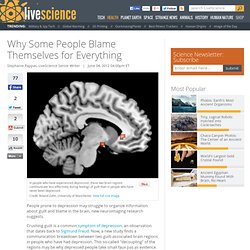
Crushing guilt is a common symptom of depression, an observation that dates back to Sigmund Freud. Now, a new study finds a communication breakdown between two guilt-associated brain regions in people who have had depression. This so-called "decoupling" of the regions may be why depressed people take small faux pas as evidence that they are complete failures. Health research : mood and intellectual performance. People smile when they are frustrated, and the computer knows the difference. Table of contents. (With last update date) Cover Foreword (August 13, 2009) Part 1.
Quantum theory and consciousness Preface to part 1 (April 12, 2000) Chapter 1. Blast from Dr. Mosher against psychiatry. Rosenhan experiment. Rosenhan's study was done in two parts.
The first part involved the use of healthy associates or "pseudopatients" (three women and five men, including Rosenhan himself) who briefly feigned auditory hallucinations in an attempt to gain admission to 12 different psychiatric hospitals in five different states in various locations in the United States. All were admitted and diagnosed with psychiatric disorders. After admission, the pseudopatients acted normally and told staff that they felt fine and had no longer experienced any additional hallucinations. All were forced to admit to having a mental illness and agree to take antipsychotic drugs as a condition of their release. The average time that the patients spent in the hospital was 19 days.