
Harmony. Simplicity. Community. Justin Goff, Community Specialist Last week, Jessica Lahey’s article in the Atlantic, “Letter Grades Deserve an ‘F,’” introduced Standards-Based Grading to the mainstream discussion on American education.
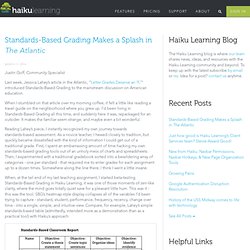
When I stumbled on that article over my morning coffee, it felt a little like reading a travel guide on the neighborhood where you grew up. I’d been living in Standards-Based Grading all this time, and suddenly here it was, repackaged for an outsider. It makes the familiar seem strange, and maybe even a bit wonderful. Reading Lahey’s piece, I instantly recognized my own journey towards standards-based assessment. When, at the tail end of my last teaching assignment, I started beta-testing Standards-Based Grading in Haiku Learning, it was one of those moments of zen-like clarity, where the mind goes totally quiet save for a pleasant little hum.
Lahey's mockup of a standards-based gradebook Standards-Based Grading in Haiku Learning Of course, Lahey’s piece isn’t perfect. Networlding Presents Five Global Values A New Book 10/01 by Networlding. tUnE-yArDs: Tiny Desk Concert. Tips for Organizing TEDxYouth Events. TEDxYouth@Manchester, one of the first TEDxYouth events, recently wrapped up its third event with over 400 young people from local sixth form school — between the ages of 17 and 18 — in attendance at the Fallibroome Academy.
We would like to share some TEDxYouth event organizing tips that we’ve gathered over the course of our three events: 1. Get students to apply online for the event. This adds a little kudos to the event. We get students to fill in a short form about themselves, as well their favorite quote, and things that they care most about. 2. 3. 4. 5. 6. 7. 8. 9. 10. 11. For Schools: Join the Global Classroom Today!
Tinkering and Technological Imagination in Educational Technology. Given the infusion of technology in almost every aspect of our lives, the education sector is struggling on how to integrate it into the classroom.
We have seen current trends and attempts for the use of educational technology with the Flipped Classroom ala Khan Academy, Interactive Whiteboards in every classroom, and lots of discussion about what are 21st century skills and literacies. Most educators would agree that a major purpose of education is to assist learners in gaining the skills, attitudes, and knowledge for having a better quality of life now and in their futures.
So any discussion about technology integration should include this purpose. Qualitative evidence points to the ease by which kids pick up their computer devices and use them as if they were brain-wired to do so. Hmm. Two recent and interconnected discussions have implications about how technology can be used in the classroom to ignite passion, innovation, and creativity . . . technological imagination and tinkering. Brewster Kahle: Universal Access to All Knowledge. As founder and librarian of the storied Internet Archive (deemed impossible by all when he started it in 1996), Brewster Kahle has practical experience behind his universalist vision of access to every bit of knowledge ever created, for all time, ever improving.

He will speak to questions such as these: Can we make a distributed web of books that supports vending and lending? How can our machines learn by reading these materials? Can we reconfigure the information to make interactive question answering machines? Can we learn from past human translations of documents to seed an automatic version? All knowledge, to all people, for all time, for free Universal access to all knowledge, Kahle declared, will be one of humanity's greatest achievements. Start with what the ancient library had---books. Moving images. The Web itself. "What is the Library of Alexandria most famous for?
" --Stewart Brand. Tipping Barrels. TALENTPHARM by Steven Hebert - Daily Dose - The Social Promotion Infographic. Marc and Angel Hack Life - Practical Tips for Productive Living. The incredibly painful way of getting an RSS feed of a Twitter list. (why does Twitter make it so hard?
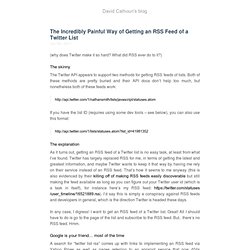
What did RSS ever do to it?) The skinny The Twitter API appears to support two methods for getting RSS feeds of lists. Both of these methods are pretty buried and their API docs don’t help too much, but nonetheless both of these feeds work: If you have the list ID (requires using some dev tools – see below), you can also use this format: The explanation As it turns out, getting an RSS feed of a Twitter list is no easy task, at least from what I’ve found. In any case, I digress! Google is your friend… most of the time A search for “twitter list rss” comes up with links to implementing an RSS feed via Yahoo Pipes as well as pages referring to an appspot service that now 404s (twiterlist2rss). Twitter REST API to the rescue After digging through the API docs, I found just the page I was looking for, detailing the REST service for Twitter lists. As it turns out, the basic structure for requesting list data is as follows: Where’s this list_id you speak of?
So..