
Web page size and layout : Iteracy - Web Designers Cornwall. Most web pages follow a common set of sizes and layouts, which you'll recognise even if you aren't aware of them.
For example, did you know that nine out of the top ten most popular websites in the world use a fixed-width, centre-aligned design? Maybe you should too. Our article on web page size and layout breaks down web design into simple concepts, and helps you decide on a format for your website. To understand what the individual elements of a page are for, and why you need them, read our anatomy of a web page.
Page width This is the first decision to make when designing a website. Of the most popular websites in the world, most of their page sizes are fixed width. Facebook - 980 pixelsYouTube - 961 pixelsYahoo! The average size of these web pages is around 960 pixels, which is what you would expect as the most screen resolutions are 1024x768 or larger. Page height. Dreamweaver CS5 & CS5.5 * Absolute, document-relative, and site root-relative paths. Site root–relative paths describe the path from the site’s root folder to a document.
You may want to use these paths if you are working on a large website that uses several servers, or one server that hosts several sites. However, if you are not familiar with this type of path, you may want to stick to document-relative paths. A site root–relative path begins with a leading forward slash, which stands for the root folder of the site. For example, /support/tips.html is a site root–relative path to a file (tips.html) in the support subfolder of the site’s root folder. Introducing the new CSS layouts in Dreamweaver CS5. After you select the layout you'd like to start your web page with, you have several other choices to make in the bottom right of the dialog box.
First, you need to choose your doctype—HTML, XHTML, or HTML5. Using a Behavior to Launch a New Browser Window. Add Dreamweaver Extensions from Adobe Exchange site. Even with all the cool features in Dreamweaver, there will almost certainly come a day when you want to do things that Dreamweaver can’t do with the features that shipped with the program.

Fortunately, the programmers who created Dreamweaver made it possible for other programmers to add features using the Extension Manager. The result? You can add new functionality by adding extensions from a variety of third-party sources. You can find extensions that do everything from add Flash buttons to Fly-Out Menus to full-featured shopping cart systems. As you consider the many extensions available, remember, many of them are great, but they don’t all enjoy the same quality control as Dreamweaver. In this lesson, I’ll walk you through the steps to find, download, and install a free extension that adds Flash buttons to Dreamweaver. Jquery XPOSE Gallery Overview. Photoshop/Dreamweaver Tutorial: Rollover Buttons. Dreamweaver Horizontal Spry Menu Bar: Explained in Depth (Drop down menubar, cs5, cs5.5) Getting started with jQuery Mobile. Note: You can follow the tutorial with any version of Dreamweaver or a text editor.
You probably have one in your pocket, or you may be talking to it, or you may be playing games on it—it's a smartphone. The category of smartphone seems to be quite broad—is it an Android phone, Apple iOS device, BlackBerry phone or something else? To give you a taste, here is a list of some mobile devices that are in the smartphone category: Apple iPhone/iPod TouchGoogle AndroidRIM BlackBerry/Playbook OSNokia Symbian (retired, but still with over 1 billion users worldwide)HP/Palm WebOSMicrosoft Window Phone 7 The challenge you have with such a vast number of different systems is fragmented support for standards. Developing mobile websites is no longer a wish list item for the web design team—it's a reality.
The goal of jQuery Mobile is to allow the framework to run on as many mobile devices as possible. Figure 1. Dreamweaver templates: Customizable starter designs for beginners. Managing websites with multiple layouts. Listing 4.
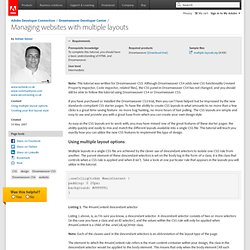
A modified header rule In listing 4 you can see the modified rule, once you have modified one instance of your #header and #header h1 rules all remaining rules that reference these elements can be safely deleted. Understanding inheritance. Open tree3.html and you will see that after you add the previous rule to your style sheet, the p element and the em element (which is a child of the p element) both become blue.
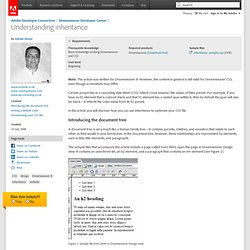
This is specificity at work; the color value set against the p element is more specific than the color value set against the body element, so the color value against the p wins out. The em element within the p element then inherits the color from the p element, which is its parent element. While all this color changing has been going on, your ul and li elements have remained unchanged.
Building scalable websites with Dreamweaver. Dreamweaver CS5 & CS5.5 * The CSS Styles panel.