
Neuroscience Challenges Old Ideas about Free Will. Do we have free will?
It is an age-old question which has attracted the attention of philosophers, theologians, lawyers and political theorists. Now it is attracting the attention of neuroscience, explains Michael S. Gazzaniga, director of the SAGE Center for the Study of the Mind at the University of California, Santa Barbara, and author of the new book, “Who’s In Charge: Free Will and the Science of the Brain.” He spoke with Mind Matters editor Gareth Cook. Female orgasm captured in series of brain scans. Scientists have used brain scan images to create the world's first movie of the female brain as it approaches, experiences and recovers from an orgasm.

The animation reveals the steady buildup of activity in the brain as disparate regions flicker into life and then come together in a crescendo of activity before gently settling back down again. To make the animation, researchers monitored a woman's brain as she lay in a functional magnetic resonance imaging (fMRI) scanner and stimulated herself. The research will help scientists to understand how the brain conducts the symphony of activity that leads to sexual climax in a woman. By studying people who have orgasms, Professor Barry Komisaruk, a psychologist at Rutgers University in New Jersey and his team hope to uncover what goes wrong in both men and women who cannot reach sexual climax. Your brain's family album, from hydra to human - Image 1.
How exactly do neurons pass signals through your nervous system? Brain's synaptic pruning continues into your 20s - health - 17 August 2011. The synaptic pruning that helps sculpt the adolescent brain into its adult form continues to weed out weak neural connections throughout our 20s.

The surprise finding could have implications for our understanding of schizophrenia, a psychological disorder which often appears in early adulthood. As children, we overproduce the connections – synapses – between brain cells. During puberty the body carries out a kind of topiary, snipping away some synapses while allowing others to strengthen.
Over a few years, the number of synapses roughly halves, and the adult brain emerges. Or so we thought. Why harmony pleases the brain - physics-math - 19 September 2011. The key to pleasant music may be that it pleases our neurons.
A new model suggests that harmonious musical intervals trigger a rhythmically consistent firing pattern in certain auditory neurons, and that sweet sounds carry more information than harsh ones. Since the time of the ancient Greeks, we have known that two tones whose frequencies were related by a simple ratio like 2:1 (an octave) or 3:2 (a perfect fifth) produce the most pleasing, or consonant, musical intervals. This effect doesn't depend on musical training – infants and even monkeys can hear the difference. How Embarrassing: Researchers Pinpoint Self-Consciousness in the Brain. Feeling embarrassed?
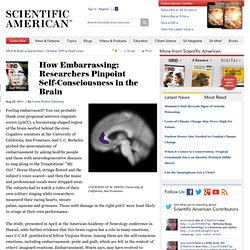
You can probably thank your pregenual anterior cingulate cortex (pACC), a boomerang-shaped region of the brain nestled behind the eyes. Cognitive scientists at the University of California, San Francisco, and U.C. Berkeley probed the neuroanatomy of embarrassment by asking healthy people and those with neurodegenerative diseases to sing along to the Temptations’ “My Girl.” Horns blared, strings flowed and the subject’s voice soared—and then the music and professional vocals were stripped away. The subjects had to watch a video of their own solitary singing while researchers measured their racing hearts, sweaty palms, squirms and grimaces.
The study, presented in April at the American Academy of Neurology conference in Hawaii, adds further evidence that this brain region has a role in many emotions, says U.C.S.F. postdoctoral fellow Virginia Sturm. The Neuroscience of Barbie. In science fiction and fantasy tales, there is a long running fascination with the idea of dramatically diminishing or growing in stature.
In the 1989 classic, Honey, I Shrunk the Kids, Rick Moranis invents a device which accidentally shrinks both his own and the neighbor’s children down to a quarter-of-an-inch tall. Preceding this by more than 100 years, Lewis Carroll wrote about a little girl who, after tumbling down a rabbit hole, nibbles on some cake and then grows to massive proportions. How scientists discovered the "fear center" of the brain. Take a psychedelic trip through 700 layers of the human brain. The Whole Brain Atlas. Neuroscientists identify a master controller of memory. When you experience a new event, your brain encodes a memory of it by altering the connections between neurons.

This requires turning on many genes in those neurons. Now, MIT neuroscientists have identified what may be a master gene that controls this complex process. Seeking the neurological roots of conflict. MIT postdoc Emile Bruneau has long been drawn to conflict — not as a participant, but an observer.
In 1994, while doing volunteer work in South Africa, he witnessed firsthand the turmoil surrounding the fall of apartheid; during a 2001 trip to visit friends in Sri Lanka, he found himself in the midst of the violent conflict between the Tamil Tigers and the Sri Lankan military. Those chance experiences got Bruneau, who taught high school science for several years, interested in the psychology of human conflict.
While teaching, he also volunteered as counselor for a conflict-resolution camp in Ireland that brought Catholic and Protestant children together. At MIT, Bruneau is now working with associate professor of cognitive neuroscience Rebecca Saxe to figure out why empathy — the ability to feel compassion for another person’s suffering — often fails between members of opposing conflict groups. Just How Free Is Free Will? Neuromarketing - Ads That Whisper to the Brain. Bee swarms behave just like neurons in the human brain. TV Watching Is Bad for Babies' Brains. Babies who watch TV are more likely to have delayed cognitive development and language at 14 months, especially if they're watching programs intended for adults and older children.

We probably knew that 24 and Grey's Anatomy don't really qualify as educational content, but it's surprising that TV-watching made a difference at such a tender age. Babies who watched 60 minutes of TV daily had developmental scores one-third lower at 14 months than babies who weren't watching that much TV. Though their developmental scores were still in the normal range, the discrepancy may be due to the fact that when kids and parents are watching TV, they're missing out on talking, playing, and interactions that are essential to learning and development.
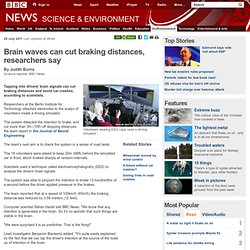
This new study, which appeared in the Archives of Pediatric and Adolescent Medicine, followed 259 lower-income families in New York, most of whom spoke Spanish as their primary language at home. Brain waves can cut braking distances, researchers say. 29 July 2011Last updated at 09:44 By Judith Burns Science reporter, BBC News Volunteers wearing EEG caps used a driving simulator Tapping into drivers' brain signals can cut braking distances and avoid car crashes, according to scientists.
Split brain with one half atheist and one half theist. Smart Guide to 2012: Mapping the human brain - health - 21 December 2011. How your brain sees your body: Meet the cortical homunculus. Neuroscience: “Mirror Neurons: Why We Don’t Need God to Be Good” « Talesfromthelou's Blog. A Neuroscientist Uncovers A Dark Secret : NPR - StumbleUpon. Weird Wired Science. Austrian physician Franz Joseph Gall sought to understand the mind of murderers and other criminals by feeling the outside of their skulls. This practice, which he first used in 1796, later came to be called Now largely discredited, it turned out that neither Gall nor anyone could systematically link the bumps and lumps on the head to any regular patterns of behavior, criminal or otherwise. Psychologists no longer need to use scalp massages as diagnostic tools.
They can now look at what's happening inside the skull using one of several types of brain scans. The most successful of these methods is the magnetic resonance imaging (MRI) brain scan, particularly the functional MRI (or fMRI). Patients are placed within a scanning device that causes nuclei within the cells to produce a rotating magnetic field detected by the scanner. Brain scans are clearly an advance over phrenology, but they also have their limitations.