
Untitled. II.
Act I H. Open for Discussion. All My Sons: Act 1 Summary. Annie tells Chris, in front of Joe and Kate, that she’s surprised he has so many clothes, but Chris reveals that Annie is staying in Larry’s old room, and that the clothes and shoes, still shined by Kate, are Larry’s—Annie seems shocked by this, and wonders aloud whether Kate is still waiting for Larry to return.
Annie admits, after some prodding by Kate, that she is not dating anyone seriously, but when Kate sees this as evidence Annie is waiting for Larry to return, and tells Annie as much, Annie replies, flatly, that she is not waiting for Larry, and that Kate must be the only mother still in America to do so, after three long years. An especially poignant scene. It is so hard for Annie to imagine the extent to which Kate still grieves for Larry—and expects him to return—that Annie cannot believe Kate would have kept Larry’s clothes and continued to shine his shoes, as if he might walk through the door that evening. Analyze My Writing. SONGS OF OURSELVES - Wellington High School. Exam centre. Post_colonial_literature.pdf.
George Herbert's Love by Mike Klassen on Prezi. AS-Level – Songs of Ourselves: Part 1. CIE Literature. Poetry is a major component of both iGCSE and A-Level Literature.
It’s something that usually puts the fear of God into students and leads to a good deal of ineffectual moaning. Unfortunately, moaning isn’t going to help you, so try to embrace it and ignore temptations to dismiss it as nonsense… A Different History. Context Bhatt is an Indian born in Pune, a metropolis (mega city) in the west of India.
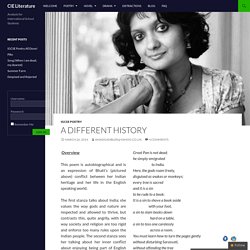
At 12, her family moved to the USA where she had to learn English from scratch. She has talked about her identity struggle with Gujarati (an Indian language) representing the ‘deepest layer of her identity’, but English representing her daily life and work. CIE Lit Poems 2013 Revision. I said that one of the things I most liked about Brewster’s poem “Where I Come From” was its simplicity: “It’s a beautiful example of a poet doing exactly what a poet should do: realising something quite profound, and sharing that idea with us in a beautiful, accessible, thought-provoking way.”
That’s what the best poetry is to me. It doesn’t have to be simple (though simple is beautiful: read Wendy Cope), and it doesn’t necessarily have to be immediately accessible (“immediate accessibility” isn’t a criteria for the lovers of the poetry of Gerard Manley Hopkins or Shakespeare), but for the more complex poems, there has to be that chink of approachability, that glimmer of light, that is the opening for you to “get into” the text. Why So Pale and Wan, Fond Lover? (Study Guide) Games at twilight by Alexandra Rodriguez on Prezi. Search for Richard III teaching resources - TES. Ama Ata Aidoo: Language in The Dilemma of A Ghost. Megan Behrent, Brown University '97 The Dilemma of a Ghost , Aidoo's first play, puts on stage a wide array of characters from diverse heritages, educational backgrounds and thus, linguistic backgrounds.
Language plays an extremely important role in that it is the primary way in which differences in background and educational status are represented, and it is also central to the miscommunications that occur between the different characters. In "Language and Drama," Dapo Adelugba argues that 'speech, in Aidoo's plays is an index of social class, age and blackground".
For Eulalie, an African-American woman, English is a first language and Aidoo tries to demonstrate this in this character's speech. Although she certainly succeeds in distinguishing Eulalie's speech from the other characters, it is perhaps in her attempt to portray American-English that Aidoo is least successful.
Perhaps the most interesting and successful use of language is that of the family as well as the two old women. Report On The Threatened City Guided Questions. Please have a copy of the short story at hand when working on the exercises below.
Read the text carefully and answer the following questions meticulously. Remember to quote selectively from the text to illustrate your points when necessary. Jot down quote/important scenario page numbers in parenthesis for easy reference later on. Give a brief outline of the plot of the story. The Custody of the Pumpkin - Ms Kirby's Class Noticeboard. P.G.
Wodehouse Jeeves & Wooster (based on 'Jeeves' by P.G. Wodehouse) Matthew's Poetry Analysis: Summer Farm - Norman MacCaig. Summer Farm Norman MacCaig Summary: The poet lies within the depths of his mind, probably in his happy place as his mother’s family lived in the rural area, which is reflected in this story.
Everything described in the story is part of his mind, with perhaps every animal representing a different aspect of his mind. The Importance by Cecilia L on Prezi. This Is My Letter to the World - Poetry for Students. Emily Dickinson c. 1862 Author Biography Poem Text Poem Summary Themes Style.
AS-Level – Songs of Ourselves: Part 1. A Martyr to Love: Mary Wroth’s Sonnets in the Early British Literature Survey Course. In the undergraduate early British literature survey course (beginnings to 1660) that I teach at a small liberal arts university, I like to introduce students to Sir Philip Sidney’s niece, Mary Wroth, also a sonneteer who began writing in 1613. Her Pamphilia to Amphilanthus, the first complete sonnet sequence by a woman writer in England, was published with her longer prose work, The Countesse of Montgomeries Urania (1621). Because we study so many sonnets by the conventional writers, Petrarch, Wyatt, Shakespeare, Spenser, Sidney, and Marlowe in the course first, students are aware of basic sonnet forms and conventions before we read her. By this point in the course, they understand the differences between Italian and English forms and notice when a writer significantly departs from established sonnet traditions.
Wroth works especially well also in courses that look at later women writers who revived the form in the late eighteenth and nineteenth centuries. Rainbow Literature. Analysis of 'Flag' by John Agard. Flag read by John Agard (AQA Conflict Anthology) John Agard 'Put The Kettle On' Poetry Jump Up by John Agard. John Agard: 'Listen Mr Oxford don' Benjamin Zephaniah author of 'Too Black Too Strong' discusses racism and multiculturalism. Benjamin Zephaniah Talking Turkeys Christmas Poem. Money - Benjamin Zephaniah.
Dis Poetry.
Theories of Diaspora. Welcome to Lit2Go ETC. A poet is, before anything else, a person who is passionately in love with language. Scottish Poetry Library. Carol Ann Duffy: Rapture (2005) Poems. Exclusive: poet laureate Carol Ann Duffy's poems for children. Carol Ann Duffy has been acclaimed as the first poet laureate for the whole family with her brilliant poems for children. New laureate Carol Ann - who edits our Poetry Corner column - has given us an exclusive preview of her latest work to share with Daily Mirror readers.
Carol Ann Duffy. On December 23, 1955, Carol Ann Duffy was born in Glasgow, Scotland to Mary Black and Frank Duffy, both of Irish Catholic descent. Together with her four younger brothers, she was raised in Staffordshire in the West Midlands of England where her father worked as a fitter with English Electric. She received a degree in philosophy from Liverpool University in 1977. Her first job was writing for television shows, followed by a C. Day Lewis Fellowship to work as a writer-in-residence in East End schools of London from 1982 and 1984.
Duffy's books of poetry include: New & Collected Poetry for Children (Faber and Faber, 2009); Rapture (Macmillan, 2006); Selected Poems (Penguin, 2004); Feminine Gospels (2002); and The World's Wife (2000), a collection of poetic retellings voiced by the wives of the famous and infamous. Her awards include a five-year grant from the National Endowment for Science, Technology and the Arts in England, a Lannan Literary Award, and the T. Phshigher.wikispaces. Faber: 60 Years in 60 Poems. The Space has relaunched with brand new material. If you were looking for the John Peel record collection, please read about our latest Record Box or visit our new homepage to explore the latest works on The Space. For further inspiration, take a look at The Space co-commissions. Custody of the Pumpkin (Use of Humour) The Importance of Being Ernest. The Importance of Being Earnest: STUDY QUESTIONS - MULTIPLE CHOICE QUIZ by Oscar Wilde.
Who's Afraid of Virginia Woolf Study Guide. Comparaingtexts.wikispaces. A-Level Synopses, AS English Lit Guides, Exam Literature Studies. The Great Gatsby. The Great Gatsby (1925) by F. Scott Fitzgerald is a short novel which takes place on Long Island during the Jazz Age and is commonly cited as one of the greatest novels of the 20th century. Chapter 1[edit] IGCSE Literature at IESE - Songs of Ourselves Poetry. The selection of poetry that you will be studying comes from the 19th and 20th Centuries. Literary Devices. WikiPaintings.org - the encyclopedia of painting.
Children's short stories. Peter was tired. After 10 years of holding together the paperwork for “Johnson, A.P. – SSN 555-66-33xx,” his tensile strength was fading; he could feel his molecules beginning to degrade. - Length: 8 pages. Classic Short Stories. Books, Poems, Articles and Stories for Children. WILLIAM SHAKESPEARE SONNETS with text of each sonnet. Stories from Shakespeare - Penguin Readers Level 3. An Analysis of Shakespeare's Sonnets and Sonnet Paraphrase in Modern English. Shakespeare's Sonnets. Shakespearean Sonnet. Cummings Guides Home..|..Shakespeare Videos..|..Shakespeare Books .By Michael J. Cummings © 2003. The Shakespearean Sonnet: Overview ........William Shakespeare wrote one hundred fifty-four sonnets.