
Untitled. WHY PEOPLE THINK COMPUTERS CAN'T Marvin Minsky, MIT First published in AI Magazine, vol. 3 no. 4, Fall 1982.
Reprinted in Technology Review, Nov/Dec 1983, and in The Computer Culture, (Donnelly, Ed.) Laser Crosswalk Saves Pedestrians From a Painful Death. When the light turns red, a huge laser wall projecting apparitions of crossing pedestrians spans across the crosswalk.
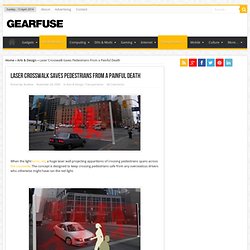
The concept is designed to keep crossing pedestrians safe from any overzealous drivers who otherwise might have ran the red light. Link [via] Doctor Who Timeline Infographic. Check out this complete timeline of Doctor Who from 1963 to present, including episodes, seasons, companions, villains, and more.

Scroll down to follow all the Doctor's adventures through time. A Fantastic resource for any Doctor Who fan. Adventure Titles. World's smallest car fuels nanotech advance. A CGI of the electric-powered nano car created by Dutch researchers Dutch scientists create the smallest vehicle in the worldNano car is the first to be powered by electricityCar traveled a distance of six nano meters Scientists hope nanomotors will power nanorobots of the future London (CNN) -- A tiny nano-sized car which can propel itself forward in response to electrical pulses has been created by scientists in the Netherlands.
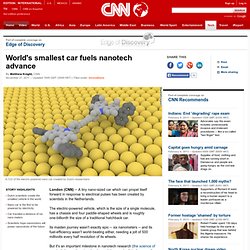
The electric-powered vehicle, which is the size of a single molecule, has a chassis and four paddle-shaped wheels and is roughly one-billionth the size of a traditional hatchback car. Tanning Printer by Hosung Jung, Junsang Kim, Seungin Lee & Yonggu Do. The Art of Solar Printing It’s here in concept and I simply love it!

The Tanning Printer is a solar powered printer that doesn’t use cartridges. Instead it uses the process of sun-tanning the paper! You got that right sir…sun tan! One weird theory could make anti-gravity and faster-than-light travel possible. "Famously, physicist John Reed noted in 2006 that some parts of the theory don't yield the exact quantities that Heim claimed they did, only to reverse his opinion the next year and publicly say he believed that Heim was onto something.
" More recently, Reed came to the conclusion that Heim's theory wasn't deriving the particle masses, but using them as inputs and then regurgitating them. (Among other evidence, it gives correct masses for particles whose masses were known in 1947, but not for those discovered later. Ultimate FPS Simulator Actually Shoots You. October 18th, 2011 by Shane McGlaun This is the most awesome, intense, realistic (and painful) video game simulator I have ever seen.
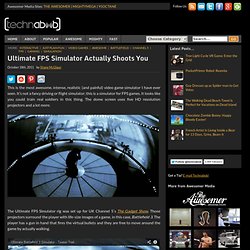
It’s not a fancy driving or flight simulator; this is a simulator for FPS games. It looks like you could train real soldiers in this thing. The dome screen uses five HD resolution projectors and a lot more. MIT Creates New Energy Source. This is some pretty exciting news.
It seems that researchers at the Massachusetts Institute of Technology (MIT), one of the most prestigious science and engineering schools in the United States, has created a new energy source -- and it's clean and renewable. The odd thing is that the only way you can see this energy source is with a very powerful microscope, because it is created by using nanotechnology. For a few years now, we have been hearing about the possibilities offered by the new field of nanotechnology. Now it looks like the first usable breakthrough has been accomplished. MIT has devised a process to generate electricity using nanotechnology. The researchers built tiny wires out of carbon nanotubes. 12 bizarre real-life places that are stranger than science fiction. Science fiction is home to some fantastic societies, from Cloud City to Bartertown.

Scientists reconstruct images from our brains, plan to do the same for dreams (video) Stumbling, Bumbling LittleDog Can Tiptoe Across Tops of Cylinders. Physicists Observe Neutrino Quick-Change in Japan. EDWARD_BSL.jpg (JPEG Image, 919x768 pixels) Boston Dynamics Robots Tiptoe Toward Terminator. A new video of a Boston Dynamics robot has surfaced--possibly the scariest yet.
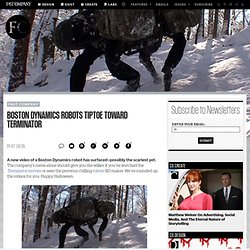
The company's name alone should give you the willies if you've watched the Terminator movies or seen the previous chilling robots BD makes. We've rounded up the videos for you. Happy Halloween. Boston Dynamics is a small engineering and robotics firm spun off from MIT in 1992. 7 Man-Made Substances that Laugh in the Face of Physics. The universe is full of weird substances like liquid metal and whatever preservative keeps Larry King alive. But mankind isn't happy to accept the weirdness of nature when we can create our own abominations of science that, due to the miracle of technology, spit in nature's face and call it retarded. That's why we came up with... Militants may try bomb implants to attack - US.
Who wants to live forever? Scientist sees aging cured. Meet the Matrix, er, Elephant Trunk-Inspired Arm of Your Future Robot Overlord. Meet Festo, a prototype robotic arm that takes its design inspiration from the way an elephant's trunk moves every which way thanks to its series of highly flexible muscle segments. Clever? Yes. Astrolabe – Magnificent Computer of the Ancients. It is an ancient tool, created over two thousand years ago when people thought that the Earth was the center of the universe. Photo-twitpic-login-future-28theyE28099re.jpg (JPEG Image, 600x4090 pixels) Them Punks: The Reality of Cyber, the Rise of Steam « SciFi4Me.com. Since my work with SciFi4me began I’ve had to catch up on some science fiction films I’ve never seen before, essentials I should have seen years ago.
Starting with the classic Blade Runner the theatrical cut, we are brought to the topic at hand, “Cyber Punk”. Science fiction becomes fact as filmmaker with bionic eye explores the technology of Deus Ex.