
Exemples Facebook. Pinterest - WSJ Tech & Gadgets. Monoprix. UNICEF Photography. Decision 2012. Quel est le meilleur jour/heure pour poster sur Facebook et Twitter ? [infographie] Best time to tweet. Leo Widrich is the co-founder of Buffer, a smarter way to publish tweets and Facebook posts.
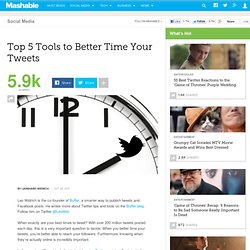
He writes more about Twitter tips and tools on the Buffer blog. Follow him on Twitter @LeoWid. When exactly are your best times to tweet? With over 200 million tweets posted each day, this is a very important question to tackle. When you better time your tweets, you’re better able to reach your followers. Let’s examine different tools that help determine Twitter metrics. 1. This first tool is certainly my favorite in terms of simplicity. Your best times are determined by two key measures: the performance of your past tweets and when most of your followers will be online. 2.
TweetStats is a comprehensive tool that provides more detailed best tweeting times. The app also features a tweet density report. 3. My favorite in terms of algorithm is certainly Tweriod. 4. Additionally, the app allows for a very comprehensive keyword search. 5. What else is important other than timing? L'impact de la nouvelle timeline Facebook. Le Paysage des Médias Sociaux en 2013 par Brian Solis [Infographie] Brian Solis, principal analyst chez Altimeter Group, vient de sortir la 4ème version de son « Conversation Prism », un document qui dresse la cartographie des médias sociaux disponibles en 2013 aux consommateurs et professionnels.
![Le Paysage des Médias Sociaux en 2013 par Brian Solis [Infographie]](http://cdn.pearltrees.com/s/pic/th/infographie-emarketinglicious-60959899)
Il explique à son sujet : « Le prisme de la conversation est important car il est la seule carte axée sur la recherche qui explore l’évolution du web social depuis la montée des médias sociaux. C’est une combinaison de la recherche et de l’enthographie digitales. Il regroupe les réseaux en fonction de leur utilisation par les gens et présente à la fois les réseaux sociaux incontournables et les plus prometteurs. Le prisme de la conversation n’est pas destiné à montrer chaque réseau, mais plutôt comment la forme du web social est en train de changer et qui du peloton de tête pousse les médias sociaux dans de nouvelles directions. 1. 2. 3. Panorama des médias sociaux 2012.
(The english version of this article is here: Social Media Landscape 2012) Il y a quelques années une analyste disait que dans cinq ans, les médias sociaux seront comme l’air (omniprésents).
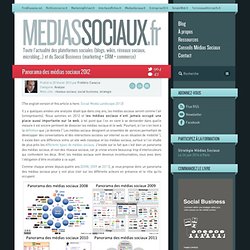
The Current State Of Social Networks 2012. By Shea Bennett at Media Bistro: Did you know that Twitter is the social network with the strongest growth rate in 2012, ahead of LinkedIn, Pinterest and Reddit? Facebook? That didn’t even make the cut. Still, when you’re closing in fast on one billion users, your annual growth rate does tend to slow down a smidgen. Still, don’t shed a tear for Mark Zuckerberg – save those for the owners of Digg, Bebo, Friendster and, of course, MySpace, who are the four social networks most in decline, reminding us that success in this space can be both dramatic and fleeting.
This data comes courtesy of Ignite Social Media, who have compiled the infographic of infographics about the state of social media, worldwide, in 2012. Check out all this, and more, in the visualization below. Twitter : 500 millions d’utilisateurs. Infographie Twitter 2012. Top 100 des comptes Twitter. Les médias les plus Twitterisés. Quel apport d'audience ? Périmètre Etude réalisée du 1er au 31 janvier 2012Périmètre de 12 sites web d’actualité.

How social sites make money. “The Guardian’s Facebook app” - Martin Belam at news:rewired. In September last year the Guardian launched our Facebook app as one of the media partners working on new features announced at the company’s f8 conference.

The app uses the Open Graph to implement “frictionless sharing”, where the act of reading an article automatically pushes it as an action into Facebook’s database. The Guardian Facebook app Several of us at the Guardian - including colleagues Meg Pickard and Dan Catt - had thought for some time about what a “social news experience” might be like, but when we came to build the app we concentrated on shifting one particular metric. We knew that 77% of visits to the Guardian from facebook.com only lasted for one page. A good hypothesis for this was that leaving the confines of Facebook to visit another site was an interruption to a Facebook session, rather than a decision to go off and browse another site.
When we launched the app, some people were quizzical about the approach. And @Playwert got straight to the point...