
How Drugs Helped Invent the Internet & The Singularity: Jason Silva on "Turning Into Gods". Mouse Party. Drug Overdose Game. Alcohol. 1999 BBC News Health: Alcohol benefits debunked Moderate alcohol consumption has no positive effect on health.
The Good Drug Guide. Psychedelics. The 5 Greatest Things Ever Accomplished While High. Cracked.com's new book is now on sale.
What follows is one of the classic articles that appear in the book, along with 18 new articles that you can't read anywhere else. Any dreadlocked white guys finding this article after Googling "Drugs Rule" should know that we've given this list about drugs a rule. To make the cut, an accomplishment has to be considered great by people who could pass a field sobriety test.
So no Grateful Dead music. We're sure someone somewhere has enjoyed the Dead perfectly sober, just as there are probably non-Christians who listen to Christian Rock. In fact, because we're masochists, we gave ourselves a strict no music policy, leaving us with ... well, not a whole lot actually. Francis Crick Discovers DNA Thanks to LSD The Accomplishment: For the few Cracked readers not versed in the history of human genetics, Francis Crick is the closest that field gets to a rock star, which is pretty fucking close as it turns out.
Above: Science? The Drug: LSD. Valium. Valium is Schedule IV in the United States.
This means it is illegal to sell without a DEA license and illegal to buy or possess without a license or prescription. Addictive Potential: Medium Emergency Room Visits Yearly: Unknown. 5-HT2A Receptor. The mammalian 5-HT2A receptor is a subtype of the 5-HT2 receptor that belongs to the serotonin receptor family and is a G protein-coupled receptor (GPCR).[1] This is the main excitatory receptor subtype among the GPCRs for serotonin (5-HT), although 5-HT2A may also have an inhibitory effect[2] on certain areas such as the visual cortex and the orbitofrontal cortex.
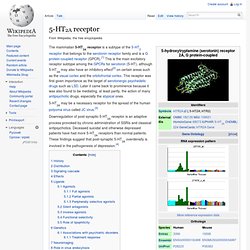
This receptor was first given importance as the target of serotonergic psychedelic drugs such as LSD. Later it came back to prominence because it was also found to be mediating, at least partly, the action of many antipsychotic drugs, especially the atypical ones. 5-HT2A may be a necessary receptor for the spread of the human polyoma virus called JC virus.[3] Downregulation of post-synaptic 5-HT2A receptor is an adaptive process provoked by chronic administration of SSRIs and classical antipsychotics.
Deceased suicidal and otherwise depressed patients have had more 5-HT2A receptors than normal patients. American Drug War. Versus War on Drugs Debate. The War on Drugs is a War on You. By Michael Boldin The drug war is based on a repugnant assertion: that you do not have ownership over your own body; that you don’t have the right to decide what you’ll do with your body, with your property and with your life.
The position of the drug warriors is that you should be in jail if you decide to do something with your body that they don’t approve of. This is an abomination of everything that America is supposed to stand for. As long as this country continues the drug war, you are not free. At the root, then, those that force the drug war on you are enemies to your freedom. If you are concerned at all about liberty, the economy, the Constitution and the power of the Federal Government – you cannot ignore the US government’s longest and most costly “war” – the War on Drugs. But no matter how long it lasts, how much is costs, how many lives are disrupted, and how much it fails – the war rages on. Why? All they care about is their own power. Period. If not, what’s going to be next? Cannabis. 5 Amazing New Experimental Drugs. I'm the resident Alternative Lifestyle Specialist around here (which is what I keep asking my boss to call me instead of "drug-addled wreck of a human being"), so when new pharmaceutical trends sweep through the United States like Daniel Larusso's leg, it's up to me to cover them.
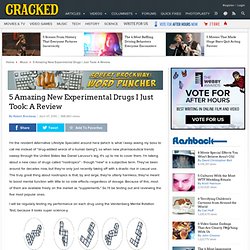
I'm talking about a new class of drugs called "nootropics" - though "new" is a subjective term. They've been around for decades now, but they're only just recently taking off with a drastic rise in casual use. The truly great thing about nootropics is that, by and large, they're utterly harmless; they're meant to boost mental function with little to no side effects--regardless of dosage. Because of this, most of them are available freely on the market as "supplements. " So I'll be testing out and reviewing the five most popular ones.
I will be regularly testing my performance on each drug using the Vandenberg Mental Rotation Test, because it looks super science-y. Meditation and "Drugs" It's a not-so-dirty little secret that most of today's leading meditation teachers were interested in drugs.
By "drugs," of course, I don't mean alcohol or Oxycontin, but rather that subset of chemicals which our society has deemed unfit for human consumption, including cannabis, psilocybin, MDMA, and others. Many of today's leading Buddhist teachers, for example, credit their first taste of altered mind states not to samadhi but to LSD or mushrooms, and almost every spiritual teacher I know (and I know a bunch) smoked pot. Some still do. So what's the connection? Why do people who like drugs (I'll stop scarequoting the word, even though I shouldn't) like meditation?