
Bret Victor, beast of burden. Algorithm Aims To Predict Crime By Tracking Mobile Phones. Learning From Data - Online Course. A real Caltech course, not a watered-down version on YouTube & iTunes Free, introductory Machine Learning online course (MOOC) Taught by Caltech Professor Yaser Abu-Mostafa [article]Lectures recorded from a live broadcast, including Q&APrerequisites: Basic probability, matrices, and calculus8 homework sets and a final examDiscussion forum for participantsTopic-by-topic video library for easy review Outline This is an introductory course in machine learning (ML) that covers the basic theory, algorithms, and applications.
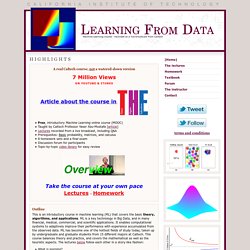
ML is a key technology in Big Data, and in many financial, medical, commercial, and scientific applications. What is learning? Live Lectures This course was broadcast live from the lecture hall at Caltech in April and May 2012. The Learning Problem - Introduction; supervised, unsupervised, and reinforcement learning. Is Learning Feasible? 2011 Annual Question. Proxy Your Way to Online Anonymity. Anvaka/VivaGraphJS. Welcome. SemWeb.NET: Semantic Web/RDF Library for C#/.NET. Querying with SPARQL. Home > User Guide > Querying with SPARQL SPARQL is the standard query language for the Semantic Web and can be used to query over large volumes of RDF data. dotNetRDF provides support for querying both over local in-memory data using it's own SPARQL implementation and for querying remote data using SPARQL endpoints or through other stores SPARQL implementations.
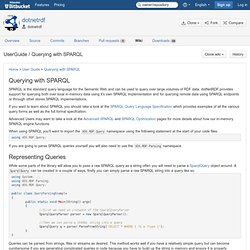
If you want to learn about SPARQL you should take a look at the SPARQL Query Language Specification which provides examples of all the various query forms as well as the full formal specifcation. Advanced Users may want to take a look at the Advanced SPARQL and SPARQL Optimization pages for more details about how our in-memory SPARQL engine functions. When using SPARQL you'll want to import the VDS.RDF.Query namespace using the following statement at the start of your code files: If you are going to parse SPARQL queries yourself you will also need to use the VDS.RDF.Parsing namespace. Result Sets ResultsType Result Results Variables Count. Cypher. A Graph-Based Movie Recommender Engine « Marko A. Rodriguez.
The MovieRatings Dataset The GroupLens research group has made available a corpus of movie ratings.

There are 3 versions of this dataset: 100 thousand, 1 million, and 10 million ratings. This post makes use of the 1 million ratings version of the dataset. The dataset can be downloaded from the MovieRatings website (~6 megs in size). The raw dataset is composed of three files: users.dat, movies.dat, and ratings.dat. Getting Started with Gremlin All of the code examples can be cut and pasted into the Gremlin console or into a Groovy/Java class within a larger application. Generating a MovieRatings Graph Before getting recommendations of which movies to watch, it is important to first parse the raw MovieLens data according to the graph schema defined above.
The data will be inserted into the graph database Neo4j. Parsing Movie Data The file movie.dat contains a list of movies. The code to parse this data into Neo4j and according to the diagrammed schema is presented below. Intro to Neo4j Cypher Query Language. Introduction to Circos, Features and Uses // CIRCOS Circular Genome Data Visualization. CreativeApplications.Net.
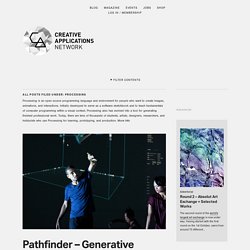
OpenProcessing - Share your sketches! Processing. Created by Princemio in collaboration with onformative, the Pathfinder project was created with aim to contribute to the creative processes of choreographic development.
RC4 in London researches computational design methodologies for large-scale 3D printing with industrial robots, taking logistical, structural and material constraints as design opportunities to generate non-representational architectural spaces with extreme information density. Created by LUSTlab in collaboration with The Mobile City, Binnen de Lijnen is part of an ongoing research project called Public Space – Public Matter from Trancity. Over 100 children took part in colouring the playground which visualised the spatial organization of Schilderswijk’s social life. Series of works exploring the subject of drawing images in the space around the earth using latitude, longitude and altitude as a coordinate system. Every once in a while a project comes along that will change how we think, discuss and produce digital art.
Software Development. Data Mining. Data visualization. Neo4j.