IMF chief warns a US default could spark recession. 13 October 2013Last updated at 19:00 ET Angry protests took place outside the White House on Sunday, as Mark Mardell reports The head of the International Monetary Fund, Christine Lagarde, has warned that a US default could tip the world into recession.
In a US TV interview, she said a default would result in "massive disruption the world over". The US Treasury will start to run short of funds on Thursday if no agreement is reached for it to raise its debt limit. Democratic and Republican leaders in the Senate held direct talks for the first time in weeks on Saturday. But there is little sign of any breakthrough, correspondents say. Pope Francis: Church too focused on gays and abortion. 19 September 2013Last updated at 13:29 ET Pope Francis says the Catholic Church must strive to heal wounds Pope Francis has said the Catholic Church is too focused on preaching about abortion, gay people and contraception and needs to become more merciful.
Honesty pays off for homeless Boston man. Quebec's student tuition protest: Who really won the dispute? - Montreal. [Listen to the full discussion of the legacy of the Quebec student protests in the audio player to the left of this page, or visit The Sunday Edition's website.]
The beat of helicopter propellers, the wail of sirens and the banging of pots and pans were familiar sounds during Montreal nights just over a year ago. With the noise of the Quebec student protests and the masses in the streets now a fading memory, some question whether the movement was a great show of democracy with lasting effect or simply a mass disruption.
In the spring of 2012, tens of thousands of young people took to the streets, objecting to a planned 75 per cent hike in university tuitions fees. Clashes between police and students became regular news. Special Report: Quebec student protests As the summer wore on, people of all ages and professions joined in. Who really won? The government changed, a new Parti Québecois government is in power, and the planned 75 per cent tuition hike was shelved. Political fallout "Mr. Languages of love: 10 unusual terms of endearment. "Chouchou" is Carla Bruni's term for her husband, the former French President Nicolas Sarkozy.

Samantha Cameron was heard on microphone saying "I love you babe" to her man, Prime Minister David Cameron - and Michelle Obama described the most-tweeted picture ever (above) with the words, "That's my honey giving me a hug. " Some terms of endearment can be used in many languages - "baby", "angel" and "sweetheart" for example. But some don't travel as well as you might think. If you call a French person "honey" ("miel") he or she may take it as a unflattering comparison with a sticky mess. And how would you react if someone called you a cauliflower, a flea, or a baby elephant? 1. Petit chou. The myth of the eight-hour sleep. Image copyright Other We often worry about lying awake in the middle of the night - but it could be good for you.
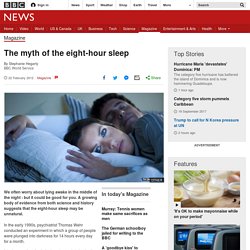
A growing body of evidence from both science and history suggests that the eight-hour sleep may be unnatural. In the early 1990s, psychiatrist Thomas Wehr conducted an experiment in which a group of people were plunged into darkness for 14 hours every day for a month. It took some time for their sleep to regulate but by the fourth week the subjects had settled into a very distinct sleeping pattern. They slept first for four hours, then woke for one or two hours before falling into a second four-hour sleep. Though sleep scientists were impressed by the study, among the general public the idea that we must sleep for eight consecutive hours persists. In 2001, historian Roger Ekirch of Virginia Tech published a seminal paper, drawn from 16 years of research, revealing a wealth of historical evidence that humans used to sleep in two distinct chunks. Image copyright bbc. VIDEO: Meet Windsor's Millennials - Windsor. Join the Conversation This is the first story in CBC Windsor's There's No Place Like Home series, an in-depth local look at the city's generation Y.
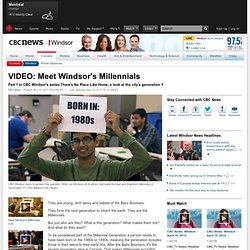
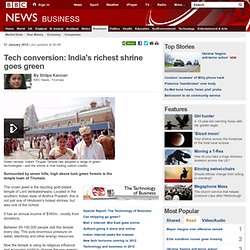
Join the conversation on Twitter #cbcwdr or by logging onto cbc.ca/windsor and Facebook to discuss how Windsor can attract and retain the best and brightest Millennials. They are young, tech savvy and babies of the Baby Boomers. Tech conversion: India's richest shrine goes green. 31 January 2012Last updated at 00:09 By Shilpa Kannan BBC News, Tirumala.
Speed-of-light experiments give baffling result at Cern. 23 September 2011Last updated at 18:03 By Jason Palmer Science and technology reporter, BBC News Enormous underground detectors are needed to catch neutrinos, that are so elusive as to be dubbed "ghost particles" A meeting at Cern, the world's largest physics lab, has addressed results that suggest subatomic particles have gone faster than the speed of light.

The team has published its work so other scientists can determine if the approach contains any mistakes. Earth’s rarest metals ranked in a new 'risk list' 13 September 2011Last updated at 18:50 By Leila Battison Science reporter, Bradford Rare earth metals are vital for production of a range of electronic items The relative risks to the supply of some of Earth's rarest elements have been detailed in a new list published by the British Geological Survey (BGS).
So-called "technology metals" like indium and niobium are extracted from the Earth and are used in a wide range of modern digital devices and green technologies. They are therefore increasingly in demand from global industries. Icann increases web domain suffixes. 20 June 2011Last updated at 11:08.