
Logotherapy. Basic principles[edit] The notion of Logotherapy was created with the Greek word logos ("meaning").
Frankl’s concept is based on the premise that the primary motivational force of an individual is to find a meaning in life. The following list of tenets represents basic principles of logotherapy: Life has meaning under all circumstances, even the most miserable ones.Our main motivation for living is our will to find meaning in life.We have freedom to find meaning in what we do, and what we experience, or at least in the stand we take when faced with a situation of unchangeable suffering.[4] The human spirit is referred to in several of the assumptions of logotherapy, but the use of the term spirit is not "spiritual" or "religious".
Discovering meaning[edit] "Once, an elderly general practitioner consulted me because of his severe depression. Man's Search for Meaning book. Stoicism. School of Hellenistic Greek philosophy Stoicism is a school of Hellenistic philosophy which was founded by Zeno of Citium, in Athens, in the early 3rd century BC.
Stoicism is a philosophy of personal ethics informed by its system of logic and its views on the natural world. According to its teachings, as social beings, the path to eudaimonia (happiness) for humans is found in accepting the moment as it presents itself, by not allowing oneself to be controlled by the desire for pleasure or fear of pain, by using one's mind to understand the world and to do one's part in nature's plan, and by working together and treating others fairly and justly. Stoicism flourished throughout the Roman and Greek world until the 3rd century AD, and among its adherents was Emperor Marcus Aurelius.
It experienced a decline after Christianity became the state religion in the 4th century AD. Name[edit] Stoicism was originally known as ‘Zenonism’, after the founder Zeno of Citium. Basic tenets[edit] The Virtual University: Marcus Aurelius Part 1. On The Shortness of Life: An Introduction to Seneca. Samurai and Seneca agreed: comfort with death brings better living.

(Photo: Kalandrakas) “We don’t beat the Reaper by living longer. We beat the Reaper by living well.” -Randy Pausch (1960-2008), The Last Lecture at Carnegie Mellon This week, one of my friends died after a long battle with pancreatic cancer. Several hours after I learned of his passing, I received an e-mail from my parents: the 10-year old daughter of a dear high school coach had been diagnosed with liver cancer.
How do we balance protecting time with protecting relationships? I often read “On The Shortness of Life,” one of Lucius Seneca‘s most famous letters, whenever I succumb to social pressure to treat time as less valuable than income, or whenever I find myself agreeing to help those who make unreasonable requests and get upset otherwise. Seneca’s masterful diatribe hit me like a much-needed sledgehammer, and I’ve included it below. This version was translated by John W. I hope you find this as helpful as I have. Absurdism. Absurdism is very closely related to existentialism and nihilism and has its origins in the 19th century Danish philosopher Søren Kierkegaard, who chose to confront the crisis humans faced with the Absurd by developing existentialist philosophy.[3] Absurdism as a belief system was born of the European existentialist movement that ensued, specifically when the French Algerian philosopher and writer Albert Camus rejected certain aspects from that philosophical line of thought[4] and published his essay The Myth of Sisyphus.
The aftermath of World War II provided the social environment that stimulated absurdist views and allowed for their popular development, especially in the devastated country of France. Overview[edit] "... in spite of or in defiance of the whole of existence he wills to be himself with it, to take it along, almost defying his torment. Relationship with existentialism and nihilism[edit] Related works by Søren Kierkegaard[edit] The Myth of Sisyphus. The Myth of Sisyphus is a philosophical essay by Albert Camus.
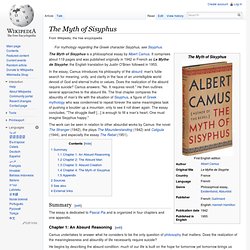
It comprises about 119 pages and was published originally in 1942 in French as Le Mythe de Sisyphe; the English translation by Justin O'Brien followed in 1955. In the essay, Camus introduces his philosophy of the absurd: man's futile search for meaning, unity, and clarity in the face of an unintelligible world devoid of God and eternal truths or values. Does the realization of the absurd require suicide? Camus answers: "No. It requires revolt. " Summary[edit] The essay is dedicated to Pascal Pia and is organized in four chapters and one appendix.
Chapter 1: An Absurd Reasoning[edit] Camus undertakes to answer what he considers to be the only question of philosophy that matters: Does the realization of the meaninglessness and absurdity of life necessarily require suicide? For Camus, who set out to take the absurd seriously and follow it to its final conclusions, these "leaps" cannot convince.