
4 Ways High School Makes You Hate Reading. Text Messages: Recommendations for Adolescent Readers. Home › Parent & Afterschool Resources › Podcast Series.
Book Report Alternative: Creating Reading Excitement with Book Trailers. ReadWriteThink couldn't publish all of this great content without literacy experts to write and review for us.
If you've got lessons plans, videos, activities, or other ideas you'd like to contribute, we'd love to hear from you. More Find the latest in professional publications, learn new techniques and strategies, and find out how you can connect with other literacy professionals. More Teacher Resources by Grade Your students can save their work with Student Interactives.
Considering the Future of Reading: Lessons, Links and Thought Experiments. Video How is the definition of “reading” changing?
How does the experience of reading with new technologies affect the transaction between text and reader? What is the future of the book industry? Doc.renlearn.com/KMNet/R004101202GH426A.pdf. Entertainment - Emily Temple - 10 Important Life Lessons From Children's Books. The 20 Biggest Reasons You Should Read. Passionate readers generally enjoy more finely-tuned brains than those who prefer more passive (though not lesser) activities, so anyone hoping to improve their minds both psychologically and cognitively might want to think about taking up the habit of regular reading. Enhances the senses Merely reading a word reflecting a color or a scent immediately fires up the corresponding section of the brain, which empathizes with written experiences as if they actually happened to the audience. Researchers believe this might very well help sharpen the social acumen needed to forge valuable relationships with others. An International Non-Profit Advocating for and Working Towards Global Literacy - Words Changing Worlds - Add Your Voice.
The End of Nonfiction: Common Core standards force us to rethink categorization. Photo by CCAC North Library Reference is dead.
Don’t worry though, fiction and nonfiction will keep it good company in the great resting place in the sky for obsolete library sections. These days, it’s the Common Core standards that should be driving collection development in the school library, and CC requirements extend well beyond fiction, nonfiction, and reference. I’m not suggesting you jettison all reference materials. Quite the contrary, we must free these valuable resources from reference shelves in the off chance that someone will need to ask a question without having easy access to Wikipedia (I’m joking, sort of). The Common Core calls for primary sources and short pieces on social studies and scientific topics. Discount School Supply - Spectra® Art Tissue.
10 Apps for Learners Who Struggle with Reading and/or Writing. Despite the growing use of multimedia in classrooms, schools remain primarily text oriented.
This is a major problem for significant numbers of learners who struggle with text. No matter how capable they may be in other respects, these students are not “academically” oriented in the ways that tend to matter most in the classroom. For many, it’s a processing issue. Others have difficulty with the physical mechanics of writing. Teach Mentor Texts: It's Monday! What Are You Reading? 2/20/12.
Reading for Pleasure. Stephen Krashen explains why we should stop scolding teenagers and their schools Contrary to popular opinion, there is no evidence that teenagers are less engaged in literacy activities today than teenagers of the past.
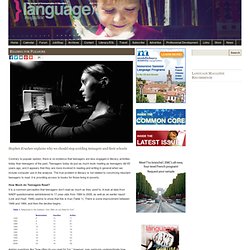
Teenagers today do just as much book reading as teenagers did 65 years ago, and it appears that they are more involved in reading and writing in general when we include computer use in the analysis. The true problem in literacy is not related to convincing reluctant teenagers to read: It is providing access to books for those living in poverty. Rocco Staino: Oscar-Nominated Short Celebrates Books & It's an App, Too! (Video) Top Ten Urban YA. In preparation for compiling a top ten list, I asked a good friend of mine if I could raid her English department library to brush up on my urban YA lit.
As we poured over titles in a colleague’s classroom library, she asked, “How are you defining ‘urban YA?’” I paused. “Well, YA titles with urban settings I guess?” (Dur). I started to rattle off a number of what I felt to be obvious criteria: issues that deal with street violence, gangs, drugs, racial conflict, teen pregnancy, homeless teens, obscene language….and I stopped myself.
Not only are these selections never sitting on the shelf collecting dust, they represent the realities of so many of our students whose stories traditionally have not been included in the literature we teach (or the titles with which we stock our classroom libraries). Lastly, I most appreciate these books for the sense of personal and reading identity they inspire in their reader.
MagellanTech4U - Tech Tools for Teaching Reading. There are many ways to integrate Internet resources, hardware, and application software to enhance reading instruction.

The following is just a start. Feel free to add more ideas. 2011 Best Fiction for Young Adults. The list of 99 books, drawn from 191 official nominations, is presented annually at the ALA Midwinter Meeting.

In 2010, YALSA restructured the charge for the Best Books for Young Adults committee and renamed it Best Fiction for Young Adults. The 2011 list is the first for the new committee. The books, recommended for ages 12-18, meet the criteria of both good quality literature and appealing reading for teens. The list comprises a wide range of genres and styles, including contemporary realistic fiction, fantasy, horror, science fiction and novels in verse. The committee also selected a Top Ten list. Nerdy Book Club. Writing for Readers. Wilhelm Book.