
Why Are Millennials Wary of Freedom? Parental culture in this country has become increasingly guarded and safety focused, as illustrated by the rise of “helicopter parenting.”
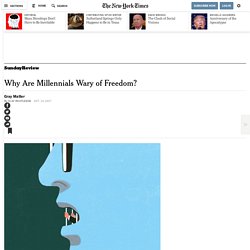
The benefits of increased safety are many. But somewhere along the way, protecting children from needless harm became conflated with shielding them from stressors and uncertainties (such as having to solve everyday problems, like getting lost, on one’s own) that are critical for developing personal independence. Researchers have linked helicopter parenting to college students’ having a lower degree of self-confidence. Relatedly, a study released last month found that today’s teenagers and young adults are less likely than those of past generations to engage in a range of activities that involve personal independence, such as working for pay, driving, dating and spending time with friends without adult supervision.
You don’t have to be stupid to work here, but it helps. The Science Behind Motivation (Video) How often do you hear people say things like, “Ugh, I would totally do that if I could just get motivated,” as if it’s something you can pick up at the store?
What if it wasn’t necessarily all about your personal drive and instead had a science behind it that could help you reach your goals? In the video below, AsapSCIENCE explains everything you need to know regarding what we understand about motivation, plus how to harness it to get you were you want to go. Photo of runner courtesy of Shutterstock. About The Author Lily is a writer, editor, and social media manager, as well as co-founder of The Prospect, the world’s largest student-run college access organization. Even the Thought of Earning Less than Their Wives Changes How Men Behave. Masculinity is a fragile thing.

Volumes of research in sociology and political science over the past 20 years have shown that men often react in surprisingly strong ways to what they see as threats to their masculine identities. These reactions are most visible in the political world, but they can take place at home and in the office as well, and can potentially contribute to a toxic work environment. A notable recent example of how men react to a threat to their masculinity comes from a survey experiment that I carried out with my colleagues at Fairleigh Dickinson University’s PublicMind poll. How Information Graphics Reveal Your Brain’s Blind Spots. This story was co-published with Source.
Visual Evidence Data and design in everyday life Lena Groeger. Twenty Cognitive Biases That Could Be Helping You Make Bad Decisions. The human mind is a beautiful thing.
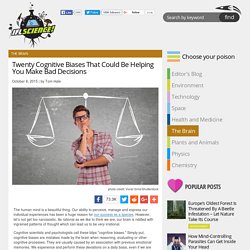
Our ability to perceive, manage and express our individual experiences has been a huge reason for our success as a species. However, let’s not get too narcissistic. As rational as we like to think we are, our brain is riddled with ingrained patterns of thought which can lead us to be very irrational. Cognitive scientists and psychologists call these blips "cognitive biases. " Simply put, cognitive biases are mistakes made by the brain when reasoning, evaluating or other cognitive processes.
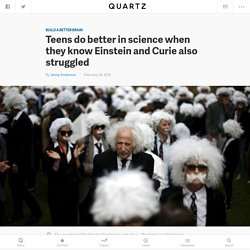
Everything We Think We Know About Addiction Is Wrong. Teens do better in science when they know Einstein and Curie also struggled. Safe to say, Federal Bureau of Investigation director James Comey was unprepared for a barrage of technical questions by California congressman Darrell Issa (R), during a hearing on iPhone encryption.
The House Judiciary Committee is holding a hearing today (March 1) after Apple refused to comply with a federal court order to help the FBI break into the iPhone 5c of one of the San Bernardino shooters by bypassing a security feature that erases its data after too many unsuccessful unlocking attempts. To do so, Apple said it would have to create a special version of its mobile operating system.
In his opening statement at the hearing, Comey described the FBI’s request as akin to “asking Apple to take away the vicious guard dog and let[ting] us pick the lock.” During his five minutes of questioning, Issa repeatedly asked if the FBI had tried other solutions before asking Apple to comply. His questions centered around whether the FBI asked Apple for the source code.
The psychology of narcissism - W. Keith Campbell. Interested in learning more on narcissism?
Here are the abstracts for two good papers: Narcissism at the crossroads: Phenotypic description of pathological narcissism across clinical theory, social/personality psychology, and psychiatric diagnosis and Grandiose and vulnerable narcissism: A nomological network analysis. These papers describing vulnerable and grandiose narcissism can be found on Google scholar or at your local university library. The Human Brain Reacts to Guns as if They Were Spiders or Snakes. Ipopba/iStock After each highly publicized mass shooting, there's a political debate about how to make them stop, with researchers and politicians alike firing up about assault-rifle bans, background checks, and other possible solutions.
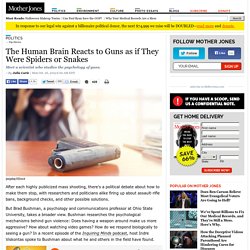
But Brad Bushman, a psychology and communications professor at Ohio State University, takes a broader view. Bushman researches the psychological mechanisms behind gun violence: Does having a weapon around make us more aggressive? Help! I’m Looking at my Phone and I Can’t Stop! Whistling Vivaldi (Book review) Here Are 5 Infuriating Examples of Facts Making People Dumber. On Monday, I reported on the latest study to take a bite out of the idea of human rationality.
In a paper just published in Pediatrics, Brendan Nyhan of Dartmouth University and his colleagues showed that presenting people with information confirming the safety of vaccines triggered a "backfire effect," in which people who already distrusted vaccines actually became less likely to say they would vaccinate their kids. Does having choice make us happy? 6 studies that suggest it doesn’t always. We have all been there: standing in aisle five of the supermarket trying to decide which jar of mustard to buy. Do we go organic, or for the brand with whole mustard seeds? Or do we simply pick the one in the brightest yellow bottle?
In a fascinating talk at TEDxStanford, “Sometimes it’s good to give up the driver’s seat,” marketing professor Baba Shiv reveals that discomfort over making choices extends into medical decisions. Five years ago, Shiv’s wife was diagnosed with breast cancer. “The most harrowing and agonizing part of the whole experience was that we were making decision after decision,” Shiv shares in his talk.
Shiv decided to test the theory on undergraduate students about to solve word puzzles. Why Do Internet Trolls Exist? [INFOGRAPHIC] As you've probably discovered, there are people lurking all over the web who find great joy in humiliating and attacking others.
![Why Do Internet Trolls Exist? [INFOGRAPHIC]](http://cdn.pearltrees.com/s/pic/th/internet-trolls-infographic-51134730)
This insightful infographic describes the inner workings of Internet trolls, explaining why they decide to spend their online time in attack mode. Tapping the expertise of psychologists and experts, it offers solid reasons why this scourge of the Internet continues. PsycNET - Option to Buy. Social Psychology Experiment. The smoke filled room study.
Why Are Americans So Easy to Manipulate? (Image: Head gears via Shutterstock)What a fascinating thing! Total control of a living organism! — psychologist B.F. Skinner The corporatization of society requires a population that accepts control by authorities, and so when psychologists and psychiatrists began providing techniques that could control people, the corporatocracy embraced mental health professionals. Why Are We So Afraid of Creativity? Creativity: now there’s a word I thought I wouldn’t see under attack.
Don’t we live in a society that thrives on the idea of innovation and creative thought? The age of the entrepreneur, of the man of ideas, of Steve Jobs and the think different motto? Evolution bugs people. 15 Styles of Distorted Thinking. The Ten Most Revealing Psych Experiments. Psychology is the study of the human mind and mental processes in relation to human behaviors - human nature. Due to its subject matter, psychology is not considered a 'hard' science, even though psychologists do experiment and publish their findings in respected journals.
The Original Milgram Experiment (1961) Solomon Asch Conformity Experiment (Or How People Believe Obvious Lies) Elevator conformity. Stanford Prison Experiment (Documentary) Announcing the Healthy Mind Platter. The US government has just revised the food pyramid - the diagram that's been with us for decades that is supposed to remind people how to eat well. The model needed a revision, and the new version, called ChooseMyPlate, is a big improvement. Groupthink. Cognitive dissonance theory. Life online "popcorn brain"
Over time, and with enough Internet usage, the structure of our brains can actually physically change, according to a new study. Are We Addicted to Gadgets or Indentured to Work? - Alexis Madrigal. The End of Solitude By William Deresiewicz. The 'Busy' Trap.