
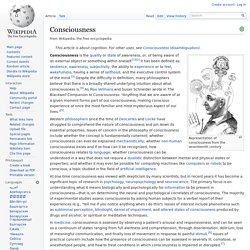
Consciousness. Representation of consciousness from the seventeenth century At one time consciousness was viewed with skepticism by many scientists, but in recent years it has become a significant topic of research in psychology, neuropsychology and neuroscience.
The primary focus is on understanding what it means biologically and psychologically for information to be present in consciousness—that is, on determining the neural and psychological correlates of consciousness. The majority of experimental studies assess consciousness by asking human subjects for a verbal report of their experiences (e.g., "tell me if you notice anything when I do this"). Issues of interest include phenomena such as subliminal perception, blindsight, denial of impairment, and altered states of consciousness produced by drugs and alcohol, or spiritual or meditative techniques. Etymology and early history[edit] John Locke, British philosopher active in the 17th century In the dictionary[edit] Philosophy of mind[edit] God as the Devil. Satan in the Hebrew Bible[edit] In the Hebrew Bible God is depicted as the source of both light and darkness, as in Isaiah 45:6-7.[1] However this concept of "darkness" or "evil" was not yet personified as "the devil," a later development in Jewish thought.[2] The author of the Books of Chronicles is thought to have first introduced the notion of "divine intermediaries", not found in the earlier parts of the Hebrew Bible.
The main evidence adduced by theologians to support this is 1 Chronicles 21, a reworked version of 2 Samuel 24. This change is made most evident in the Chronicler's treatment of 2 Samuel 24:1 "And again the anger of the LORD was kindled against Israel, and he moved David against them to say, Go, number Israel and Judah. " which in 1 Chronicles 21:1 becomes: "And Satan stood up against Israel, and provoked David to number Israel. " While in the book of Samuel, YHWH himself is the agent in punishing Israel, while in 1 Chronicles, an "adversary" is introduced.
Marcion of Sinope. Alex Peak - Kids Coяner - Anarchism. Not everyone agrees on exactly what anarchism is, or ought to be.

However, most people understand it to be a system without government. Anarchism is a Greek term, which literally means “without rulers.” Some people are, of course, confused by this. They assumes it means “without any law” or “without any rules,” although few self-described anarchists would tell you that that’s what they want. A ruler and a leader are not exactly the same thing. Not surprisingly, anarchists are anti-racist and anti-sexist. Anarchism does not mean the desire for chaos and destruction, although many mistakenly believe it does. Anarchists differ from non-anarchists in that non-anarchists believe the government is above the law. Anarchists are often quick to point out that many of the world’s worse crimes have been committed by government. Different anarchists, however, propose different theories as to what institutions ought to replace the government so as to protect natural rights. Document. The Matrix as Metaphysics. David J.

Chalmers Department of Philosophy University of Arizona Tucson, AZ 85721. chalmers@arizona.edu *[[This paper was written for the philosophy section of the official Matrix website. As such, the bulk of the paper is written to be accessible for an audience without a background in philosophy. 1 Brains in Vats The Matrix presents a version of an old philosophical fable: the brain in a vat. The brain is massively deluded, it seems. Neo's situation at the beginning of The Matrix is something like this. Let's say that a matrix (lower-case "m") is an artificially-designed computer simulation of a world. We can imagine that a matrix simulates the entire physics of a world, keeping track of every last particle throughout space and time. When the possibility of a matrix is raised, a question immediately follows. Let us call the hypothesis that I am in a matrix and have always been in a matrix the Matrix Hypothesis.
The Matrix Hypothesis is one that we should take seriously.