
The concept of common global school evolution. A place to share our learning. 7 habits of highly effective teachers Always Prepped Blog. We’ve all heard about Stephen Covey’s 7 Habits of Highly Effective People.
Some teachers out there may have heard of the 7 Habits of Highly Effective Teachers. Below are our 7 habits of highly effective teachers who use technology: 1) They always start with the why. Mrs. Wideen's Classroom Blog. Teacher Reboot Camp. Daily Telegraph Maralyn Parker Blog. Imagine Learning. As educators and leaders, we need to re-think every aspect of our professional practice to consider ‘could we be doing this better?’

Here is a brain-dump of the 6 most powerful strategies that I have used or in which have participated. 1. Use a ‘hands-on’ approach that teaches team work I want the teachers for whom I am accountable to comprehensively embrace student centred, inquiry based learning. Ask a Tech Teacher. Educational Technology and Mobile Learning: 10 Great Resources on 21st Century Education. I believe the 21st century education is idiosyncratic in nature.
It has acquired some distinctive features that sets it apart from the kind of traditional education that was prevalent in the 20th century. Of course it does not take you long to guess the reason behind this change , digital revolution has and is still radically transforming the way learning and instruction is delivered. Even inside this technology itself there is another deep revolution going on, we no longer talk about computers ( laptops and desktops ) as being the main vehicle of the 'technologized' ( term borrowed from New Literacies: Everyday Practices and Classroom Learning ) instruction inside schools but there is also the emergence of mobile devices such as smart phones and tablets , and they are gaining more ground in the educational sector. In this post , I am providing you with the best content I have published here about the 21st century education. 1- The 33 Digital Skills Every Teacher should Have.
Education. “When are we ever going to use this?” When I was a teacher, this was a question I heard almost daily. I would imagine that has not changed much since I left the classroom five years ago, particularly when it comes to math. 52 Education Blogs You Should Follow. If you are a teacher, student, parent, or administrator, you should be following education blogs.

Why? Simply because blogs are an ever-increasing way to spark ideas, creativity, and innovation. Educator Consultant Author. F.I.T. ~ Fun Integrating Technology ~ News, trends and ideas in education. Feeding My ED-diction. Your Smarticles. Paper Blogging. Earlier this week, I had a chance to visit a school in my district, where they found a unique way to introduce blogging to junior and intermediate aged students.
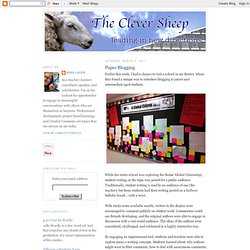
While the entire school was exploring the theme 'Global Citizenship', student writing on the topic was posted for a public audience. Traditionally, student writing is read by an audience of one (the teacher); but these students had their writing posted on a hallway bulletin board... with a twist. With sticky notes available nearby, visitors to the display were encouraged to comment publicly on student work. Commenters could see threads developing, and the original authors were able to engage in discussion with a real world audience. The ideas of the authors were considered, challenged, and celebrated in a highly interactive way. By engaging an impermanent tool, students and teachers were able to explore many e-writing concepts. Will.
Become a Tech Savvy Teacher by 2014: A 12-Month Plan. Whether you’re into New Year’s Resolutions or not, you’ve probably spent at least some time engaged in end-of-year reflection, planning, and goal setting.
Considering we’re coming off a year of massive growth in the ed tech industry — and as a result, much exploration, experimentation, and sharing around teaching with tech, why not make a commitment in 2013 to improve your use of technology in the classroom? A 12-Month Plan to Master Ed Tech January—Conduct an Ed Tech Audit What technology are you already using the classroom? Whether it’s for instruction, record-keeping, or organization, do a complete inventory of what you’re using and why. Ask yourself, are you getting the results you hoped to when you first started using the tool?
Essentially you’re cleaning house here. 4KM and 4KJ @ Leopold Primary School. Posted by Mrs Kathleen Morris on Friday, November 2nd 2012.
Mr G Online. :Roll up your sleeves and get messy. “Reading” Sebastien Wiertz Close reading is one of the “strategies du jour”.
From the Common Core State Standards in ELA: 1. Read closely to determine what the text says explicitly and to make logical inferences from it; cite specific textual evidence when writing or speaking to support conclusions drawn from the text. In addition from the Harvard Writing Center: The second step is interpreting your observations. Dangerously Irrelevant. The Twitteraholic’s Ultimate Guide to tweets, hashtags, and all things Twitter. Most educators who learn to use Twitter effectively say they learn more from their personal learning network (PLN) on Twitter than they’ve achieved from any other forms of professional development or personal learning.
Unfortunately educators often dismiss Twitter, or fail to see the value of Twitter, when they’re first introduced to Twitter. Our aim of this post is to provide all the information you need to learn how to use Twitter effectively as an educator. Anne Knock: Learning everywhere today. Culture is the result of the fermentation process that gives yoghurt its unique texture and flavour.
We can’t actually identify this elusive element called ‘culture’, it is just there, otherwise it wouldn’t be yoghurt. NYT and WSJ Bestselling Author of Drive. Oh' Boy 4th Grade. What Ed Said. 30 Incredible Blogs Written By Students. Thursday, December 8, 2011 9:00 am, Posted by Jeff Dunn | Best Of Topics: Best Of , blogs , edublogs , students , writing , young This is part of a series of ‘ Best of 2011 ‘ posts where we share some of the best education-related materials of the past year. Be sure to check back on a regular basis as we’ve got some pretty exciting stuff coming soon! 4th Grade Blogs. Join TBA as we travel the world through fourth grade teaching blogs! If you are a TBA member (follower or subscriber) and have a fourth grade teaching blog, you are invited to link it up with us.
If you are here to find some new fourth grade teaching tips, enjoy blog hopping with the best below! A teacher learning about the web and sharing it with others. The Innovative Educator. Innovations in Learning, Edreform, Education Reform, Edtech, Educational Technology, Education Policy, EdPolicy, Blended Learning, Online Learning, Elearning. Radical Learners « Keep Learning Radical Learners. Free Technology for Teachers.
Education Rethink. Just a few things. Primary school educator. “Herding Cats” and Change 3.0 (Part 2) I sat down this morning and began to think about how I would begin Part Two of the little mini-series I began yesterday. It was tough…and three cups of coffee later, I still had no idea of how to start. 4th Grade Frolics: My Classroom. This policy is valid from 21 April 2012 This blog is a personal blog written and edited by me. Integrating Technology in the Primary Classroom. Should my class blog, tweet, Google App, Moodle, Desire2Learn, or Edmodo? Arrghhh!!! Exploring the changing world of Middle School teaching and technology. Teaching, Learning, & Life. 9 Tips Every Teacher should Know about Google Scholar. 10 big ideas from eduTECH. BYOT Network. Making Paper Blogs to Prepare for the Online Experience - The Inspired Classroom
Adventures with Chrome, Adventures in a Web only World!! Guest blog post by Joachim Cohen.