
Definition of Gregorian Chant: Gregorian Chant, 12 Latin Chants. Twelve Latin Chants Every Catholic Should Know An article bearing this title was published in the April 2003 edition of Crisis magazine.
Written by Arlene Oost-Zinner and Jeffrey Tucker, it outlined a basic repertoire of 12 Latin hymns "that have carried the Catholic faith through many centuries. " The article is written simply and beautifully, and contains resources for learning these hymns and restoring them to common use. However, one thing lacking was a central source where these 12 might be heard. So began the task of bringing free, downloadable audios of these hymns to one central location, on the Catholic Chant website. It is true that Gregorian chant audio recordings abound, including for the 12 hymns listed. The ideal setting for chant is in a group, generally known as a schola, whose purpose is to blend all individual voices in such a way that no one voice stands out, but all sound as one. Questions or comments may be directed to: cantor@catholicchant.com.
Our Lady of Clear Creek Abbey. Discalced Carmelites. Thank you and may God Bless You!
The CARMEL OF JESUS, MARY AND JOSEPHDiscalced Carmelites Valparaiso, Nebraska NOTE: These webpages brought to you by the Las Vegas Marian Information Center. Keeping the Gregorian Chant alive! Gregorian chant (music. Littlte bit of Gregorian Chant HistroyI found this websit to be helpful upon how the. Gregorian chant. Gregorian chant is the central tradition of Western plainchant, a form of monophonic, unaccompanied sacred song of the western Roman Catholic Church.
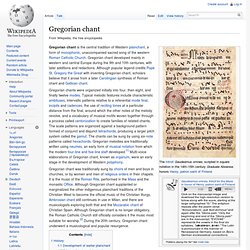
Gregorian chant developed mainly in western and central Europe during the 9th and 10th centuries, with later additions and redactions. Although popular legend credits Pope St. Gregory the Great with inventing Gregorian chant, scholars believe that it arose from a later Carolingian synthesis of Roman chant and Gallican chant. History[edit] Development of earlier plainchant[edit] Musical elements that would later be used in the Roman Rite began to appear in the 3rd century.
Scholars are still debating how plainchant developed during the 5th through the 9th centuries, as information from this period is scarce. John the Deacon, biographer (c. 872) of Pope Gregory I, modestly claimed that the saint "compiled a patchwork antiphonary",[11] unsurprisingly, given his considerable work with liturgical development. Origins of mature plainchant[edit] Relations Between Music in the Past and Present!!il and step by. Gregorian Chant. Help support New Advent and get the full contents of this website as an instant download.
Includes the Catholic Encyclopedia, Church Fathers, Summa, Bible and more — all for only $19.99... The name is often taken as synonymous with plain chant, comprising not only the Church music of the early Middle Ages, but also later compositions (elaborate melodies for the Ordinary of the Mass, sequences, etc.) written in a similar style down to the sixteenth century and even in modern times. In a stricter sense Gregorian chant means that Roman form of early plain chant as distinguished from the Ambrosian, Gallican, and Mozarabic chants, which were akin to it, but were gradually supplanted by it from the eighth to the eleventh century. Of the Gallican and Mozarabic chants only a few remains are extant, but they were probably closely related to the Ambrosian chant. The principal proofs for a Gregorian tradition may be summarized thus: Comments Sources About this page APA citation. MLA citation. Sound of Silence - Gregorian. Western Latin Liturgics. Gregorian chant - Deum verum. The History Of Gregorian Chant.
The Gregorian Chant is the collective name given to a whole tradition of chants that evolved in the world from the times of the Old Testament of The Christian Bible and have survived even today.
These chants have been quite associated with Christianity and indeed they have been sung in churches for over two thousand years now. It is certain that the Gregorian chant - though not in that name - existed even during the times of Jesus Christ, and Christ might have sung these chants in His teachings to people. The Gregorian Chant contains a collection of what is known as the plainchant (from the French plein chant, which means 'full song') - a series of unaccompanied vocal music that follows a monophone. They are most commonly heard in churches, and some of the more popular ones are Ave Maria, Te Deum and Dies Irae, Spiritus Domini among others. Online data concerning Wester music history. Gregorian Chant Details.
Gregorian Chant Definition What is chant, and we do we call it "Gregorian?
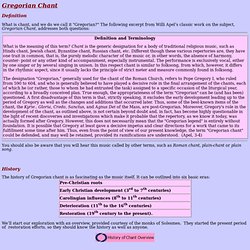
" The following excerpt from Willi Apel’s classic work on the subject, Gregorian Chant, addresses both questions: You should also be aware that you will hear this music called by other terms, such as Roman chant, plain-chant or plain song. History. Our Lady of Clear Creek Abbey. Gregorian Chant Notation.
What you really must know about Gregorian Chant.