
One man, 100,000 toothpicks, and 35 years: An incredible kinetic sculpture of San Francisco. Thirty five years ago I had yet to be born, but artist Scott Weaver had already begun work on this insanely complex kinetic sculpture, Rolling through the Bay, that he continues to modify and expand even today.
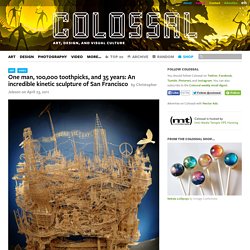
The elaborate sculpture is comprised of multiple “tours” that move pingpong balls through neighborhoods, historical locations, and iconic symbols of San Francisco, all recreated with a little glue, some toothpicks, and an incredible amount of ingenuity. He admits in the video that there are several toothpick sculptures even larger than his, but none has the unique kinetic components he’s constructed.
Via his website Weaver estimates he’s spent over 3,000 hours on the project, and the toothpicks have been sourced from around the world: I have used different brands of toothpicks depending on what I am building. I also have many friends and family members that collect toothpicks in their travels for me. 27 Genius New Products You Had No Idea Existed. The World’s First 3D Printing Pen that Lets you Draw Sculptures.
Forget those pesky 3D printers that require software and the knowledge of 3D modeling and behold the 3Doodler, the world’s first pen that draws in three dimensions in real time.
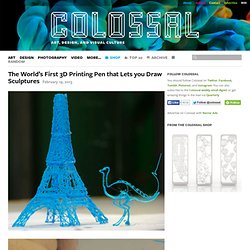
Imagine holding a pen and waving it through the air, only the line your pen creates stays frozen, suspended and permanent in 3D space. Sound like magic? Well it certainly looks like it, watch the video above to see the thing in action. The 3Doodler was designed by Boston-based company WobbleWorks who recently launched a Kickstarter campaign to sell the miraculous little devices that utilizes a special plastic which is heated and instantly cooled to form solid structures as you draw. I don’t know about you but for me this might have just won the most impulsive Kickstarter purchase in history. Cassie Jaye - FOCUS FORWARD.
RepRap Self-Replicating 3D Printer: Fuel The Revolution by Relative Design. What is the RepRap Project?
RepRap is an open-source desktop 3D printer capable of printing plastic objects. Since many parts of RepRap are made from plastic and RepRap can print those parts, RepRap is a self-replicating machine - one that anyone can build given time and materials. It also means that - if you've got a RepRap - you can print lots of useful stuff, and you can print another RepRap for a friend. The RepRap project is all about making self-replicating machines, and making them freely available for the benefit of everyone. RepRap was the first of the low-cost 3D printers, and the RepRap Project started the open-source 3D printer revolution. How does the Reprap machine work?
Look at your computer setup and imagine that you hooked up a 3D printer. RepRap is short for Replicating Rapid-prototyper. How does Relative Design want to help the RepRap Project? The funds we raise will be used to build a RepRap 3D printer. I Have a (Puzzling) Dream. The Fun Theory. Waboba provides Waboba flyer, Waboba ball - the ball that bounces on water. The Bicymple Is A Crazy-Looking Bicycle Without Chains. The bicycle's already pretty simple, but could it be simpler still?
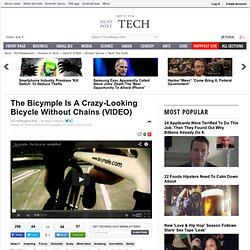
One man on the West Coast thinks so and is betting his business on the answer. But can his "Bicymple" really succeed in the world of biking? Designer Josh Bechtel's "Bicymple" is a minimalist's dream machine, a "bicycle" with the chain removed and pedals placed on the back wheel. The recently released promotional video for Bechtel's bicycle remake features angled shots that highlights the vehicle's simple design and "nimble ride" on urban streets. But cyclists have their doubts. Some background, for those who haven't seen "Bicymple" before: Bicymple is simply a bike without a chain, the pedals moved and a swiveling back wheel, which designer Bechtel says will be a vast improvement on the older bike. A direct-drive, freewheeling hub joins the crank arm axis with the rear-wheel axis, shortening the wheelbase and minimizing the design...The lightweight design and short wheelbase make for a nimble ride.