
Entity–relationship model. An entity–relationship diagram using Chen's notation In software engineering, an entity–relationship model (ER model) is a data model for describing the data or information aspects of a business domain or its process requirements, in an abstract way that lends itself to ultimately being implemented in a database such as a relational database.
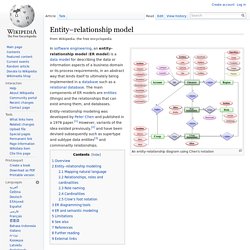
The main components of ER models are entities (things) and the relationships that can exist among them, and databases. Entity–relationship modeling was developed by Peter Chen and published in a 1976 paper.[1] However, variants of the idea existed previously,[2] and have been devised subsequently such as supertype and subtype data entities[3] and commonality relationships. Overview[edit] An entity–relationship model is a systematic way of describing and defining a business process. An ER model is typically implemented as a database. The three schema approach to software engineering uses three levels of ER models that may be developed. Role naming[edit] Relational model. Diagram of an example database according to the Relational model.[3] In the relational model, related records are linked together with a "key".

The purpose of the relational model is to provide a declarative method for specifying data and queries: users directly state what information the database contains and what information they want from it, and let the database management system software take care of describing data structures for storing the data and retrieval procedures for answering queries. Most relational databases use the SQL data definition and query language; these systems implement what can be regarded as an engineering approximation to the relational model. A table in an SQL database schema corresponds to a predicate variable; the contents of a table to a relation; key constraints, other constraints, and SQL queries correspond to predicates.
Overview[edit] Relational model concepts. Alternatives to the relational model[edit] Implementation[edit] History[edit] Controversies[edit] Algorithm. Flow chart of an algorithm (Euclid's algorithm) for calculating the greatest common divisor (g.c.d.) of two numbers a and b in locations named A and B.
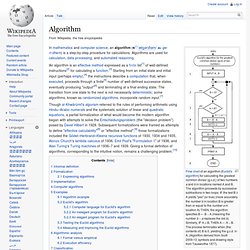
The algorithm proceeds by successive subtractions in two loops: IF the test B ≥ A yields "yes" (or true) (more accurately the numberb in location B is greater than or equal to the numbera in location A) THEN, the algorithm specifies B ← B − A (meaning the number b − a replaces the old b). Similarly, IF A > B, THEN A ← A − B. The process terminates when (the contents of) B is 0, yielding the g.c.d. in A. (Algorithm derived from Scott 2009:13; symbols and drawing style from Tausworthe 1977).
In mathematics and computer science, an algorithm ( i/ˈælɡərɪðəm/ AL-gə-ri-dhəm) is a step-by-step procedure for calculations. Informal definition[edit] While there is no generally accepted formal definition of "algorithm," an informal definition could be "a set of rules that precisely defines a sequence of operations Formalization[edit]