
Le “scie chimiche” la leggenda di una bufala. È una bufala volante, che percorre i nostri cieli da più di quindici anni.
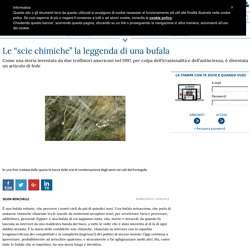
Una bufala minacciosa, che parla di sostanze chimiche rilasciate tra le nuvole da misteriosi aeroplani scuri, per avvelenare l’aria e provocare, addirittura, genocidi. Eppure è una bufala di cui sappiamo tutto, vita, morte e miracoli: da quando fu lanciata su internet da una maldestra banda del buco, a tutte le volte che è stata smentita al di là di ogni dubbio sensato. È la storia delle cosiddette scie chimiche, rilanciata su internet con la caparbia irragionevolezza dei complottisti e la complicità (ingenua?) Dei politici di mezzo mondo. Oggi continua a spaventare, probabilmente ad arricchire qualcuno, e sicuramente a far sghignazzare molti altri. Il padre delle scie chimiche si chiamava Richard Finke: non era uno scienziato, né un esperto di aeronautica, non aveva nessuna competenza in ambito di spionaggio. La bufala cominciò così a volare. Churnalism. Global Warming and Climate Change skepticism examined.
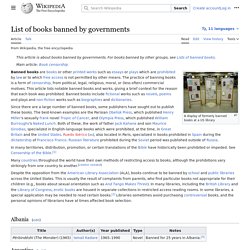
List of books banned by governments. Wikipedia list article A display of formerly banned books at a US library In many territories, distribution, promotion, or certain translations of the Bible have historically been prohibited or impeded.
See Censorship of the Bible.[1] Many countries throughout the world have their own methods of restricting access to books, although the prohibitions vary strikingly from one country to another: hate speech, for example, is prohibited in a number of countries, such as Sweden, though the same books may be legal in the United States or United Kingdom, where the only prohibition is on child pornography. [citation needed] Despite the opposition from the American Library Association (ALA), books continue to be banned by school and public libraries across the United States.
Afghanistan[edit] Albania[edit] Argentina[edit] Australia[edit] Austria[edit] Bangladesh[edit] Belgium[edit] Bosnia and Herzegovina[edit] Skeptical Software Tools. Fringe theory. A fringe theory is an idea or a collection of ideas that departs significantly from the prevailing or mainstream view.

It can include work done to the appropriate level of scholarship in a field of study but only supported by a minority of practitioners, to more dubious work. Examples include pseudoscience (ideas that purport to be scientific theories but have little or no scientific support), conspiracy theories, unproven claims about alternative medicine, pseudohistory and so forth.
Some fringe theories may in a stricter sense be hypotheses, conjectures, or speculations.[1] Characterization of a theory as fringe does not necessarily invalidate the theory. Dismissing a theory based solely, or in part, on a fringe characterization may deviate from the spirit of the scientific approach and may limit new advances and insights.[2] Fringe science[edit] Fringe scientific theories tend to involve original ideas, the validity of which is still uncertain. Fringe history[edit] See also[edit] Category:Controversies. Category:Pseudoscience. Pseudoscience is a broad group of theories or assertions about the natural world that claim or appear to be scientific, but that are not accepted as scientific by the scientific community.

Pseudoscience does not include most obsolete scientific or medical theories (see Category:Obsolete scientific theories), nor does it include every idea that currently lacks sufficient scientific evidence (e.g. String theory) This category comprises well-known topics that are generally considered pseudoscientific by the scientific community (such as astrology) and topics that have very few followers and are obviously pseudoscientific (such as the modern belief in a flat Earth). The pejorative term itself is contested by various groups for various reasons. Generally speaking, if an article belongs in this category, the article's lead will contain a well-sourced statement that the subject is considered pseudoscience.
Subcategories This category has the following 25 subcategories, out of 25 total.