
Top 20 Best Rock N' Roll Songs Ever. Rock Music Timeline - 50 years of rock & roll history with photos. Cajun Music: The Savoy Family Band. Cajun music. Flaco Jimenez & Max Baca, Tex Mex Honky Tonk, Sept ... Tex-mex Facts, information, pictures. Classic Salsa Mix 2013. Salsa music. Conga drums, one of the foundational instruments of salsa music. Salsa as a musical term[edit] "In 1973, I hosted the television show Salsa which was the first reference to this particular music as salsa. I was using [the term] salsa, but the music wasn't defined by that. Top Reggae all Dancehall Music Videos. Reggae music — Listen free at Last.fm.
♫ Native American Music - 'Spirit Of The Drums' ♥ American Indian Spiritual Relaxing Healing Music. Native American music. Characteristics[edit] Singing and percussion are the most important aspects of traditional Native American music.
Vocalization takes many forms, ranging from solo and choral song to responsorial, unison and multipart singing. Percussion, especially drums and rattles, are common accompaniment to keep the rhythm steady for the singers, who generally use their native language or non-lexical vocables (nonsense syllables). Traditional music usually begins with slow and steady beats that grow gradually faster and more emphatic, while various flourishes like drum and rattle tremolos, shouts and accented patterns add variety and signal changes in performance for singers and dancers.[1] Song texts and sources[edit] Native American song texts include both public pieces and secret songs, said to be "ancient and unchanging", which are used for only sacred and ceremonial purposes.
Societal role[edit] What Ancient Greek Music Sounded Like: Hear a Reconstruction That is ‘100% Accurate’ Between 750 BC and 400 BC, the Ancient Greeks composed songs meant to be accompanied by the lyre, reed-pipes, and various percussion instruments.

More than 2,000 years later, modern scholars have finally figured out how to reconstruct and perform these songs with (it's claimed) 100% accuracy. Writing on the BBC web site, Armand D'Angour, a musician and tutor in classics at Oxford University, notes: [Ancient Greek] instruments are known from descriptions, paintings and archaeological remains, which allow us to establish the timbres and range of pitches they produced.And now, new revelations about ancient Greek music have emerged from a few dozen ancient documents inscribed with a vocal notation devised around 450 BC, consisting of alphabetic letters and signs placed above the vowels of the Greek words.The Greeks had worked out the mathematical ratios of musical intervals - an octave is 2:1, a fifth 3:2, a fourth 4:3, and so on.The notation gives an accurate indication of relative pitch.
Selections of Jewish Music. By Lisa Snider (2013) : Table of Contents | An Explanation | Cantillation Jewish music stems all the way from ancient prayer chants of the Levant created some 3000 years ago.
Since then, Jewish music has been constantly adapting with new conditions and modern technologies, yet it retains its identity in many widely differing ethnic, social and religious environments. On this page you can find a selection of works from some of the world's most famous artists in each of the following Jewish musical genres: Israeli Music Israeli music is a unique tapestry that reflects the rich society and culture in Israel.
Naomi Shemer (1930-2004) - Born by the shores of the Sea of Galilee, Shemer penned hundreds of Hebrew songs and is often referred to as Israel's First Lady of Song. Yehudah Poliker is an Israeli singer/songwriter, musician and painter who was born to Holocaust survivor parents who were deported from their native Salonika, Greece to Auschwitz. New Music from New Zealand (Weekly Podcast) - New Sounds. Kenny Endo - Video - Excerpt from "A Night of Neo-Traditional Japanese Music and Dance" Celtic Music - Woodland Tales. Yvonne Chaka - Mamaland [African Music Video] Music of Greece. What is Jewish Music? Jewish music stems from ancient prayer chants of the Levant some 3000 years ago.
The musical notation that developed and that we find in the bible today is one of the most ancient forms of notated music, and yet it is still in current practice all over the world today. Music of Indonesia. The music of Indonesia demonstrates its cultural diversity, the local musical creativity, as well as subsequent foreign musical influences that shaped contemporary music scenes of Indonesia.
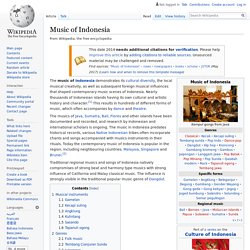
Nearly thousands of Indonesian islands having its own cultural and artistic history and character.[1] This results in hundreds of different forms of music, which often accompanies by dance and theatre. Traditional regional musics and songs of Indonesia natively compromises of strong beat and harmony type musics with strong influence of California and Malay classical music. The influence is strongly visible in the traditional popular music genre of Dangdut. Musical instruments[edit] Balinese gamelan performance. Traditional Japanese Music - Koto - Virtual Culture. The history of traditional music in Japan is rich and varied.

Many musical forms were imported from China more than a thousand years ago, but over the years, they were reshaped into distinctively Japanese styles of expression. Instruments were adapted and newly created to meet local needs, and the most important of these were the shamisen, shakuhachi, and koto. The shamisen resembles a guitar; it has a long, thin neck and a small, rectangular body covered with skin. It's got three strings, and the pitch is adjusted using the tuning pegs on the head, just like a guitar or violin. The strings aren't plucked with the fingers; a large triangular plectrum is used to strike the strings. The shakuhachi is a flute made of bamboo that's played by blowing on one end. The koto, meanwhile, is a large, wooden instrument with 13 strings. Historians think the koto was born around the fifth to third century B.C. in China.
Ceolas celtic music archive. African music. MUSC 111 ETHNIC MUSIC.