
Infinity Imagined. Infinity Imagined. Infinity Imagined. Infinity Imagined. Infinity Imagined. Infinity Imagined. Critical thinking explained in six kid-friendly animations. Infinity Imagined. Infinity Imagined. Brian Cox explains the interconnectedness of the universe, explodes your brain. Scientists release first 'cinematic MRI' of live birth. Let's get one thing straight up front: the term "cinematic" does not in this instance mean it's time to order up some popcorn.
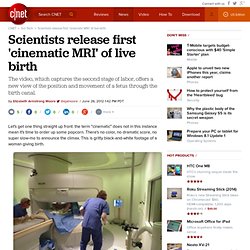
There's no color, no dramatic score, no super slow-mo to announce the climax. This is gritty black-and-white footage of a woman giving birth. But don't let the grit fool you into thinking it's low tech. The world's first birth in an MRI machine was announced by scientists at Charite University Hospital in Berlin back in December 2010, and they're only now releasing the 25-second video, which was made by the arduous process of joining a series of magnetic resonance images of the same slice of the body.
The footage, by the way, comes just weeks after a similar video was released capturing fetal twins. Infinity Imagined. Infinity Imagined. Infinity Imagined. SpaceX Testing - SuperDraco Engine Firing. Infinity Imagined. Infinity Imagined. Watch Neil deGrasse Tyson lay bare the decline of American science in 180 seconds. MIND in Pictures: Music to Your Brain. Nacreous Clouds. Nacreous clouds are very high, 9-16 miles (15 – 25 km) in the stratosphere.
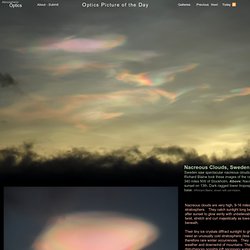
They catch sunlight long before ground level sunrise and after sunset to glow eerily with unbelievably bright electric colours. They twist, stretch and curl majestically as lower dark tropospheric clouds hurry beneath. Their tiny ice crystals diffract sunlight to give the iridescent hues. They need an unusually cold stratosphere (less than -85 Celsius) and are therefore rare winter occurrences. They tend to form in very windy weather and downwind of mountains.
Search before sunrise or after sunset late December to February in the Northern Hemisphere. Friday Illusion: Tricky stripes create stepping motion. Caitlin Stier, video intern Don't believe your eyes as you watch this video: although the rectangles moving in sync suddenly seem to shuffle, their motion hasn't actually changed.
Keep watching when a backdrop of morphing stripes appears and a caterpillar-like motion can be seen. Created by graduate student Sebastiaan Mathôt from VU University of Amsterdam, the brain trick occurs when the background is striped rather than solid, an illusion originally developed by researcher Stuart Anstis from University of California, San Diego. The effect is caused by the influence of contrast on motion. When there is a big difference in contrast between a moving object and its background, it appears to move faster than when brightness levels are similar. 125 Great Science Videos: From Astronomy to Physics & Psychology. Astronomy & Space Travel A Brief, Wondrous Tour of Earth (From Outer Space) - Video - Recorded from August to October, 2011 at the International Space Station, this HD footage offers a brilliant tour of our planet and stunning views of the aurora borealis.A Universe from Nothing - Video - In 53 minutes, theoretical physicist Lawrence Krauss answers some big enchilada questions, including how the universe came from nothing.A Year of the Moon in 2.5 Minutes - Video - The Lunar Reconnaissance Orbiter has been orbiting the moon for over a year.
The footage gets compressed into 2 slick minutes.A Day on Earth (as Seen From Space) - Video - Astronaut Don Pettit trained his camera on planet Earth, took a photo once every 15 seconds, and then created a brilliant time-lapse film.Atlantis's Final Landing at Kennedy Space Center - Video - After more than 30 years, the space shuttle era comes to a close. Video runs 30 minutes. Physics Biology & Chemistry Environment, Geology and & Ecology. The Top 5 Astounding Animal Videos of 2011. My picks for the most astounding animal videos of 2011 take us on a journey around the globe.
They depict diverse animals in natural habitats living their everyday lives – and they are simply stunning. The footage in these videos has been subjected to varying levels of post-production, and the order of winners would be different if I was taking this into account – but I’m not. For this list it’s all about the raw footage of some of the most astonishing animal behaviors around. Diamond Dust, Poland. Best videos of 2011: Zap your arm to learn guitar. Photographer: Sam Dobson. Infinity Imagined. Infinity Imagined. Infinity Imagined. Florida Rare halos. "Yesterday [Saturday Nov 12] I observed a great display with 14 halos!
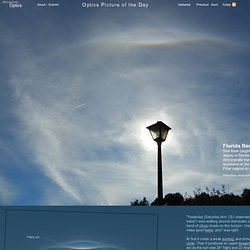
I was walking around downtown Jacksonville and noticed a band of cirrus clouds on the horizon. I had an odd feeling they would make good halos, and I was right. At first it made a weak sundog, and some segments of the parhelic circle. Then it produced an upper tangent arc [almost a circumscribed arc as the sun was 28° high] and 22 degree halo, and perhaps a Parry arc. However, when I was back home the display really escalated. There was a splendid upper tangent arc and a Parry arc and in between them, a faint Lowitz arc! Tropical Iridescence. Magellan & Airglow. The Milky Way spans the sky accompanied by the dwarf galaxies of the Magellanic Clouds.
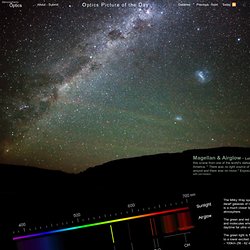
Suffusing all is a much closer light, ‘airlight’ from our own upper atmosphere. The green and red banded glow is produced by atoms and molecules whose exitation derives ultimately from daytime far ultra violet radiation. The green light is from excited oxygen atoms radiating to a lower excited state (O 1S to 1D) at an altitude of 90 – 100km (56 - 62 miles). The narrow altitude range is the result of competition between the slow radiative decay (~1s) and de-excitation by collisions coupled with the variation of atomic oxygen concentration with height. The red glow is possibly from OH radicals. Urals Sun Pillar. Venus Pillars. All bright object can make ice crystals glint to produce pillar halos.
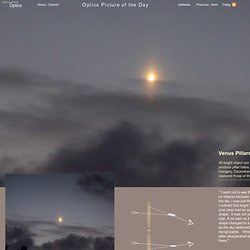
On lunar eclipse night in Hungary, December 10, Monika Landy-Gyebnar captured those of the Evening Star. ©Monika Landy-Gyebnar, shown with permission " I went out to see the lunar eclipse but there was no chance because clouds obscured that part of the sky. I was just thinking of coming home when I noticed that bright Venus hanging above the pine trees had an aureole with a well elongated shape. It was not yet dark and Venus was 8 to 9° high. Millions of wobbly hexagonal plate oriented crystals each reflect light towards the eye to produce halos that look like vertical columns. Glory & Brocken Spectre. La Cassiopea & Caustics. Caustics are Nature’s ‘focussing’, quite different from that laboriously achieved by our multi-element lenses.
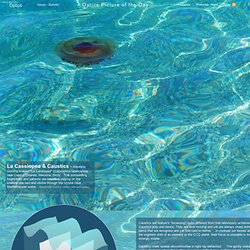
Caustics play and dance. They are ever moving and yet are always sharp with strangely permanent and stable forms that we recognise and yet find hard to define. In contrast our lenses are fragile, they lose their focus with the slightest shift of an element or the CCD plane, their focus is unstable in the sense that caustics are robust and strongly stable. Caustics mark spatial discontinuities in light ray behaviour. Glories. Find a seat on the side of the aircraft opposite the sun.
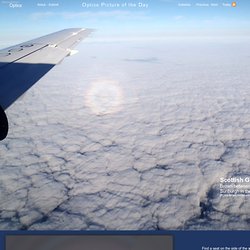
Search the clouds where the shadow of the aircraft would be – the antisolar point. The glory is a delicate shimmering pattern of concentric coloured rings that drifts along the clouds with the airplane sometimes shrinking or swelling as it does so. It is a diffraction pattern produced by light interacting with small cloud droplets and being scattered almost directly backwards. Not all cloud decks produce glories. Planetary Coronae. 2 kinds of green flash. "Many people do not believe the green flash can actually occur. Tonight at Beacons Beach 15 or 20 people saw a fantastic series of them.....as the sun set several were seen and the people who were watching saw them very very clearly....here are the two best!
" A green flash needs a mirage, ordinary atmospheric dispersion is too weak to separate colours sufficiently. A mirage needs layers of air at different temperature and therefore density. Science Videos: Grape + Microwaves = Plasma. Science Videos: Supersized Slow-Mo Slinky Drop. Melting gallium spoon. High speed video reveals the bizarre physics of an ordinary water droplet. Einstein vs Stephen Hawking - Epic Rap Battles of History #7 [subtitulado español] Droplet Collisions at 5000fps - The Slow Mo Guys. Sarychev Volcano Eruption from the International Space Station. How the Ear Works. The Electric InterGrid - Why A Smart Power Grid is Essential. Atomic Rant. Carl Sagan's Cosmos: 'The Meat Planet' Kevin Slavin: How algorithms shape our world.
The Best Pictures of the Week, September 9 – September 16. Nikon International Small World Photography Winners 2011. Feast your eyes on a rare lunar rainbow — against the Northern Lights! Volcanic Activity in the Red Sea. An eruption occurred in the Red Sea in December 2011. According to news reports, fishermen witnessed lava fountains reaching up to 30 meters (90 feet) tall on December 19. The Moderate Resolution Imaging Spectroradiometer (MODIS) on NASA’s Terra and Aqua satellites observed plumes on December 20 and December 22. Meanwhile, the Ozone Monitoring Instrument (OMI) on NASA’s Aura satellite detected elevated levels of sulfur dioxide, further indicating an eruption. The activity in the Red Sea included more than an eruption.
By December 23, 2011, what looked like a new island appeared in the region. The volcanic activity occurred along the Zubair Group, a collection of small islands off the west coast of Yemen. ReferencesBauwens, J. (2011, December 22). Neil deGrasse Tyson recounts his first meeting with Carl Sagan. Lennart Nilsson Photography. Lennart Nilsson Photography. Watch Five Breathtaking Underwater Videos Made by Robots. NASA Releases Visual Tour of Earth's Fires.
NASA Releases Visual Tour of Earth's Fires NASA has released a series of new satellite data visualizations that show tens of millions of fires detected worldwide from space since 2002. The visualizations show fire observations made by the MODerate Resolution Imaging Spectroradiometer, or MODIS, instruments onboard NASA's Terra and Aqua satellites. NASA maintains a comprehensive research program using satellites, aircraft and ground resources to observe and analyze fires around the world. The research helps scientists understand how fire affects our environment on local, regional and global scales. Earth As It Might Be In The Future. ArcticPhoto - Galleries. Mesmerizing visualization of a geomagnetic storm. One Per Cent: Stupid robots take to the stage. Jacob Aron, technology reporter Ever worry that robots are getting a little too smart? If science fiction has taught us anything, it's that it won't be long until the machines take over.
Thankfully, some people are dedicated to keeping our metal friends dumb. Bacarobo, the Stupid Robot Championship, is a showcase for just such robots. One-Minute Physics: How do we know our world is 3D? One-Minute Physics: How a particle can also be a wave. Colour me beautiful: photography at the nanoscale - Image 1. Friday Illusion: Colours emerge from spinning disc. Caitlin Stier, video intern Most people would agree that the static disc in this video is covered with a black-and-white pattern. But once the disc starts spinning, many viewers see colourful swirls appear. This classic illusion, invented by English toymaker Charles Benham in 1895, is still puzzling scientists today. The colours perceived seem to vary from person to person, as well as with lighting and rotation speed, and there is still no clear explanation for why this happens.
However, a recent functional MRI study by Hiroki Tanabe and his team from the National Institute for Physiological Sciences in Japan is giving some insight. Nanotubes help cloak objects in a mirage - tech - 04 October 2011. Born to be Viral: Watch a surgical robot peel a grape. Turning tunnels into musical instruments. Reclaiming 'intelligent design' with stunning photos. Out of the lab, into the gallery - Image 1. Art of Science / 2011 Gallery. Art of Science 2011 Gallery. Art of Science 2011 Gallery.