
L Computer Terms. 8 digital skills we must teach our children. The social and economic impact of technology is widespread and accelerating.
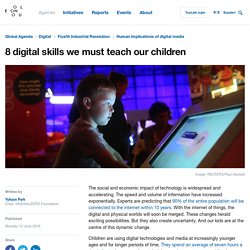
The speed and volume of information have increased exponentially. Experts are predicting that 90% of the entire population will be connected to the internet within 10 years. With the internet of things, the digital and physical worlds will soon be merged. These changes herald exciting possibilities. But they also create uncertainty. Children are using digital technologies and media at increasingly younger ages and for longer periods of time. The digital world is a vast expanse of learning and entertainment. Moreover, there is the digital age gap. So how can we, as parents, educators and leaders, prepare our children for the digital age? The e5 Instructional Model.
Page Content The e5 Instructional Model is a reference point for school leaders and teachers to develop a deeper understanding of what constitutes high quality teacher practice in the classroom. 1.
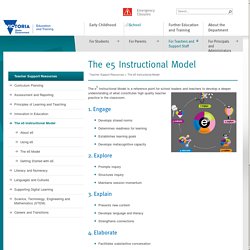
Engage Develops shared normsDetermines readiness for learningEstablishes learning goalsDevelops metacognitive capacity 2. Prompts inquiryStructures inquiryMaintains session momentum 3. Presents new contentDevelops language and literacyStrengthens connections 4. Facilitates substantive conversationCultivates higher order thinkingMonitors progress 5. Assesses performance against standardsFacilitates student self assessment Disclaimer. TPACK.ORG. Technology Integration Matrix. More Than English: Teaching Language & Content to ELLs. What is Bloom’s Taxonomy?
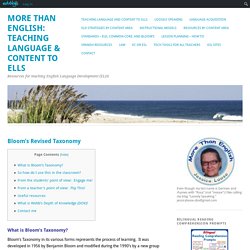
Bloom’s Taxonomy in its various forms represents the process of learning. It was developed in 1956 by Benjamin Bloom and modified during the 1990’s by a new group of cognitive psychologists, led by Lorin Anderson (a former student of Bloom’s) to make it relevant to the 21st century. The revised taxonomy emphasizes what a learner “Can Do” so the stages are now represented as verbs: We must remember a concept before we can understand it.
We must understand a concept before we can apply it. So how do I use this in the classroom? We need to “teach to the highest and scaffold the lowest” students of all ages and levels of English proficiency. Remember Understand Apply Analyze Evaluate Create Model what each means for your students in the context of a lesson. It is useful to picture Bloom’s taxonomy as a wheel since all stages are not required for every lesson and every lesson does not necessarily lead to “Creating.” The Research Behind Choice and Inquiry-Based Education - A.J. JULIANI. Updated: I’ve updated this post and page since publishing my most recent book about student choice.

I’d love for you to add resources you’ve found in the comments section of this post so I can add them to the list! Since experimenting with “Genius Hour and 20% Time” in my class a few years ago, I’ve been fascinated by the research and history of this practice in education and the business world. This has led me down a long road to eventually writing Inquiry & Innovation in the Classroom (published by Routledge) on inquiry-driven education and choice-based learning experiences. During that time I’ve had hundreds of conversations with fellow teachers practicing choice-based and inquiry-driven learning in some way shape or form (Genius Hour, 20% Time, Passion Projects, Choose2Matter etc). Today I want to shed some light on the research behind choice, and more broadly, inquiry-driven education. I’m breaking the post down into four sections.
Inquiry Project Learning Research via Edutopia 1. 10 Reasons Today’s Students NEED Technology in the Classroom. Technology is everywhere, entwined in almost every part of our lives.
It affects how we shop, socialize, connect, play, and most importantly learn. With their great and increasing presence in our lives it only makes sense to have mobile technology in the classroom. Yet there are some schools that are delaying this imminent future of using technology in the classroom as the valuable learning tool it is. Here is a list of ten reasons your school should implement technology in the classroom. 1) If used correctly, will help prepare students for their future careers, which will inevitably include the use of wireless technology. 2) Integrating technology into the classroom is definitely a great way to reach diversity in learning styles. 3) It gives students the chance to interact with their classmates more by encouraging collaboration. El200512 prensky. BBC Radio 4 - My Teacher Is an App, The Classroom of the Future. Technology in education: if students aren't worried, why are teachers?
The third episode of the BBC Radio 4 series, My Teacher is an App, offered a provocative glimpse into the ways that technology is now being used to meet current educational needs.
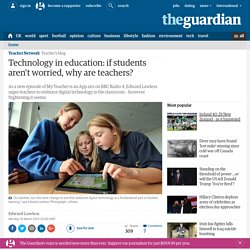
I attended the debate at The Great Hall of King's College London, where a respected panel and an energetic audience discussed the future of online technology and education. While students in the audience didn't think it was a big deal, not all of the educators saw technology and education flowing together so smoothly. There was some anxiety in the room about what would happen to "authentic teaching", whether online learning could really offer "meaningful activity" and "true engagement", and if social media could provide "real interaction". Then, of course, there was concern about what would become of "the human element" in a virtual classroom. These are all valid concerns, but they represent the dangerous assumption that a "different" learning environment can't preserve cherished educational priorities.