
Interactive Writing. Extract: A Visit from the Goon Squad by Jennifer Egan. Diaries and Journals - Women's Studies Resources in the Special Collections Research Center - Research Guides at College of William & Mary. Lydia Hart Diary, 1823-1831--diary recording the activities and thoughts of a Walden, New York minister's wife Jane Gay Robertson Diary, 1825-1849, Mss 65 R54, Box 6--diary sporadically kept by a Caroline County plantation mistress Lydia Wasson Diary, 1826-1853 (Mss Acc 2010.099)--memoir written in 1826 followed by diary entries for the remainder of this Indiana Quaker woman's life, with some entries dictated to her daughter Charlotte Wasson Cox, who made some diary entries of her own after her mother's 1853 death.

She reflects a great deal on religion. Ann Lettice Murdoch Diary, 1845-1864 (Mss Acc 2009.468)--diary of a Frederick County, Maryland, woman whose husband Richard Potts was a bank president. She was active in her church and helped run an orphanage and a farm. Drawing in class: Rachel Smith at TEDxUFM. Flow Chart for Studying. Sticky Notes & Boards. Making Sure They Are Learning. Sarah Kaufmann: I think of authentic assessment as my ability to teach each student where they actually are.
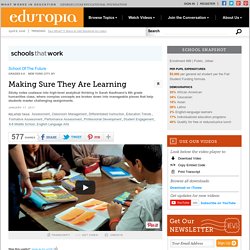
I'm Sarah Kaufmann. I teach sixth grade humanities at School of the Future. In order to know where they actually are, I have to be able to assess them really specifically and in a variety of ways that are appropriate for that student, so that what I'm doing is every day giving that child an environment where they're challenged, where they feel good about what they're learning and they feel like they're learning. Stacy Goldstein: What's been amazing to watch in Sarah's class as a sixth grade teacher is also, she just is extremely rigorous in what she demands from the kids. And so her class really has high standards. Lesson 6: A Lesson on Nature Note Taking. Teach your students the art of recording observations in the field.

Download Lesson 6 (68KB) Free Notetaking Sites. Notemaking. What is Argument Mapping? Argument Mapping is the expression of an argument is in a structured visual form.
Arguments have been expressed in prose since the time of Socrates. Modern information technology has made little impact on the expression and understanding of arguments. We now use word processing, electronic mail and spell checking instead of just the pen and paper but this has little changed the way arguments are understood. Argument mapping allows you to move from prose to a visual structure expressing premises, reasons, objections, assumptions and general commentary. Look at the Wikipediaentry for more detailed definition. Some good examplefiles can be found on the Philosophy Programme - University of Natal, Durban site. A tutorial series in PDF may be found at Jamel Ostwald's site on his Classespage. Other Argument Mapping software packages exist with Rationalebeing the best, in my opinion.
There is an Argument Map group on Yahoo Groups here . The Book Outlines Wiki / FrontPage. How to Take Notes like Thomas Edison. Journal Notebook Sketchbook. A Year in Marginalia: Sam Anderson. By Sam Anderson posted at 11:00 am on December 16, 2010 34 The writing I enjoy doing most, every year, is marginalia: spontaneous bursts of pure, private response to whatever book happens to be in front of me.
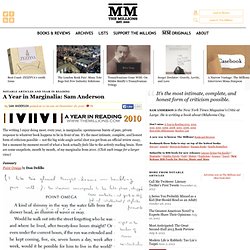
It’s the most intimate, complete, and honest form of criticism possible — not the big wide-angle aerial shot you get from an official review essay, but a moment-by-moment record of what a book actually feels like to the actively reading brain. Here are some snapshots, month by month, of my marginalia from 2010. (Click each image for a larger view) ‘What I Really Want Is Someone Rolling Around in the Text’ This hit home for me — it spoke to the little scribal monk who lives deep in the scriptorium of my soul — and I quickly adopted the habit of marginalia: underlining memorable lines, writing keywords in blank spaces, jotting important page numbers inside of back covers.
It was addictive, and useful; I liked being able to glance back through, say, “Great Expectations,” and discovering all of its great sentences already cued up for me. (Chapter 4, underlined: “I remember Mr. Hubble as a tough high-shouldered stooping old man, of a sawdusty fragrance, with his legs extraordinarily wide apart: so that in my short days I always saw some miles of open country between them when I met him coming up the lane.”) This wasn’t exactly radical behavior — marking up books, I’m pretty sure, is one of the Seven Undying Cornerstones of Highly Effective College Studying. Soon my little habit progressed into a full-on dependency. The Writer as Reader: Melville and his Marginalia. Marginalia by Billy Collins from The Best Cigarette Album.
Teaching Student Annotation: Constructing Meaning Through Connections. Lesson Plan Instructional Plan Students will: examine and analyze text closely, critically, and carefully.make personal, meaningful connections with text.clearly communicate their ideas about a piece of text through writing, revision, and publication. back to top Session One Begin the session by asking students if they are familar with the word annotation.

Session Two Pass out "Eleven" by Sandra Cisneros or any other text appropriate for your students and this activity. Session Three Return annotations from the previous session and address any questions or concerns.Explain that, working in pairs, the students will examine each other's annotations and look for ideas that have the potential for further development and revision. Session Four Review and comment on student reflections after each step of the annotation drafting and revision process.If you use this lesson as an introduction to the idea of annotation, the focus of the assessment should be on the variety of annotations a student makes.
Briefly Noted: Practicing Useful Annotation Strategies. Overview | How does annotating books help to develop stronger reading skills?

What can we learn from the marginalia of others? In this lesson, students review strategies of annotation and consider the benefits. They brainstorm ways to annotate, explore various methods in depth and test the value of annotating while reading. Giulia Forsythe at Faculty Academy 2012. Drawing conclusions. Visual Notetaking. Drawing on the Right Side of the Brain: The Definitive, 4th Edition eBook: Betty Edwards. Thinking in Pictures, Expanded Edition: My Life with Autism (Vintage) eBook: Temple Grandin. The Art of Changing the Brain: Enriching the Practice of Teaching by Exploring the Biology of Learning (9781579220549): James E. Zull. Biology of Learning pdf.