
Five Big Problems with Content Curation. I recently attended a conference where a major financial institution proudly displayed its new automated content curation system. Basically, their answer to the content marketing dilemma every company is facing is to use an outside company to skim off the best financial-services content around the web and present it on their site as a value-added customer service. On the surface, this seems like a very elegant solution. I mean, why spend the time and money to create original content when you can curate unlimited content from the web and present it as your own customer portal? An intoxicating idea. This is a popular trend but it is also problematic because it flies in the face of other marketing considerations … 1) Why should I trust you with my news?
If I really am interested in this subject matter, there are thousands of other places I can get the same thing. 2) Whose problem are you solving? Why is this company uniquely qualified to curate this content? 3) One size does not fit all. It’s not curation or aggregation, it’s just how the Internet works. 0 La curation marque-t-elle la fin de l’esprit critique ? Pinterest, Tumblr and the Trouble With ‘Curation’ Content curation: A required skill for digital-era communicators. Posted on October 6, 2010 10:35 am by Shel Holtz | New Media | PR | Research | Social Media Over the years, I have chatted with people who work for museums.
There’s Michael Edson, for example, whom I’ve interviewed twice for my podcast based on his work with the Smithsonian Institution. I’ve also met several museum communicators. These interactions have given me some introductory insight into the job of a curator. There is more to it than simply collecting pieces and displaying them. Why curate content? This understanding of a curator’s role isn’t in synch with the description I hear when people talk about content curation as a required skill for digital-era communicators. Collecting links doesn’t require much skill. The need for curation in communications arises from the staggering amount of information available on any given topic. There are plenty of good examples of the useful collection and display of links.
The elements of content curation The importance of documentation. The Secret, Selfish Side Of Social-Curation Sites. Here’s my beef with social platforms today: I don’t think they’re very social at all.
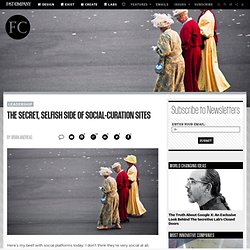
As much as Google+, Facebook, and Pinterest promise a way to connect, they’ve also promoted a disconnect--sharing on different platforms, proving a fragmented sense of keeping tabs on any social network. We can track our connections’ job promotions on LinkedIn, photos from their new office on Facebook, and hear their celebratory music on Spotify--but what about how these all link together?
And what about the platforms themselves? Unfortunately, competition currently drives their existence. Specifically, these days every startup, brand, journalist, etc. has set out to associate themselves with the craze that is “social curation": What is this Pinterest? Stowe Boyd · Open Curation. The result of a survey on how many times people kiss when they greet a friend in France *Web browser, released 19 years ago today.
Conscious Curation « SweetMedia. Thanks to Tom Foremski and Oliver Starr for inviting me to share my thoughts on curation at last night’s salon, and to the group for a lively discussion.
This article is an expansion on the bullet points in my remarks. There is a prior post- What is Curation? - that attempts to professionalize and put some limits around the use of the word, which may be needed- lest I seriously think that I’m curating my garage next time I clean it out.- CMM Does all curation have a viewpoint? “The Curator Bias” Yes, all curation has opinion and intention- this can be conscious or unconscious. Two different curators can create vastly different views on a topic by how they frame it. Billet d'humeur : la curation (curage, fuyons !) BBC College of Journalism Blog - Social media: what's the difference between curation and journalism? La "Web curation" : au-delà du hype!
Je m'en veux presque d'avoir dit, lors d'une conférence, que la figure forte des belles réflexions du Digital Humanities Manifesto de Stanford University était celle du "curator", c'est-à-dire, celui qui crée des ARGUMENTS à travers les différents objets, éléments de culture et à travers différents médias.
Pourquoi? Parce qu'au cours du dernier mois, une panoplie d'articles et de billets de blogue, que j'intégrerai sous forme d'hyperliens à même mon texte ici, définissent, pour les besoins de la cause, ce qu'on appelle la Web curation, d'une manière qui m'apparaît plutôt superficielle. Puisque je me penche sérieusement sur le sujet, à la fois pour ma thèse sur la cyberculture et dans dans le cadre d'un commissariat en arts électroniques pour la biennale de Montréal, je suis en plein de le bain!