
Application Development In The Age Of Mobility - Mobility - Mobile business. The Value of Customer Journey Maps: A UX Designer’s Personal Journey. A History of the GUI. Introduction Today, almost everybody in the developed world interacts with personal computers in some form or another.

We use them at home and at work, for entertainment, information, and as tools to leverage our knowledge and intelligence. It is pretty much assumed whenever anyone sits down to use a personal computer that it will operate with a graphical user interface. We expect to interact with it primarily using a mouse, launch programs by clicking on icons, and manipulate various windows on the screen using graphical controls. But this was not always the case. In what follows, I? Prehistory Like many developments in the history of computing, some of the ideas for a GUI computer were thought of long before the technology was even available to build such a machine.
However, starting in about 1937 several groups around the world started constructing digital computers. The father of the GUI Douglas Engelbart in 1968 This was a huge leap in thinking for 1962. Development, Technology Topics, simple, it management, interface, CIO role, Apple-simple, Apple. Adaptive Path.
On Intelligence - Welcome. Human-Computer Interaction. Visual Thinking + Synthesis. Photo by Ken Yeung I really enjoy talking complex subjects, processes or business problems and boiling them down to their core essence.

This is becoming known as the process of "Visual Thinking". I use visual metaphors and storytelling to do this. My style of visual thinking is immediately recognizable and has helped me build a strong following of influential professionals who use my visuals in their own presentations and documents.
A comprehensive archive of my visuals can be found on Flickr (please credit if you use them) and if you are interested in Visual Thinking as a discipline, you can visit VizThink for additional resources. New Defining the User Experience. One of the best blogs I know on user experience is Logic+Emotion.
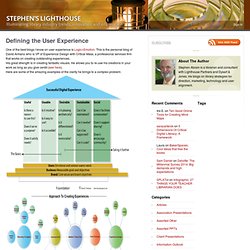
This is the personal blog of David Armano who is VP of Experience Design with Critical Mass, a professional services firm that works on creating outstanding experiences. His great strength is in creating fantastic visuals. He allows you to re-use his creations in your work as long as you give cerdit (see here). Here are some of the amazing examples of the clarity he brings to a complex problem: A User Experience Blog by Bradley Hebdon. Measuring Usability: Quantitative Usability, Statistics and Six-Sigma. Better User Experience With Storytelling - Part One. Advertisement Stories have defined our world. They have been with us since the dawn of communication, from cave walls to the tall tales recounted around fires.
They have continued to evolve with their purpose remaining the same; To entertain, to share common experiences, to teach, and to pass on traditions. Today we communicate a bit differently. Demystifying Usability. Demystifying Usability : Figuring out how to deal with Stupid Users. There's a common belief that the problem with errors users make with Web sites or Web apps has to do with differing intelligence levels.Some users even blame themselves for being dumb.
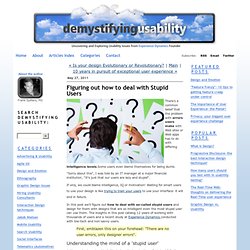
"Sorry about this", I was told by an IT manager at a major financial institution, "It's just that our users are lazy and stupid". If only, we could blame intelligence, IQ or motivation! Waiting for smart users to use your design is like trying to train your users to use your interface- it will end in failure. In this post we'll figure out how to deal with so-called stupid users and design for them with designs that are so intelligent even the most stupid user can use them.
Stumbling on Usability - Ideas - User Experience - UX Design. Of Bugs and Humbugs We all have blind spots.
Literally and figuratively. Blind spots are areas of reality we are not normally aware of. We have blind spots of vision (physiological), blind spots of perception (experiential and cultural), even of blind spots of themselves (psychological). Not to worry, though; it’s only natural. As ever, though, there’s a trade off. In Part III, The Blind Spot of the Mind’s Eye, Gilbert describes the problem of Realism.
UX Design Defined - User Experience - UX Design. User Experience Design (UXD, UED), Interaction Design (IxD), User Interface (UI) Design and other web/application design professionals use the term User Experience Design to refer to the judicious application of certain user-centered design practices, a highly contextual design mentality, and use of certain methods and techniques that are applied through process management to produce cohesive, predictable, and desirable effects in a specific person, or persona (archetype comprised of target audience habits and characteristics).
All so that the affects produced meet the user’s own goals and measures of success and enjoyment, as well as the objectives of the providing organization. This is not the only definition of User Experience Design. The term was coined by Don Norman while he was Vice President of the Advanced Technology Group at Apple. In his own words: “I invented the term because I thought human interface and usability were too narrow. What Is User Experience Design » Articles » Montparnas User Experience Design Blog. User experience design can sometimes be a slippery term.
With all the other often used terms that float around in its realm in the technology and web space: interaction design, information architecture, human computer interaction, human factors engineering, usability, and user interface design. People often end up asking “what is the difference between all these fields and which one do I need?” This article examines the term and field of user experience to plainly extrapolate its meaning and connect the dots with these other fields. Formal Definition of User Experience. Welcome — SIGCHI. Usability resources for practitioners and managers. The ROI of Usability - UPA's User Experience Winter 2002. ROI - Return on Investment - is one way of looking at the value of usability to a business.
This article was originally published in the Winter 2002 User Experience Magazine as part of "Return on Investment for Usable UI Design" by Aaron Marcus. Overall Value of Implementing UI Practices Because there have been many well-documented examples of cost savings with usability engineering, sound statistics can be applied generally to UI development. These statistics serve as benchmarks. Value proposition: High return on savings and product usability Some statistics: "The rule of thumb in many usability-aware organizations is that the cost-benefit ratio for usability is $1:$10-$100. Interaction Design Association - Homepage. World Usability Day. Human Factors and Ergonomics Society. The UX Workshop.TV - UX Design Defined. By Ritch Macefield Published: June 18, 2012 “In the field of user experience, people often confuse terms like information architecture, interaction design, visual design, usability engineering, and UX design.”
Unfortunately, in the field of user experience, people often confuse terms like information architecture, interaction design, visual design, usability engineering, and UX design. In some cases, people use these terms almost interchangeably. Ubicomp UX Design in ACM's interactions - Orange Cone. I wrote an article on ubiquitous computing user experience design for ACM's interactions magazine.
The final article is only available to subscribers, but here's a preprint version of it: I think 2005 was the year we began living in the world of commonplace ubiquitous computing devices. That year Apple put out the screenless iPod Shuffle, Adidas launched the adidas_1 shoe, and iRobot launched the Discovery—its second-generation vacuum robot. Sadly, even though we live in that world, the user experience design of most everyday ubiquitous computing devices—things you see in gadget blogs—is typically terrible. 10 things every UI designer should know about end users. An interface that fails to consider the user perspective isn't likely to win acceptance. Jack Wallen looks at user habits and attitudes that UI designers should keep in mind. With Ubuntu Unity having its first anniversary recently and Windows 8 on the brink of release, it's becoming quite clear that not all user interfaces are created equal.
In fact, it is possible to have a brilliant design that could revolutionize the way computers are used -- but if that design doesn't take into account the end users, that design will fail before it has a chance to prove its brilliance. After years of using nearly every Linux desktop and each Windows desktop, hearing the broad spectrum of complaints, and speaking to both designers and end users, I believe I have a solid handle on what UI designers need to know about end users to create fantastic, user-friendly interfaces that can easily avoid the adoption hurdle.
Note: This all applies to the AVERAGE end user. 1: End users do not like change. How to Make User Experience Count Page 1. By Dennis Drogseth, vice president, Enterprise Management Associates We live in an industry that seems to be governed by acronyms, which, though often confusing, represent terms and ideas which are themselves confusing and often misleading. Trying to clean up the mess would probably be only a tad easier than publicly legitimizing every CIA action since the beginning of the Cold War. User experience management (UEM) (or end user experience (EUE) or real user management (RUM)) is a case in point. As the next-generation acronym to replace quality of experience (QoE) that reflects what goes on when real flesh-and-blood IT consumers are taken into account, it is also central to what I would call the “humanization of IT”-- a richer and in my opinion more complete vision than the one captured in the phrase the “consumerization of IT.” Okay, so what am I talking about when I talk about UEM?
Consider the following: All About UX. User experience definitions « All About UX. The user experience. Developers sometimes ask which aspects of look and feel contribute most to the overall usability of an application or Web site. They are typically surprised when I answer that the "look and feel" aspects aren't the major contributors at all. Look and feel have been popular discussion topics for many years, and some developers have proposed various schemes purporting to allow an easy swap of one look and feel for another.
They were perhaps compelled to this thinking to compensate for an inadequate understanding of their users. Classifying Experiences. Wednesday February 22, 2006 / 8 Comments I’m excited to announce that I’ll be presenting at the 2006 IA Summit in Vancouver Canada. While it’s not a formal lecture style presentation (maybe next year?) , I’m very grateful to have been asked to convert my proposal into a poster presentation (you can view the 2005 presentations here). Www.jjg.net/elements/pdf/elements.pdf. Content Strategy and UX: A Modern Love Story. Content strategy has been around for a long time. Large corporations such as Disney, Wells Fargo, and Mayo Clinic have had functional content strategy teams for years. User Experience Network. Information Architecture Consulting by Peter Morville. User Centred Design - Infographic Poster by Pascal Raabe.
What’s this all about? The central premise of user centred design is that the best designed products and services result from understanding the needs of the people who will use them. Activity-Centered Design. IA Summit 2007] 'Tasks to Experiences' Poster. The Fundamentals of Experience Design. 8 Must-see UX Diagrams. Interaction-Design.org. User Experience and Experience Design. The user experience: Book details potential of 8 different combinations of virtuality and reality. [From Internet Evolution; a condensed report from the book is available here]
The Anatomy of APM – 4 Foundational Elements to a Successful Strategy. April 04, 2012. Real End User Monitoring and End-User Experience Management Software. User experience evaluation. User experience (UX) evaluation or User experience assessment (UXA) refers to a collection of methods, skills and tools utilized to uncover how a person perceives a system (product, service, non-commercial item, or a combination of them) before, during and after interacting with it. It is non-trivial to assess user experience since user experience is subjective, context-dependent and dynamic over time.[1] For a UXA study to be successful, the researcher has to select the right dimensions, constructs, and methods and target the research for the specific area of interest such as game, transportation, mobile, etc.
User experience design. In most cases, user experience design (UXD or UED) fully encompasses traditional human-computer interaction (HCI) design, and extends it by addressing all aspects of a product or service as perceived by users.[1] User experience is any aspect of a person's interaction with a given IT system, including the interface, graphics, industrial design, physical interaction, and the manual.[2] History[edit] User experience. User Experience Design Training & Consulting–UX Design Edge. Web Usability, Website Usability Testing, Usability Professionals. What is End User Experience? - End User Experience Today. EUM Integration. Optimizing End User Productivity. Application Performance Management. End User Experience Management, part of the BMC Application Management Suite. 15 Free Ebooks about User Experience and Interface Design » paul olyslager.
Patterns : Designing Interfaces. 6 Steps to Persuasive Design. The De-Evolution of UX Design. The Psychologist’s View of UX Design. Why Persuasive Design Should Be Your Next Skill Set. Persuasive Tech. Useit.com: Jakob Nielsen on Usability and Web Design. The Humane Interface. Windows 8 Schools Google Chrome In Building A Great User Experience. 10 Heuristics for User Interface Design. Apple’s 27 Guidelines for Mobile User Experience Design « Significantpixels.com. 40 Innovative UI Concepts from Dribbble. Nitpicker / The Humane Interface. Ensuring user satisfaction through user-centered design, user experience design, human factors, and software ergonomics. User Experience for Developers.
Principles of User Interface Design. How to drag your users out of the Stone Age. User Experience The Don Draper Way.