
Oceana North America. SHARKWATER. Sea Shepherd. Overfishing 101: How Ocean Fish Populations are Managed in the U.S. – National Geographic News Watch. In the second post of a special series to mark the 35th anniversary of the U.S.
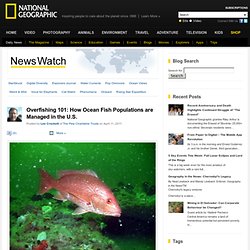
Magnuson-Stevens Fishery Conservation and Management Act, a law that is helping to rebuild America’s depleted ocean fish populations and ensure their long-term sustainability, Lee Crockett looks at some of the basics of why all Americans should care about how our fish are managed. By Lee Crockett Fish are an essential component of life in the world’s oceans, with the state of their populations serving as a bellwether of the health of ocean life overall. Unfortunately, many species around the world are in trouble. Pollution, habitat destruction and overfishing (removing fish from the ocean faster than they can reproduce) have impoverished our oceans. All too often the discussion around the issue of overfishing has been limited to a small group of stakeholders such as fishermen, conservationists and scientists.
Understanding Overfishing Footnotes: [ii] U.N. [iii] M.J. Marine Stewardship Council - home. Oceans. Food, work, fun, adventure, sport and life – not many things can give us all those things in one.
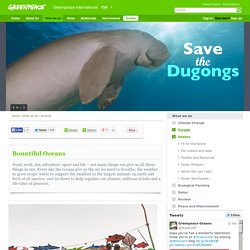
Every day the oceans give us the air we need to breathe; the weather to grow crops; water to support the smallest to the largest animals on earth and 80% of all species; vast ice flows to help regulate our climate; millions of jobs and a life-time of pleasure. Send us your favourite ocean image and it could be featured here! You and I are alive right now because of the oceans. There is no other place in the universe so full of life as this planet; so green, so rich in diverse, beautiful, weird and wonderful, large and small species, on land and at sea and it is all because Planet Earth is Planet Ocean.
They are home to the largest animal our planet has ever known – the now-endangered blue whale - but there are still huge areas of ocean that humans have never seen. Our Conservation and Research Programs at the Monterey Bay Aquarium. Earth: our water world. Rich biodiversity Life began in the oceans, and continues to thrive in its diverse habitats.

With as many as 100 million species - from the largest animal that has ever lived on Earth, the blue whale, to the tiniest bacteria - marine biodiversity far outweighs that on land. And new species are being discovered all the time. Vital role for life on land... Protecting the Ocean. World’s Largest Single Marine Reserve Created in Pacific The area around the Pitcairn Islands is one of the most pristine places on Earth.
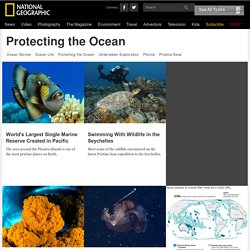
Swimming With Wildlife in the Seychelles Meet some of the wildlife enountered on the latest Pristine Seas expedition to the Seychelles. Value passed to resize filter must be a valid URL. Gabon Unveils Huge Marine Reserve The protected area will cover 18,000 square miles of ocean—home to great hammerhead sharks, manta rays, whale sharks, and tiger sharks. Watch: Rare Sea Devil Fish Caught Made famous in the movie Finding Nemo, a sea devil is caught on film for the first time. Mapping the World's (Few) Protected Seas Gabon and the U.S. have new marine reserves, but just a fraction of the seas are protected. The Antarctic's New Way to Melt Ice shelves lose more mass through melting where the ice meets the sea than by shedding icebergs, a new study says. Oceans & Marine Life Science. 25 Things You Can Do To Save Coral Reefs [photogallery/photo00018790/real.htm] American Cetacean Society The American Cetacean Society protects whales, dolphins, porpoises, and their habitats through public education, research grants, and conservation actions.
Founded in 1967, the American Cetacean Society (ACS) is the oldest whale conservation group in the world. ACS offers educational information, updates on current issues facing whales, and info on what you can do to help. Endangered Whales Fact Sheet Fisheries Facts Important information from Ocean Legacy about the state of our fisheries. Be sure to surf their site to see what you can do to help! Friends of the Sea Otter Premier sea otter advocacy organization. Institute for Marine Mammal Research Located on the Mississippi Gulf Coast, IMMR provides programs in conservation, rehabilitation, and research while also helping rescue and rehabilitate injured dolphins. Environmental News, Articles & Information. Posted on 23 April 2007.

Editor’s Note: One of the most compelling reasons to report on the oceans is because it is here that sweeping changes are happening now, not in 50-100 years. The final destruction of the major ocean reef habitats as well as the collapse of major fish populations is well underway. As of 2007, both may be destroyed beyond repair within a few years. The encouraging news is this doesn’t have to happen. Where coral reefs have been protected from destructive fishing practices, they have often began to show signs of revitalization within a few years. It is difficult to know where to begin when reporting on the world’s oceans, after all, Earth is a water planet.