
OpenID for Java Web applications, Part 1: Enable your Java Web applications to use OpenID authentication. The missing cdn. Eclipse plugin for LESS. Using this plugin?
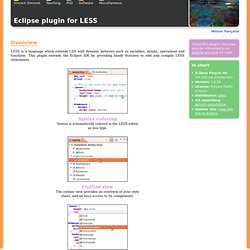
You may also be interested in an Apache Ant task for LESS. Overview LESS is a language which extends CSS with dynamic behavior such as variables, mixins, operations and functions. This plugin extends the Eclipse IDE by providing handy features to edit and compile LESS stylesheets. Syntax coloring Syntax is automatically colored in the LESS editor as you type. Outline view The outline view provides an overview of your style sheet, and an easy access to its components.
Content assist Press CTRL+space to get a context relevant list of completion proposals for CSS properties and variable names. Errors and warnings Potential errors in your stylesheet are detected in background and signaled by problem markers. Variable and Mixin linking Variable and mixin uses are automatically linked to their definition, allowing navigation and detection of undefined names.
Launch the LESS compiler Create launch configurations for LESS stylesheets, and run them directly from their contextual menu. Elasticsearch - - Open Source, Distributed, RESTful, Search Engine. QUnit. Home · LOLCODE.
Free software downloads. Myron (WebCamXtra) - Computer Vision & Well Connected Motion Tracking. Html5. Gaming and the Mozilla Labs Apps Project. In this post I give a quick overview of the Mozilla Labs Apps project and how it and the other technologies at Mozilla relate to gaming.
We really are at a point where amazing games can be created on the Web with nothing but open technologies. A few days ago we launched the developer preview of the Mozilla Labs Apps project, our vision of a distributed Web application platform. This apps project is directly related to our overall mission to better the Web, as recently described by Ragavan Srinivasan: As part of Mozilla’s mission to make the Web better we believe that apps should be available on any modern Web-connected device, operating system or browser, allowing billions of people worldwide to use and interact with apps.Today, apps are tied to closed ecosystems. It’s important to remember that although we often talk about apps as pieces of software that each serve a particular task, they can also be games. Identifying players with BrowserID Taming mouse input with the Mouse Lock API.
Tomcat web application with SSL client certificates « Virgo's Naive Stories. Often repeated topic, tons of stuff you can google, yet either I’m retarded or just plain unlucky – it took ma days to get it all right.

What we’re going to do? Create our own CA (certification authority),issue our own server certificate,issue client certificate,configure Tomcat 6 and browser to use it all,write an application that can identify user from the certificate. We need OpenSSL – for that I used Ubuntu installation running on Sun/Oracle VirtualBox as I run the Tomcat on Windows. Then I used JDK 1.6 and its keytool. Finally unzip downloaded Tomcat 6 somewhere. Jquery - Lesson: Concurrency (The Java™ Tutorials > Essential Classes) Computer users take it for granted that their systems can do more than one thing at a time.
They assume that they can continue to work in a word processor, while other applications download files, manage the print queue, and stream audio. Even a single application is often expected to do more than one thing at a time. For example, that streaming audio application must simultaneously read the digital audio off the network, decompress it, manage playback, and update its display.
Even the word processor should always be ready to respond to keyboard and mouse events, no matter how busy it is reformatting text or updating the display. Software that can do such things is known as concurrent software. The Java platform is designed from the ground up to support concurrent programming, with basic concurrency support in the Java programming language and the Java class libraries.
Maven 2. Open-game-finder - Client-server library to help locate other people who want to play a multiplayer game. Jena Semantic Web Framework.
3D. Bizer-heath-berners-lee-ijswis-linked-data.pdf (Objet application/pdf) Kinect : les bidouilleurs aux manettes. Las de jouer aux sempiternels jeux de sports ou de danse, fussent-ils sans manette ?
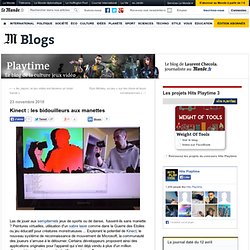
Peintures virtuelles, utilisation d'un sabre laser comme dans la Guerre des Etoiles ou jeu éducatif pour créatures monstrueuses ... Explorant le potentiel de Kinect, le nouveau système de reconnaissance de mouvement de Microsoft, la communauté des joueurs s'amuse à le détourner. Certains développeurs proposent ainsi des applications originales pour l'appareil qui s'est déjà vendu à plus d'un million d'exemplaires depuis sa sortie, le 10 novembre en France. Trois jours après son lancement américain, la presse spécialisée indiquait que des pilotes "open source" permettaient d'utiliser Kinect, non seulement avec le système d'exploitation Windows, mais aussi avec Linux ou Mac Os.
Depuis, un groupe, baptisé Open Kinect, incite les développeurs à créer des applications innovantes, utilisant le système. Spécialisé dans la création 3D, Oliver Kraylos est l'un des contributeurs les plus actifs. Laurent Checola. Neo4j: The Open Source, NOSQL Graph Database.