
Lorde: Green Light - SNL. DataSTICKIES - Design Concept for the next Generation of Data Portability. Scientists Discover a Jewel at the Heart of Quantum Physics - Wired Science. Physicists reported this week the discovery of a jewel-like geometric object that dramatically simplifies calculations of particle interactions and challenges the notion that space and time are fundamental components of reality.
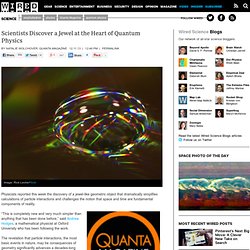
“This is completely new and very much simpler than anything that has been done before,” said Andrew Hodges, a mathematical physicist at Oxford University who has been following the work. The revelation that particle interactions, the most basic events in nature, may be consequences of geometry significantly advances a decades-long effort to reformulate quantum field theory, the body of laws describing elementary particles and their interactions. Interactions that were previously calculated with mathematical formulas thousands of terms long can now be described by computing the volume of the corresponding jewel-like “amplituhedron,” which yields an equivalent one-term expression.
The amplituhedron itself does not describe gravity. CABpL.png 1872×1224 pixels. Evacuated Tube Transport could take you around the world in just 6 hours. The world's quietest place is a chamber at Orfield Laboratories. Orfield Laboratories' 'anechoic chamber' in the U.S is 99.99% sound absorbentVolunteers see hallucinations after a short while By Ted Thornhill Published: 16:35 GMT, 3 April 2012 | Updated: 15:39 GMT, 5 April 2012 They say silence is golden – but there’s a room in the U.S that’s so quiet it becomes unbearable after a short time.
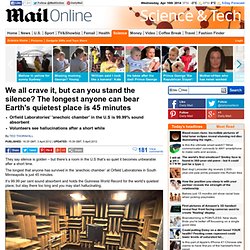
The longest that anyone has survived in the ‘anechoic chamber’ at Orfield Laboratories in South Minneapolis is just 45 minutes. It’s 99.99 per cent sound absorbent and holds the Guinness World Record for the world’s quietest place, but stay there too long and you may start hallucinating. Giant Waterworld Confirmed Around Naked Eye Star 55 Cancri A is a Sun-like star some 40 light years away.
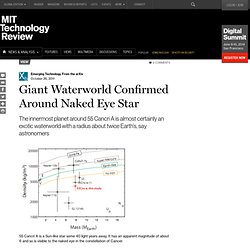
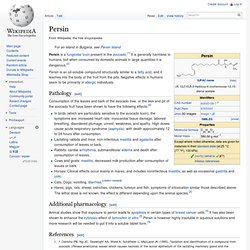
It has an apparent magnitude of about 6 and so is visible to the naked eye in the constellation of Cancer. This star is unusual in that it is just one of a handful that are known to have at least 5 planets. The innermost of these planets–55 Cancri e–was discovered in 2004 and has since had plenty of attention from astronomers. Various groups have observed the the changes in radial velocity that it causes its parent star. Persin. For an island in Bulgaria, see Persin Island Persin is a fungicidal toxin present in the avocado.[1] It is generally harmless to humans, but when consumed by domestic animals in large quantities it is dangerous.[2] Persin is an oil-soluble compound structurally similar to a fatty acid, and it leaches into the body of the fruit from the pits.
Scientists squeeze light past quantum limit › News in Science (ABC Science) News in Science Monday, 12 September 2011 Stuart GaryABC Tiny ripples The race to discover gravity waves may be getting closer to the finish line with scientists successfully squeezing light using quantum mechanics.
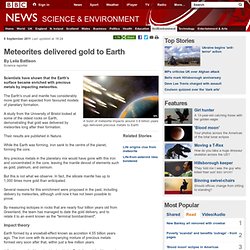
The detection of gravity waves is one of the Holy Grails of astronomy and astrophysics. It will allow researchers to study the inner workings of exploding stars and colliding black holes. The Questions. Meteorites delivered gold to Earth. 8 September 2011Last updated at 18:24 By Leila Battison Science reporter A burst of meteorite impacts around 3.9 billion years ago delivered precious metals to Earth Scientists have shown that the Earth's surface became enriched with precious metals by impacting meteorites.
Word association: Study matches brain scans with complex thought. In an effort to understand what happens in the brain when a person reads or considers such abstract ideas as love or justice, Princeton researchers have for the first time matched images of brain activity with categories of words related to the concepts a person is thinking about.
The results could lead to a better understanding of how people consider meaning and context when reading or thinking. The researchers report in the journal Frontiers in Human Neuroscience that they used functional magnetic resonance imaging (fMRI) to identify areas of the brain activated when study participants thought about physical objects such as a carrot, a horse or a house.
The researchers then generated a list of topics related to those objects and used the fMRI images to determine the brain activity that words within each topic shared. For instance, thoughts about "eye" and "foot" produced similar neural stirrings as other words related to body parts. Tracking the brain's 'semantic threads' Government Study Proves THC from Cannabis Destroys Cancer Cells. Ben Stein v.s. Richard Dawkins. Candle flames contain millions of tiny diamonds. (PhysOrg.com) -- The flickering flame of a candle has generated comparisons with the twinkling sparkle of diamonds for centuries, but new research has discovered the likeness owes more to science than the dreams of poets.
Professor Wuzong Zhou, Professor of Chemistry at the University of St Andrews has discovered tiny diamond particles exist in candle flames. His research has made a scientific leap towards solving a mystery which has befuddled people for thousands of years. Since the first candle was invented in ancient China more than 2,000 years ago, many have longed to know what hidden secrets its flames contained. Amazing algorithms to enhance or transform images. List of algorithms for image processing whose level of intelligence avoids infinitely complex tasks.

From the simplest to more complex ones... Depixelizing images Starting from a raster image that is made of large squares, we arrive at a clearer picture, as if one could a posteriori change the definition of the screen on which it was drawn ... This can be very useful if one wants to convert an old game on a modern platform such as Canvas or a smartphone. See article depixelizing. Star Found Shooting Water "Bullets" Seven hundred and fifty light-years from Earth, a young, sunlike star has been found with jets that blast epic quantities of water into interstellar space, shooting out droplets that move faster than a speeding bullet.

The discovery suggests that protostars may be seeding the universe with water. These stellar embryos shoot jets of material from their north and south poles as their growth is fed by infalling dust that circles the bodies in vast disks. "If we picture these jets as giant hoses and the water droplets as bullets, the amount shooting out equals a hundred million times the water flowing through the Amazon River every second," said Lars Kristensen, a postdoctoral astronomer at Leiden University in the Netherlands. Scientists create hottest substance on Earth. Stuart Gary for ABC Science Online Posted Tue 14 Jun 2011, 12:37pm AEST Scientists using the world's largest atom smasher have made some of the hottest and densest matter ever achieved on Earth. The state of matter called a quark gluon plasma existed in the milliseconds after the big bang 13.7 billion years ago.
Physicists using the Large Hadron Collider (LHC) at CERN, the European Centre for Nuclear Research, smashed heavy lead ions together at close to the speed of light. Fragments of Single Meteorite Show Different Chemistry: Scientific American Podcast. It came from outer space. It being the stuff of life—amino acids, sugars and other organic molecules. Meteorites reveal startling assortments of such prebiotic compounds. So it's possible that asteroids and comets delivered the ingredients for life billions of years ago. Human cell becomes living laser. Moving mirrors make light from nothing. Difference engine: Nikola Tesla's revenge. Two New Elements Join the Periodic Table. ‘Worms from hell’ unearth possibilities for extraterrestrial life.
BiJUo.jpg 554×286 pixels. Human Heartbeat Could Be Used To Charge Electronic Devices Such As iPod. Sharebar 8 Scientists are hoping that human heartbeat could be used to charge electronics which don’t require batteries such as an iPod. This comes after the development of a tiny chip which uses human body movements to generate power. The team from National Meeting and Exposition of the American Chemical Society demonstrated their project by powering LCD displays and diodes. Fsn. Fsn (File System Navigator; pronounced "fusion") is an experimental application to view a file system in 3D, made by SGI for IRIX systems.
See also[edit] File System Visualizer, a free clone of fsn for GNU/Linux and other Unix-like operating systems. References[edit] External links[edit] fsn SGI homepage at the Wayback Machine (archived April 9, 2007)fsv fsn clone for GNU/Linux and other Unix-like operating systems. Some black holes may be older than time. The First Man to Be Cured of AIDS: An Update on the Amazing Story. An Interview With Jeffrey Laurence, M.D. David Eagleman and Mysteries of the Brain. HkWEf.jpg 3850×1925 pixels. Feds Know Marijuana Agent Kills Tumors, Cancer Cells. Super-small transistor created: Artificial atom powered by single electrons. Jem Melts Rock Using Sunshine - Bang Goes The Theory - Series 3, Episode 5 Preview - BBC One.
Eyes on the Solar System. Seth Lloyd on Quantum Life. Quadrocopter Ball Juggling. Obama administration restricts findings on Gulf’s dead dolphins. Beetle turns itself into a wheel (that’s how it rolls) The E-Cat. Genius at work: 12-year-old is studying at IUPUI. When Jacob Barnett first learned about the Schrödinger equation for quantum mechanics, he could hardly contain himself. DIY Scanning Electron Microscope - Overview. Batteries charge quickly and retain capacity, thanks to new structure. The batteries in Illinois professor Paul Braun's lab look like any others, but they pack a surprise inside.
Fractal Lab - Interactive WebGL Fractal Explorer. History. You’ll shoot your eye out…with a 1MW laser pulse pistol. How To Turn A Laser Into A Tractor Beam. A photon has a small momentum which it can impart to anything it hits, as Arthur Compton and Peter Lebedev discovered at the beginning of the last century. 'Atomtronics' May Be The New 'electronics' Walking cactus discovered in China. THE COLORS OF TWILIGHT AND SUNSET - Stephen F. Corfidi. Lioness shows trust in man with her newborn cubs. Revolutionary Politics » Blog Archive » Einstein was right – honey bee collapse threatens global food security. How to Hold Your Breath Like David Blaine, World Record Holder (and Now, Me) Using Aeronautical Principles, Air Force Researchers Capture Wave Energy With 99 Percent Efficiency.
lO9OV.jpg 1370×1240 pixels. Art04. Italian scientists claim to have demonstrated cold fusion (w/ Video) New Type Of Entanglement Allows 'Teleportation in Time,' Say Physicists. A brave new world of fossil fuels on demand. Messier 82. Molecular Visualizations of DNA. TECS - The most amazing CS course I have seen! One gene lost = one limb regained? Scientists demonstrate mammalian regeneration through a single gene deletion. Cosmology: Going round in circles. Tooth decay to be a thing of the past? Enzyme responsible for dental plaque sticking to teeth deciphered. Californium. Harvard scientists reverse the ageing process in mice – now for humans. Antonio Damasio explores consciousness in Self Comes to Mind. - By Alison Gopnik. The Tuatara, a Still-Evolving Original. Scale of the Universe (flash) Nanowire battery can hold 10 times the charge of existing lithium-ion battery.
Demonic device converts information to energy. Life Hack - The 30/30 Minute Work Cycle Feels Like Magic. Look out, your medicine is watching you. BBC - Earth News - Snake gives 'virgin birth' to extraordinary babies. The McGurk Effect - Horizon Is Seeing Believing? A cure for the common cold may finally be achieved as a result of a remarkable discovery in a Cambridge laboratory - Science, News. Blind German Spitz dog uses echoes to find his way round. Analyzing almost 10 million tweets, research finds public mood can predict Dow days in advance. Six new isotopes of the superheavy elements discovered. Bees Solve Hard Computing Problems Faster Than Supercomputers. Professor Emiritus Hal Lewis Resigns from American Physical Society – reasonmclucus. How Prozac sent the science of depression in the wrong direction. Hogan’s holometer: Testing the hypothesis of a holographic universe.
Shooting for the Sun - Magazine. How serotonin works: Findings point to new treatments for schizophrenia and depression. Tooth Regeneration Gel Could Replace Painful Fillings. Complicated Mechanisms Explained in simple animations. Material World: Graphene's Versatility Promises New Applications. Scratched glasses give perfect vision for any eyesight - tech - 04 October 2010. Why we fight: Men check out in stressful situations, while women show increased brain coordination when looking at angry faces. Hello. Titanium foam could make your bones as strong as Wolverine's. ElectromagneticSpectrum.png 775×610 pixels. MIT Neuroscientists Reveal How The Brain Learns To Recognize Objects. For neurons to work as a team, it helps to have a beat. Why thinking of nothing can be so tiring: Brain wolfs energy to stop thinking. Relativity Tutorial.