
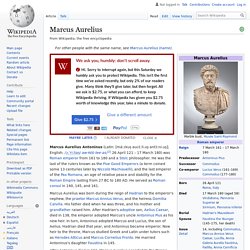
Marcus Aurelius. Roman emperor from 161 to 180, philosopher Roman emperor.
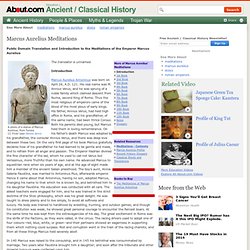
Marcus Aurelius Meditations, Introduction. Public Domain Translation and Introduction to the Meditations of the Emperor Marcus Aurelius The translator is unnamed.
Introduction. Logos (est. 1995) Meditations. Meditations (Τὰ εἰς ἑαυτόν, Ta eis heauton, literally "thoughts/writings addressed to himself") is a series of personal writings by Marcus Aurelius, Roman Emperor 161–180 CE, setting forth his ideas on Stoic philosophy.
Marcus Aurelius wrote the 12 books of the Meditations in Koine Greek[1] as a source for his own guidance and self-improvement. It is possible that large portions of the work were written at Sirmium, where he spent much time planning military campaigns from 170 to 180. The Meditations by Marcus Aurelius. James Stockdale. Stockdale was the highest-ranking naval officer held as a prisoner of war in Vietnam.
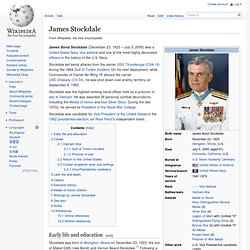
He was awarded 26 personal combat decorations, including the Medal of Honor and four Silver Stars. During the late 1970s, he served as President of the Naval War College. Stockdale was candidate for Vice President of the United States in the 1992 presidential election, on Ross Perot's independent ticket. Early life and education[edit] Stockdale was born in Abingdon, Illinois on December 23, 1923, the son of Mabel Edith (née Bond) and Vernon Beard Stockdale.[1] Following a brief period at Monmouth College, he entered the United States Naval Academy in Annapolis, Maryland in 1943. Career[edit] Shortly after graduating, Stockdale reported to Naval Air Station Pensacola, in Florida, for flight training. In 1959, the U.S.
Vietnam War[edit] Gulf of Tonkin Incident[edit] Thoughts of a philosophical fighter ... Epictetus. Philosophy, Epictetus taught, is a way of life and not just a theoretical discipline.
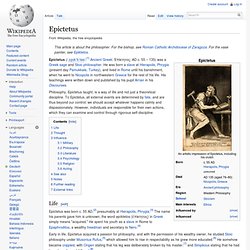
To Epictetus, all external events are determined by fate, and are thus beyond our control; we should accept whatever happens calmly and dispassionately. However, individuals are responsible for their own actions, which they can examine and control through rigorous self-discipline. Life[edit] Epictetus was born c. 55 AD,[2] presumably at Hierapolis, Phrygia.[3] The name his parents gave him is unknown; the word epíktetos (ἐπίκτητος) in Greek simply means "acquired. " He spent his youth as a slave in Rome to Epaphroditos, a wealthy freedman and secretary to Nero.[4] Roman-era ruins at Nicopolis Epictetus obtained his freedom sometime after Nero's death in 68 AD,[9] and began to teach philosophy in Rome. Thought[edit] No writings of Epictetus himself are really known. THE MORAL DISCOURSES OF EPICTETUS. The Discourses Of Epictetus. The Enchiridion by Epictetus. Commentary: A few comments have been posted about The Enchiridion.
Download: A 40k text-only version is available for download. The EnchiridionBy Epictetus Written 135 A.C.E. Ia600307.us.archive.org/1/items/moraldiscourseso017352mbp/moraldiscourseso017352mbp.pdf. Cato the Younger. A statue of Cato the Younger.
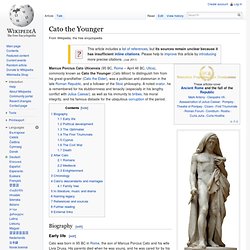
The Louvre Museum. Seneca the Younger. Lucius Annaeus Seneca (often known simply as Seneca /ˈsɛnɪkə/; c. 4 BC – AD 65) was a Roman Stoic philosopher, statesman, dramatist, and in one work humorist, of the Silver Age of Latin literature.
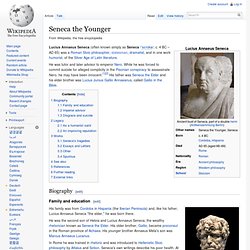
He was tutor and later advisor to emperor Nero. While he was forced to commit suicide for alleged complicity in the Pisonian conspiracy to assassinate Nero, he may have been innocent.[1][2] His father was Seneca the Elder and his elder brother was Lucius Junius Gallio Annaeanus, called Gallio in the Bible. Biography[edit] Family and education[edit] Apocolocyntosis. L. Annaeus Seneca on Benefits by Lucius Annaeus Seneca. Octavia Praetexta by Lucius Annaeus Seneca. Seneca Essays Book 1. Seneca: Letters from a Stoic. Stoicgroup - home. Stoicgroup - Major Tenets of Stoicism. The Manual of New Stoicism - The Rational Science-Based Non-Christian Philosophy - The Meditations of Marcus Aurelius: Selections Annotated & Explained by Russell McNeil PhD. "Marcus Aurelius in his Meditations implores human beings to exercise their 'divine' gift of reason to uncover the laws of nature.
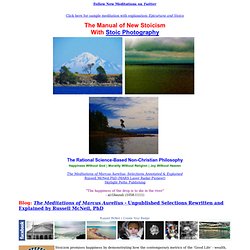
For Marcus Aurelius our reason is what defines our core humanity, and our reason is governed by the same physical laws that govern the stars. When we explore nature and when we visit the stars today we are doing what Aurelius commands, and in so doing we uncover those same laws that we were meant to live by. The Stoics demanded that we must 'live according to nature.' We cannot live according to nature until we understand what nature is. Our exploration of Mars is the latest stage in a complex human journey that we humans began nearly two thousand years ago. " - Russell McNeil, PhD, Mars LIDAR pioneer & author. A Mind Map of Stoicism. Stoic Philosophy. Stoicism. Stoicism Table of Contents 1.
General Description The term "Stoicism" derives from the Greek word "stoa," referring to a colonnade, such as those built outside or inside temples, around dwelling-houses, gymnasia, and market-places. They were also set up separately as ornaments of the streets and open places. Stoic Philosophy. Stoic principles of. The Core Dogmas of Stoicism. The Stoic Library. Stoicism. Introduction to Stoicism. Contrary to common perception, being stoic doesn’t mean being emotionless. The real quality of Stoicism is far more masculine than not caring about anything – it’s about knowing when to care, when to be upset, and how to accept the inescapable with your head held higher than you thought possible. The first thing you need to know about Stoicism is that it isn’t exactly the same today as it was in ancient times—in fact, none of the first Stoic texts are known to exist, and all we know of it today we know from stuff written before Justinian I banned philosophy schools.
The second thing you need to know is that Stoicism isn’t for mental or emotional wimps, if you think you’re tough, read on grasshopper. The last thing there, that’s what Stoicism is about . This is why a lot of Hemingway’s stories revolve around men and nature. Stoicism. Stoicism. Buddhism & Stoicism. A Conversation Among Stoics The following is a discussion that was held on the International Stoic Forum from late August to early September of 2007.
Buddhism and Stoicism: Two Ancient Philosophies. The following essay, seeking to compare the seemingly unrelated philosophies of Stoicism and Buddhism, must first begin with a brief overview of both religions. I hope to conclude by stating the obvious parallels between Buddhism and Stoicism and speculating on how these came about. Furthermore, I hope to ascertain whether the ethical practices of either system are indeed viable. Buddhism, an Eastern mystic religion that originated in India around the 6th century B.C., is very popular in almost every East Asian country, especially China. The problem with Stoicism. Stoicism isn’t perfect. BBC Radio 4 Programmes - In Our Time, Stoicism. Twenty-First Century Stoic. This is the third and final essay, written by a Stoic, about what it means to practice an ancient philosophy in the modern world.
(Read the first essay and the second essay.) The Rebirth of Stoicism. By William O. How becoming a Stoic can make you happy. From Zen to Zeno: How I Became a Stoic. This is the first in a series of three essays, written by a Stoic, about what it means to practice an ancient philosophy in the modern world. (Read the second essay.) I never intended to become a Stoic. Stoicism. Stoic Home Page. Stoic Foundation Home Page. New Stoa. Stoic Practice.