
Most Math Lectures Make Me Want To Take A Nap. This One Made Me Rethink Most Of Earth's Problems. 8 math talks to blow your mind. Mathematics gets down to work in these talks, breathing life and logic into everyday problems.
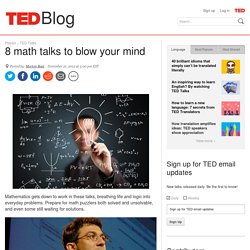
Prepare for math puzzlers both solved and unsolvable, and even some still waiting for solutions. Ron Eglash: The fractals at the heart of African designs When Ron Eglash first saw an aerial photo of an African village, he couldn’t rest until he knew — were the fractals in the layout of the village a coincidence, or were the forces of mathematics and culture colliding in unexpected ways? Here, he tells of his travels around the continent in search of an answer.
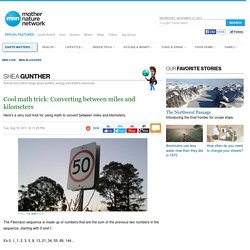
How big is infinity? There are more whole numbers than there are even numbers … right? Arthur Benjamin does “Mathemagic” A whole team of calculators is no match for Arthur Benjamin, as he does astounding mental math in the blink of an eye. Scott Rickard: The beautiful math behind the ugliest music What makes a piece of music beautiful? Cool math trick: Converting between miles and kilometers. The Fibonacci sequence is made up of numbers that are the sum of the previous two numbers in the sequence, starting with 0 and 1.
Dot Product Basics. Dot Product Basics Dot Product of Two Vectors The dot product of two vectors A and B is a key operation in using vectors in geometry.
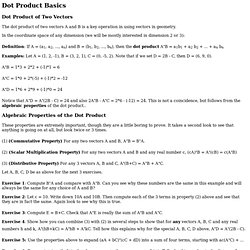
In the coordinate space of any dimension (we will be mostly interested in dimension 2 or 3): Perfect numbers. Boyfriend And Girlfriend Discussing Math - TheFunnyPlanet.com - Funny Pictures, Epic Fails, Funny Planet, iPhone Autocorrects, Awkward Texts, LOL Photos, TheFunnyPlanet, Hilarious, Animal LOLs, Troll Comics, Gags, Cartoon , Humour, Funny Facts, Movies, Ep. Web Equation. Nerd Paradise : Calculating Base 10 Logarithms in Your Head. Calculating base 10 logarithms in your head on the fly is a lot easier than you may think.
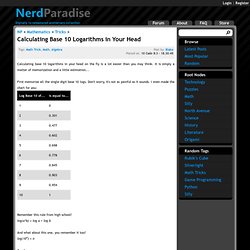
It is simply a matter of memorization and a little estimation... First memorize all the single digit base 10 logs. Don't worry, it's not as painful as it sounds. I even made the chart for you: Impress your friends with mental Math tricks « Wild About Math! See Math tricks on video at the Wild About Math!

Mathcasts page. Being able to perform arithmetic quickly and mentally can greatly boost your self-esteem, especially if you don't consider yourself to be very good at Math. And, getting comfortable with arithmetic might just motivate you to dive deeper into other things mathematical. This article presents nine ideas that will hopefully get you to look at arithmetic as a game, one in which you can see patterns among numbers and pick then apply the right trick to quickly doing the calculation. Stephen Wolfram: Computing a theory of everything.
Fibonacci in Nature. The Fibonacci numbers play a significant role in nature and in art and architecture.
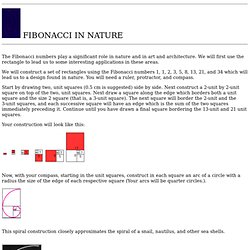
We will first use the rectangle to lead us to some interesting applications in these areas. We will construct a set of rectangles using the Fibonacci numbers 1, 1, 2, 3, 5, 8, 13, 21, and 34 which will lead us to a design found in nature. Most Popular Math Fun Facts. Foundations of Mathematics. Prime numbers. Version for printing Prime numbers and their properties were first studied extensively by the ancient Greek mathematicians.
The mathematicians of Pythagoras's school (500 BC to 300 BC) were interested in numbers for their mystical and numerological properties. They understood the idea of primality and were interested in perfect and amicable numbers. A perfect number is one whose proper divisors sum to the number itself. e.g. Perfect numbers. Prime Time. Pauls Online Math Notes. Math Gems. Mathematical Atlas: A gateway to Mathematics. 6174. 6174 is known as Kaprekar's constant[1][2][3] after the Indian mathematician D.
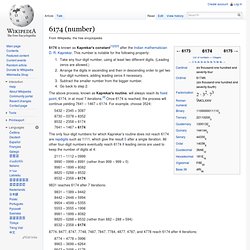
R. Kaprekar. This number is notable for the following property: Take any four-digit number, using at least two different digits. (Leading zeros are allowed.)Arrange the digits in ascending and then in descending order to get two four-digit numbers, adding leading zeros if necessary.Subtract the smaller number from the bigger number.Go back to step 2. Developing Your Intuition For Math. Our initial exposure to an idea shapes our intuition.
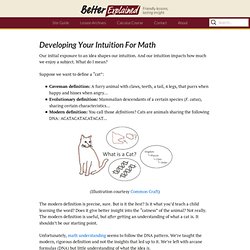
And our intuition impacts how much we enjoy a subject. What do I mean? Suppose we want to define a “cat”: Caveman definition: A furry animal with claws, teeth, a tail, 4 legs, that purrs when happy and hisses when angry…Evolutionary definition: Mammalian descendants of a certain species (F. catus), sharing certain characteristics…Modern definition: You call those definitions? Cats are animals sharing the following DNA: ACATACATACATACAT… (Illustration courtesy Common Craft) The modern definition is precise, sure.
Unfortunately, math understanding seems to follow the DNA pattern. Let’s approach ideas from a different angle. But not all starting points are equal. What is a Circle? Time for a math example: How do you define a circle? There are seemingly countless definitions. The list goes on, but here’s the key: the facts all describe the same idea! But these initial descriptions are important — they shape our intuition. Let’s try it out. Phi.