
10 Things Science Says Will Make You Happy by Jen Angel. What Does Your Body Language Say About You? How To Read Signs and Recognize Gestures - Jinxi Boo - Jinxi Boo. Art by LaetitziaAs we all know, communication is essential in society.

Advancements in technology have transformed the way that we correspond with others in the modern world. Because of the constant buzz in our technological world, it's easy to forget how important communicating face-to-face is. When conversing old-school style, it's not only speech we verbalize that matters, but what our nonverbal gestures articulate as well. Body language is truly a language of its own. We all have quirks and habits that are uniquely our own. 10% from what the person actually says40% from the tone and speed of voice50% is from their body language.
Lowering one's head can signal a lack of confidence. Pushing back one's shoulders can demonstrate power and courageOpen arms means one is comfortable with being approached and willing to talk/communicate. The Overjustification Effect. The Misconception: There is nothing better in the world than getting paid to do what you love.
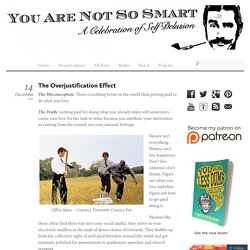
The Truth: Getting paid for doing what you already enjoy will sometimes cause your love for the task to wane because you attribute your motivation as coming from the reward, not your internal feelings. Office Space – Courtesy Twentieth Century Fox Money isn’t everything. Money can’t buy happiness. Don’t live someone else’s dream. Maxims like these often find their way into your social media; they arrive in your electronic mailbox at the ends of dense chains of forwards. Money, fame, and prestige – they dangle just outside your reach it seems, encouraging you to lean farther and farther over the edge, to study longer and longer, to work harder and harder. If only science had something concrete to say about the whole thing, you know? The researchers discovered money is indeed a major factor in day-to-day happiness. Why Daydreaming Makes You Smarter and More Creative.
Editors’ Note: Portions of this post appeared in similar form in an October, 2011, post by Jonah Lehrer for Wired.com, in an August, 2008, column by Lehrer for the Boston Globe, and in his previously published book “Imagine.”

We regret the duplication of material. Humans are a daydreaming species. According to a recent study led by the Harvard psychologists Daniel Gilbert and Matthew A. Killingsworth, people let their minds wander forty-seven per cent of the time they are awake. (The scientists demonstrated this by developing an iPhone app that contacted twenty-two hundred and fifty volunteers at random intervals during the day.) The Science of Sarcasm? Yeah, Right. How People are Fooled by Evidence. Rationality is the crowning achievement of our species.

The ability to use evidence is true the cornerstone of science, medicine, and our legal system. We use rational methods, too, in daily life – we assess an applicant’s resume, a child’s IQ, or the mileage of a used car to predict the likelihood of good performance later on. Given that we often use information to make decisions both large and small, how good are we at assessing evidence? There is a line of psychological research that studies precisely this, by measuring how accurate we are at making probability judgments.
One way to study this is to control the nature of information itself and see whether people are accurate judges of its strength. Imagine, for example, that you are in a library (assuming people still do such things), and you’ve become lost. Book 1: Piers Anthony’s Blue Adept: The Apprentice Adept Book 2: J. You’re not sure how to categorize Book 1, so it’s not good evidence for either Science Fiction or Fantasy. The Benefits of Daydreaming. The Learning Brain Gets Bigger. With age and enough experience, we all become connoisseurs of a sort.
After years of hearing a favorite song, you might notice a subtle effect that’s lost on greener ears. The Limits of Intelligence. Santiago Ramón y Cajal, the Spanish Nobel-winning biologist who mapped the neural anatomy of insects in the decades before World War I, likened the minute circuitry of their vision-processing neurons to an exquisite pocket watch.

He likened that of mammals, by comparison, to a hollow-chested grandfather clock. Indeed, it is humbling to think that a honeybee, with its milligram-size brain, can perform tasks such as navigating mazes and landscapes on a par with mammals. A honeybee may be limited by having comparatively few neurons, but it surely seems to squeeze everything it can out of them. 30 Things to Stop Doing to Yourself. 30 Things to Start Doing for Yourself. 15 Powerful Things Happy People Do Differently. What are the differences between happy people and unhappy people?

Of course, it should be very obvious: happy people are happy while unhappy people are unhappy, right? Well, that is correct. But, we want to know what happy people do differently, so I have put together a list of things that happy people do differently than unhappy people. 1. Love vs.