
Latex.
Jobs. Bioinformatics/popgen. CBSU Web Applications. Stab Vida - The best services/products provider in biotechnology - Careers. BioTool - Protocol Online. Protocol Online - Your lab's reference book. Geldoc system. E-Gel® Go! System — Precast Gels for Quick-Check Analysis. Genomics. Diagnostics. Smithsonian Institution National Museum of Natural History NMNH. Home - Under the Microscope. Welcome to Research Review. Discuss important life science topics with the experts. The study of speciation, the evolutionary processes that form new species, has long been one of the central topics of evolutionary biology.

This central position is partly because the study of how new species arise, diverge and remain separate draws together many strands of study, including population genetics, ecology, behaviour, biogeography and biodiversity. It also remains one of the most intriguing questions in evolution. From appearing virtually ‘solved’ in the mid Twentieth Century, when the geographical classification of speciation mechanisms into allopatric (by far the most dominant explanation), sympatric and parapatric was almost all that needed to be said by way of explanation, speciation has recently undergone a period of intensive study with many important advances.
The old frameworks for understanding speciation, such as the geographical classification mentioned above, have begun to look unsatisfactory. Science. Free research paper management software - Qiqqa. Open Journal Genetics. Infra Eco Network Europe. Science Daily: News & Articles in Science, Health, Environment & Technology. DeepDyve. ScienceDirect. NCBI. Bonferroni adjustment. Simple and sophisticated Bonferroni adjustment Anywhere where you compare three or more groups or conditions or repeated measures and get a significant result on the overall test (e.g.
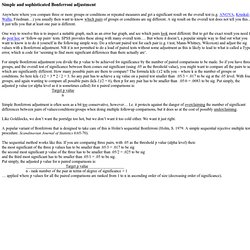
ANOVA, Kruskal-Wallis, Friedman…) you usually then want to know which pairs of groups or conditions are sig different. A sig result on the overall test does not tell you this… It just tells you that at least one pair is different. One way to resolve this is to inspect a suitable graph, such as an error bar graph, and see which pairs look most different. But to get the exact result you need to do post hoc or ‘follow-up pairs’ tests. For simple Bonferroni adjustment you divide the p value to be achieved for significance by the number of paired comparisons to be made. Target p value n Like Goldilocks, we don’t want the porridge too hot, but we don’t want it too cold either.
A popular variant of Bonferroni that is designed to take care of this is Holm’s sequential Bonferroni (Holm, S. 1979. SC Wildlands. Montado, Alentejo. Quick tour A magnificent 200 year old cork oak, able to thrive on the poorest mediteranean soils.
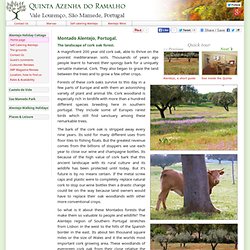
Thousands of years ago people learnt to harvest their spongy bark for a uniquely versatile material. Cork. They also began to graze the land between the trees and to grow a few other crops. Forests of these cork oaks survive to this day in a few parts of Europe and with them an astonishing variety of plant and animal life.
The bark of the cork oak is stripped away every nine years. So what is it about these Montados forests that make them so valuable to people and wildlife? Many farmers in Alentejo have families who have managed a large area of Montado forest in a traditional way for many generations. Although the ancient Greeks and romans knew about the value of cork bark it only began to be harvested commercially in Portugal about three hundred years ago. The stripping is only done in summer when the bark comes away from the living tissue, the cambium more easily.
The Molecular Ecologist. DAISIE. The Biodiversity Group. Research Tools. Scientific social network. Learn.Genetics™