
Prezi - The Zooming Presentation Editor. De Havilland Biplane No. 1. De Havilland Biplane No. 1 is a name applied retrospectively to the first aircraft constructed by Geoffrey De Havilland, who built and flew once in December 1909.

De Havilland undertook the project with the assistance of his flatmate (and soon to be brother-in-law) Frank Hearle, and financed the project with ₤1,000 borrowed from his maternal grandfather as an advance on his inheritance. With construction continuing at Fulham, De Havilland and Hearle looked for a site to test the aircraft. During a visit to Crux Easton in the summer, they discovered unused sheds that had been built on Lord Carnarvon's estate at Seven Barrows by John Moore-Brabazon.
De Havilland purchased them in August for ₤150 and secured Lord Carnarvon's permission to fly from his land. By December, De Havilland and Hearle relocated the aircraft to the sheds and took rooms at a nearby inn. Specifications[edit] Data from Jackson 1962, p.470 General characteristics Performance References[edit] Bibliography Taylor M.J.H. DE HAVILLAND HISTORIC AVIATION PHOTOS. List of de Havilland aircraft. This is a list of aircraft produced or proposed by Geoffrey de Havilland or designed by the de Havilland Aircraft Company from its founding in 1920 until its purchase by (and integration into) the Hawker Siddeley Group in 1959.

The aircraft are ordered by de Havilland model number; The numbers started with De Havilland's entry into the Airco company. although Airco built the planes, their design was owned by De Havilland and when De Havilland started his own company, he continued the numbering. This went on even for later designs of De Havilland's aircraft company, even if they were designed by a factory team with little input from De Havilland himself.
The DH.89, for example, was the De Havilland's 89th design. The designs DH.121 and DH.125 which were under development when De Havilland merged into the Hawker Siddeley Group kept their numbering and were produced as the Hawker 121 Trident and the Hawker 125. Free Online Course Materials. Maglev. Maglev (derived from magnetic levitation) is a method of propulsion that uses magnetic levitation to propel vehicles with magnets rather than with wheels, axles and bearings.

With maglev, a vehicle is levitated a short distance away from a guide way using magnets to create both lift and thrust. High-speed maglev trains promise dramatic improvements for human travel if widespread adoption occurs.[1] Compared to conventional wheeled trains, differences in construction affect the economics of maglev trains. In wheeled trains at very high speeds, the wear and tear from friction along with the hammer effect from wheels on rails accelerates equipment deterioration and prevents mechanically-based train systems from routinely achieving higher speeds.[3] Conversely, maglev tracks have historically been found to be much more expensive to construct, but require less maintenance and have lower ongoing costs. History First patent Development. Design and technology resources, lesson plans, TES Resources.
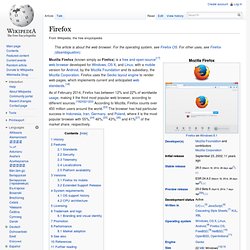
CAD CAM CIM. Firefox. As of February 2014[update], Firefox has between 12% and 22% of worldwide usage, making it the third most popular web browser, according to different sources.[19][20][21][22] According to Mozilla, Firefox counts over 450 million users around the world.[23] The browser has had particular success in Indonesia, Iran, Germany, and Poland, where it is the most popular browser with 55%,[24] 46%,[25] 43%,[26] and 41%[27] of the market share, respectively.
History[edit] Phoenix 0.1 screenshot Features[edit] Standards[edit] The result of the Acid3 test on Firefox 17. Firefox implements many web standards, including HTML4 (partial HTML5), XML, XHTML, MathML, SVG 1.1 (partial),[37] CSS (with extensions),[38] ECMAScript (JavaScript), DOM, XSLT, XPath, and APNG (Animated PNG) images with alpha transparency.[39] Firefox also implements standards proposals created by the WHATWG such as client-side storage,[40][41] and canvas element.[42]
Technical academies, University Technical Colleges and Studio Schools - The Department for Education.