
Video: Urine-powered mobile phone charger lets you spend a penny to make a call - Gadgets & Tech - Life & Style. Key to the breakthrough is the creation of a new microbial fuel cell (MFC) that turns organic matter – in the case, urine – into electricity.

The MFCs are full of specially-grown bacteria that break down the chemicals in urine as part of their normal metabolic process. The bacteria produce electrons as they consume the matter and it this natural process that creates a small electrical charge to be stored in the MFC. Time Regained! by James Gleick. Time Reborn: From the Crisis in Physics to the Future of the Universe by Lee Smolin Houghton Mifflin Harcourt, 319 pp., $28.00 A pregnant moment in intellectual history occurs when H.G.

22 Maps That Show The Deepest Linguistic Conflicts In America.
Aesthetics of the Anthropocene. Matthew Omelsky “After the End Times”: African Futures and Speculative Fictions Our current historical moment, as Slavoj Zizek has put it, is one of “apocalyptic time.”
We live the “‘time of the end of time,’ the time of emergency, of the ‘state of exception’ when the end is near” (261). In this era of the Anthropocene, the human has literally become a geological force, indisputably transforming the surface, climate, and life forms of the planet. And our impulse to burn fossil fuels, to strip forests is, of course, entangled in our impulse to accumulate capital. Written nearly a century ago, in a radically different moment of social crisis, Ernst Bloch’s The Spirit of Utopia (1918) speaks hauntingly to our current impaired vision. In recent years, African artists have begun to articulate this “moment after,” ushering in a new paradigm in African literature and film that speculates upon post-crisis African futures. African topographies Neuropolitics African futures now Download full text PDF.
Wi-Fi signals enable gesture recognition throughout entire home (w/ Video) (Phys.org) —Forget to turn off the lights before leaving the apartment?
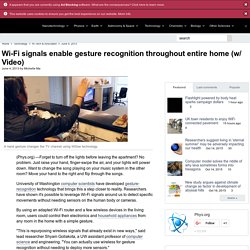
No problem. Just raise your hand, finger-swipe the air, and your lights will power down. Want to change the song playing on your music system in the other room? Move your hand to the right and flip through the songs. University of Washington computer scientists have developed gesture-recognition technology that brings this a step closer to reality. By using an adapted Wi-Fi router and a few wireless devices in the living room, users could control their electronics and household appliances from any room in the home with a simple gesture. "This is repurposing wireless signals that already exist in new ways," said lead researcher Shyam Gollakota, a UW assistant professor of computer science and engineering.
The UW research team that includes Shwetak Patel, an assistant professor of computer science and engineering and of electrical engineering and his lab, published their findings online this week.
Best U.S. Job: Become a Farmer to Make More than a Banker. If you want to become rich, Jim Rogers, investment whiz, best-selling author and one of Wall Street's towering personalities, has this advice: Become a farmer.
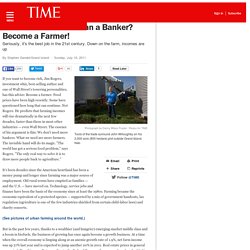
Food prices have been high recently. Some have questioned how long that can continue. Not Rogers. He predicts that farming incomes will rise dramatically in the next few decades, faster than those in most other industries — even Wall Street. The essence of his argument is this: We don't need more bankers. It's been decades since the American heartland has been a money pump and longer since farming was a major source of employment. But in the past few years, thanks to a wealthier (and hungrier) emerging-market middle class and a boom in biofuels, the business of growing has once again become a growth business. These days, a trip to Grand Island, Neb., a city of 48,500 surrounded by farms, is a trip to an economic bizarro land. Why The Human Body Will Be The Next Computer Interface. By now you’ve probably heard a lot about wearables, living services, the Internet of Things, and smart materials.
As designers working in these realms, we’ve begun to think about even weirder and wilder things, envisioning a future where evolved technology is embedded inside our digestive tracts, sense organs, blood vessels, and even our cells. As a service design consultancy we focus on how the systems and services work, rather than on static products. We investigate hypothetical futures through scenarios that involve production/distribution chains and how people will use advanced technology. Although scientifically grounded, the scenarios proposed aren’t necessarily based on facts but on observations. They are designed to create a dialogue around technologies that are still in science labs.
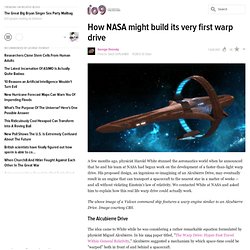
To see the future, first we must understand the past. How NASA might build its very first warp drive. I want to see this work as much as anyone else on io9, but every time I read an article on warp drive, I expend so much mental energy trying to wrap my head around the concept that my entire left hand side goes numb.
Somewhere along the line my understanding of concepts such as the nature of Spacetime is deficient. Keystone XL: The Video President Obama Hopes You Won’t See.