
Filthy Rich Dream Wish List. One day if when I have entirely way too much money, after many generous donations to needy animals, here are some of the things I shall splurge on… Lazy river inside the house?
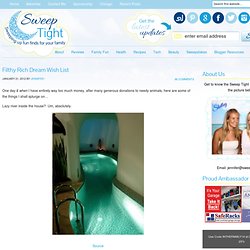
Um, absolutely. Source My own island yacht? But, of course. Source This bunk bed to have the top as a reading nook! Source This shower for sure. Source Slides as a means of transportation throughout the house, to go down at least… Source And amazing staircases to go back up! Source Our bedroom, which will be attached to the lazy river, naturally. Source In our backyard we shall have this gazebo-ish area… And, of course, everyone needs a vacation home… Source I think I am being quite practical, don’t you? Brilliant Stairs photos. CNC carpentry: the 'selfsupportingframework' Two students working on load-bearing systems in the architecture department at Kassel University, Mischa Proll and Andreas Günther, have taken advantage of the wide range of design techniques available and breathed new life into a one-hundred-year-old construction concept.
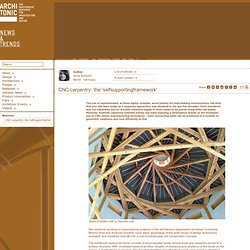
The traditional reziprocal frame consists of short wooden joists, whose ends are carpentry-joined to a surface structure. With consistant types of profiles, lengths of elements and positions of the knots on the axises, a dome shape is created. The first documenting of such a framework, also called a „mandala roof“, dates back to the 12th century, according to the students' research, when a Buddhist monk by the name of Chogen created designs for temples, whose influence can still be seen today in the architecture of domes in China and Japan. The variation of individual parameters, for instance changing the join between two elements, leads to a change in all the other subsequent joins. Soft gravitational pull towards fleshy architectural bodies.
Soft gravitational pull towards fleshy architectural bodies.
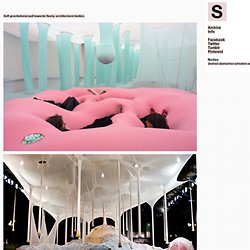
External Stimuli : Ernesto Neto at the Armoury, Themes : Architecture, Sculpture Nodes : densities, Ernesto Neto, organic, soft, surreal, transparency, womb. The Coolest Elevator in New York. Last week, I was scouting office space in a building in Queens.
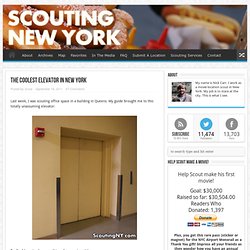
My guide brought me to this totally unassuming elevator: Really, I have to show you this as I encountered it: WOW. It’s like Willy Wonka built an elevator to the land of Oz! Easily the coolest elevator I’ve ever been on in New York: Here’s a full panorama looking toward the rear of the elevator (that’s a railing beneath the mirror)… …and a reverse pan showing the front: Lining the ceiling are these great monster heads made out of mechanical bits… Architecture and design.
Architecture. Imagine the renovation dilemmas.

A huge penthouse of a converted 1930s office building in TriBeCa, New York, is to be turned into a functioning home for a family with three teenagers. In fact, we can not quite imagine the issues that faced Steven Harris Architects when the family showed up, literally, at the doorstep of the celebrated architect and asked if he’d like to work on their home. Harris said yes and proceeded to make his magic. The scale of the apartment is huge and the freedom from budget constraints allowed for some spectacular solutions. Harris’s work is often distinguished by clarity and light, by the use of glass, by the maximization of views and, above all, bold solutions. 15 Awesome And Inspiring Offices. I’m sure you’ve seen this office plenty of times on the internet.

This office is all about fun: it has a lot of specially decorated rooms in which employees can do their work. There’s even a game room for relaxation and a gym where you can work out. Check it out: The Selgas Cano Architecture office, designed by Iwan Baan, makes you feel like a part of nature. Thanks to the fact that the office is below ground level and the huge windows, you really feel encapsulated by plants and trees. Unless you’ve been living under a rock for the past five years, you’ve probably already heard of Twitter. Saegeling Medizintechnik is a German company that produces high-end medical equipment.
This office somehow reminds me of the nuclear bunker in the end of Terminator 3. Yahoo has several offices around the world. TBWA Hakuhodo is a Japanese advertising company. You probably know Pixar from great animation films such as Toy Story, Finding Nemo, Wall-E and The Incredibles.