
M32 - 32-bit ARM Cortex MCUs. Welcome to microchipDIRECT. PlugComputer.org. How to use Beagleboard as full PC. Introducing RTL-SDR: a $20 SDR. If you don’t want to spend $1,200+ for a USRP SDR to use GNU Radio the crew at OsmoSDR want to help.

In addition to their other amazing work, Osmocom team members (notably Steve Markgraf) have been hacking away on an alternative least-cost solution they call rtl-sdr. So what is rtl-sdr? It is a creative form of using consumer-grade DVB-T USB receivers, turning them into fully-fledged software defined radios.Those DVB-T receivers supported by rtl-sdr are based on the Realtek RTL2832U chipset plus a tuner IC like the Elonics E4000.The RTL2832U has some undocumented commands/registers, by which it can be placed into a mode where it simply forwards the unprocessed raw baseband samples (up to 2.8 MS/s 8-bit I+Q) via high-speed USB into the PC, where they are routed into GNU Radio.At a street price of about USD 20 to USD 25, they are undoubtedly the most capable low-cost SDR hardware that can be bought.
So now there is really no more excuse for anyone to not learn GNU Radio. USB development board with a custom scriptable language. SigLab is an open source USB development board that takes commands from a small program that runs Python-like scripts.
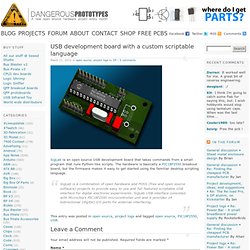
The hardware is basically a PIC18F2550 breakout board, but the firmware makes it easy to get started using the familiar desktop scripting language. SigLab is a combination of open hardware and FOSS (free and open source software) projects to provide easy to use and full featured scriptable USB interface for digital electronic experiments. SigLab USB interface consisted with Microchip’s PIC18F2550 microcontroller unit and it provides 14 bidirectional (digital) I/O ports for external interfacing.
About DorkbotPDX. DorkbotPDX is the Portland chapter of Dorkbot, people doing strange things with electricity.
We were founded in 2006 are now in a permanent (revolutionary) process of redefining ourselves and the logistics of this organization. We are a community of creative types who enjoy experimenting, finding art in technology and pushing the limits of whatever is in front of us. We meet on an regular, informal basis every other week, but you can find out more on our meetings page. We occasionally hold larger events and workshops, so sign up for the mailing lists to find out what's going on. We welcome you to join us at our gatherings and to bring something interesting to view or ponder. Embedded Single Board Computers - Single Board Computer, 3.5" SBC, Embedded SBC, Fanless PC, Embedded Single Board Computer, Module IO - Advantech.
Advantech embedded Single Board Computer (SBC Computer) series range from 3.5 SBC, PC 104, EPIC, EBX, to 5.2 SBC boards.

These embedded computers come in standard form factors in compact sizes with rich I/O, high flexibility and easy expansion capabilities. Embedded computers offer scalable performance to fulfill multiple applications that demand reliable operation and industrial grade design and quality. FAQs. Table of Contents: The Raspberry Pi is a credit-card-sized computer that plugs into your TV and a keyboard.
It is a capable little computer which can be used in electronics projects, and for many of the things that your desktop PC does, like spreadsheets, word processing, browsing the internet, and playing games. It also plays high-definition video. We want to see it being used by adults and children all over the world to learn programming and digital making. You can read more about the Raspberry Pi here. The Raspberry Pi Foundation is a charity, so you can’t buy shares in the company. You can buy a Raspberry Pi from our main distributors, Premier Farnell/Element14 and RS Components/Allied Electronics.
The Model A+ costs $20, the Model B+ costs $25, the Pi 2 costs $35, the Pi 3 costs $35, and the Pi Zero costs $5, plus local taxes and shipping/handling fees. You get the Raspberry Pi board itself. The components we buy are priced in dollars, and we negotiate manufacturing in dollars. Bone. Explore the high-performance, low-power world with the tiny, affordable, open-source Beagles.
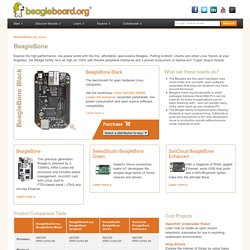
Putting Android, Ubuntu and other Linux flavors at your fingertips, the Beagle family revs as high as 1GHz with flexible peripheral interfaces and a proven ecosystem of feature-rich "Cape" plug-in boards. BeagleBone Black The benchmark for open hardware Linux computers. Get the workhorse 1GHz AM335x ARM® Cortex-A8 processor, expanded peripherals, low power consumption and open source software compatibility. Learn more » What can these boards do? The Beagles are tiny open-hardware (you could make one yourself), open-software computers that plug into whatever you have around the house.
BeagleBone. Teensy USB Development Board. The Teensy is a complete USB-based microcontroller development system, in a very small footprint, capable of implementing many types of projects.

All programming is done via the USB port. Seeed Studio Bazaar, Boost ideas, extend the reach.