
The Transmedia Approach. Integration is chaos.
With so many agency / channel specialists – clients waste a ton of money paying for redundancies in their big agency fees. Furthermore, when Kellogg wrote the textbook on marketing integration years ago, I know that what they describe in their scenario planning was not what marketers are attempting to pass off as an integrated marketing plan. Today, 'Integrated Marketing' is defined as a multi-channel plan using the same message across all channels.
What we know now is that one size does not fit all! The same message or conversation doesn’t work in all media channels. Digital Literacy, Creativity & Transmedia Publishing For Kids: 02/01/2011 - 03/01/2011 - (Private Browsing) "I want to create experiences that allow the audience to step into the shoes of the protagonist.
"-Lance Weiler When I talk to most people in publishing and tell them I am creating character bibles & StoryWorlds for kids IP, they usually look at me kind of funny and ignore what I say or ask, "what? " I tell them I'm an obsessed student of transmedia, and in order to create a compelling digital storytelling experience on the web (i.e. to get & retain eyeballs), you need to create an amazing place for your digital story to live and be shared. You need to create context.
That's what StoryWorld is. Webdocs.com new non-linear storytool. Social Multi Platform TV Brief O'Matic. Archive: Just broke 10 000 views! Transmedia StoryTelling Workshop Template. Screen Australia - Filming in Australia. Screen Australia's budget templates are intended as a guide to preparing budgets in the format usually required by funding bodies.
All are provided as downloadable Excel spreadsheets suitable for both PC and Macintosh users. You will need some level of proficiency in Microsoft Excel. We have taken care to ensure that the formulas in these budgets are correct. However, we acknowledge that as people use them, they will pick up errors. If you do find an error, please notify us at web@screenaustralia.gov.au so we can correct it. Please also check Updates and Corrections regularly. A-Z budgets. Personalizemedia. Transmedia StoryTelling Workshop Template. New Infographic: The Brandsphere by Brian Solis and JESS3 Brian Solis. InShare698 In discussions about new media, you will often hear the division of media opportunities as Paid, Owned, and Earned media (P.O.E.M.).
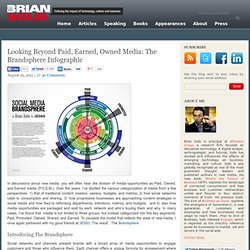
Over the years, I’ve studied the various categorization of media from a few perspectives, 1) that of traditional content creation, owners, budgets, and metrics, 2) how social networks cater to consumption and sharing, 3) how progressive businesses are approaching content strategies in social media and how they’re rethinking departments, intentions, metrics, and budgets, and 4) also how media opportunities are packaged and sold by each network and who’s buying them and why. In many cases, I’ve found that media is not limited to three groups, but instead categorized into five key segments: Paid, Promoted, Owned, Shared, and Earned. To visualize the model that reflects the state of new media, I once again partnered with my good friends at JESS3.
The result…The Brandsphere. 1. 2. 3. 4: Promoted: in-stream or social paid promotions vehicles (e.g. 5. Social Media's Critical Path: Relevance to Resonance to Significance - Brian Solis. If social media warranted a mantra, it would sound something like this, “Always pay it forward and never forget to pay it back…it’s how you got here and it defines where you’re going.”
This intentional form of alternative giving is referred to as “generalized reciprocity” or “generalized exchange.” The capital of this social economy is measured in these productive relationships and those relationships are earned through the acts of reciprocity, recognition, respect and benevolence. So how can businesses, which, one could argue, typically represent a “pay it backward” approach (ie, “pay me for my goods and services”), thrive in this environment? In my experience as a longtime social media observer who advises companies on how to successfully navigate the new media landscape, the key lies in embracing the linear concept of Relevance, Resonance, and Significance. To understand this model, it’s important we define the base unit for social media: the “social object.” Relevance The good news?
The Social Media Style Guide: 8 Steps to Creating a Brand Persona Brian Solis. InShare26 What follows is an edited excerpt from Engage!
Anyone who has ever worked in corporate marketing, advertising, and branding is more than familiar with a brand style guide. It’s how we ensured that the brand was represented as intended through marketing aesthetics and messaging – including detailed usage instructions on font, style, color, language, placement, positioning, etc. It is our bible and adherence to its tenets and instructions is strictly enforced.
However, with the unstructured proliferation of social media within many organizations, the brand style guide is seemingly disregarded or not considered in favor of expediting the creation of profiles in social networks and the participatory engagement that immediately ensues. Everything the brand was intended to represent is no less important simply because new tools and services make it easier for anyone within the company to reach and connect with markets. The goal of a social media style guide is to establish: 1. 2. 3. 4. Kurt Vonnegut on how to write a short story.