
Gary O.. Claytor
Global Healthcare Business Development Executive and Consultant
Cambridge researchers release report on how mobile phones are transforming healthcare. >Many would argue the greatest promise of mobile health lies in the developing world – areas where low-cost, portable diagnostic and treatment tools could impact millions of people.

Researchers at the University of Cambridge recently released a comprehensive study of mobile health applications in a nation where the confluence of poverty, geography, and rapid economic growth have created an environment where mobile health should thrive – China. Having received unprecedented access from Mobile China, the largest mobile communications provider in the world, their findings are compiled in a 100+ page report on the promise of mobile health technology. Sharing Widget, Sharing Button, Sharing Plugin - ShareThis. Accountable Care Organizations. Hospitals and Mobile Health: Time To Get Involved. How mHealth Can Immediately Save Healthcare Dollars - Healthcare Talent Transformation. Posted by: Dr.

David Scher, MD, dlschermd@gmail.com , DLS Healthcare Consulting OK, so it’s going to take some time for mHealth to reach quotidian jargon, healthcare provider acceptance, obtain reimbursement status, and demonstrate improved outcomes with clinical trials. I was with the Old Guard from 1976 to 1979 with Company D and with the Public Relations office which was in the same building as the museum. Sherpas in Blue Shirts. If “An Apple a Day Keeps the Doctor Away,” can mHealth Apps Bring Patients and Healthcare Folks Together? The February 1866 edition of Notes and Queries magazine includes this: “A Pembrokeshire proverb; Eat an apple on going to bed, and you’ll keep the doctor from earning his bread.”
Since then a number of variants of the rhyme have been coined, up to our present-day “An apple a day keeps the doctor away.” Just as apples have a numerous benefits – they contain Vitamin C, reduce tooth decay by cleaning one’s teeth and killing off bacteria, and may even protect brain cells against neuro-degenerative disorders like Alzheimer’s Disease, as has been suggested by Cornell University researchers – mHealth apps serve multiple purposes including promotion of wellness and communicating with healthcare providers, payers, and pharmacists. Indeed, many of the country’s large healthcare providers and payers are offering patient-focused smart phone applications that will change the way information is exchanged between member patients and their physicians, hospital providers and payer companies.
The Consumerization of IT may be a Bigger Problem for Business than IT. King Cnut (Cnut the Great) of England, Denmark, Norway, and parts of Sweden once famously instructed the tide to refrain from rising, only to hours later find its disdain for his royal decree.

Today’s CIOs find themselves faced with similar limits on their power and influence as Androids, iPhones, and iPads flood the workplace. The power of the purse cannot control these new and disruptive technologies as they are funded directly by employees. Corporate policies and other traditional control mechanisms are also being eroded or washed away in the rapid adoption of these easy to install and attach devices.
Report from the Doctor’s Office: Complexities of a Modern Day Integrated Delivery Network. We recently met in our offices with a practicing physician leader for a major healthcare organization selected to direct development of an Accountable Care Organization (ACO) and a regional Health Information Exchange (HIE).

The mission he is embarking on is highly complex, and managing it effectively will require cooperation from competing internal and external constituencies. Our discussion focused, from a physician’s viewpoint, on the intricacies and hurdles that will need to be bridged before the new organizations can be launched. Win-Win Contractual Relationships in Healthcare Industry. As a country music fan, several lines in Kenny Rogers’ hit song “The Gambler” tend to make me think about outsourcing relationships, especially in the healthcare industry, as that’s where I’ve spent the bulk of my career.

“If you’re gonna play the game, boy, ya gotta learn to play it right” In the 1995 to 2004 timeframe there was a proliferation of outsourcing among healthcare provider and health plan companies. The outsourcing advisory community began to cater to large and complex Integrated Delivery Networks (IDNs) and Academic Medical Centers to ensure they received the same type of world-class outsourcing services that Fortune-rated companies in other industries had already been receiving. When You Come to a Fork in the Road, Take It! Healthcare Reform Will NOT Negatively Impact Industry Profitability. A client recently engaged Everest Group to analyze the U.S. health insurance industry and identify long-term trends and their implications.

From the outset, I realized that due to the ongoing healthcare reform, this was an unusual case in which one couldn’t extrapolate existing industry dynamics into future periods. Trying to understand the implications of President Obama’s healthcare reform on overall industry profitability, I discovered many contradicting predictions. Eyes Wide Open – What Are the Risks of Global Services? Over the last decade, we have been witness to a world that is logically shrinking in size and expanding in its ability to provide options in global services.

The phenomenon is being driven by the increased integration of technology and the sudden emergence of service delivery capabilities in new geographies, thus allowing organizations to tap into global resources at a rapidly increasing rate. The utilization of a global services delivery model is allowing organizations, regardless of their size, to: mHealth Providers Learning It’s All About Competitive Cooperation. mHealth (also written as m-health or mobile health) is a term used for the practice of medical and public health supported by mobile devices.
It is fast becoming a top priority for large, complex healthcare organizations seeking to make electronic records, patient information, etc. accessible to a wide range of constituencies via the device or appliance of choice. And its importance is not to be underestimated, as it offers the mobility and flexibility necessary for the user to react instantaneously to the provider, thereby facilitating wellness and avoidance of critical outcomes that require intense and expensive treatments.
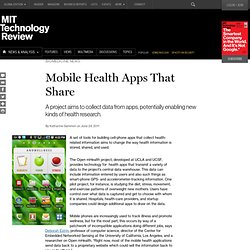
Many quality applications already exist that create opportunities for physicians and clinicians in their quest to provide efficient quality healthcare. Competitive Cooperation Is the Key There are several types of mHealth providers. Dallas Cowboys QB Tony Romo has cracked rib, punctured lung - ESPN Dallas. Mobile Health Apps That Share. A set of tools for building cell-phone apps that collect health-related information aims to change the way health information is stored, shared, and used.
Cambridge researchers release report on how mobile phones are transforming healthcare. Ten predictions for the mobile health market. Tags: ABI Research | Chilmark Research | IDC | In-Stat | industry metrics | InMedica Research | Juniper Research | Manhattan Research | Over the past three years, research firms including InMedica, Juniper, Chilmark, ABI, In-Stat, IDC, and Manhattan have been predicting the future size of and eventual revenues generated by mobile health services. This week MobiHealthNews has compiled its list of ten predictions for the next five years of mobile health — including prognostications for both consumer and enterprise — beginning with one that has already come to pass. 81 percent of physicians using smartphones by 2012 Manhattan Research has repeatedly predicted that by 2012, 81 percent of physicians would own a smartphone.
That level of adoption already occurred in 2011, according to a May 2011 report from Manhattan. Mhealth. The Social Media Daily. Open #mHealth Partnership Discussion. Where do we go from here? - More pre-blogspot than pre-posterous. Mind Mapping & Diagrams. Twitter / Home. Linkedin.
Kaiser Permanente Health Plans Receive High Marks in 'NCQA's Health Insurance Plan Rankings 2011-2012' September 20, 2011 In the “NCQA’s Health Insurance Plan Rankings 2011–2012” Kaiser Permanente has seven regions in the top 25 Medicare plans, the No. 2 Medicaid plan in the nation and six regions in the top 50 Private (Commercial) plans. OAKLAND, Calif. — Kaiser Permanente continued to demonstrate strong performance and ranked among the top health plans in the nation, in a report published today by the National Committee for Quality Assurance . The “ NCQA’s Health Insurance Plan Rankings ”report is published annually and ranks health plans in three categories: Medicare, Medicaid and Private (Commercial). The top four Medicare plans in the country were Kaiser Permanente Northern California, Kaiser Permanente Southern California, Kaiser Permanente Colorado and Kaiser Permanente Northwest.
Kaiser Permanente Hawaii ranked number seven in the nation for Medicare plans and retained its 2010 position as the No. 2 ranked Medicaid plan in the nation. Birding. Gamification. As Wipro drops out of the “offshore big three”, high-time to offload Infocrossing? iPhone.