
Words Of Wisdom. Felice Varini: Landscapes of Perspective and Illusion. To walk into a space exhibiting the art of Felice Varini is to be confused.

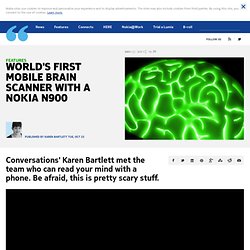
You’ll immediately notice vaguely geometric, monocolor shapes stretchings and sprawling across the room, but you won’t be able to determine any kind of method to the apparent madness. Varini’s work looks like interesting abstract art superimposed on an architectural space. But if you walk around and explore the space a little more, you’ll start to notice that the shapes change as you move. The more you move, and the more you stare at them, the more you’ll start to realize that there’s something you aren’t getting. Brain Scans Reveal What You’ve Seen. Parametric. Wireless brain scanners - Google Search. World’s first mobile brain scanner with a Nokia N900.
Conversations' Karen Bartlett met the team who can read your mind with a phone.
Be afraid, this is pretty scary stuff. Jim Fallon is a world-renowned neuroscientist. He’s also a potential psychopath, or so say the results of a brain scan and a series of genetic tests that he undertook to check if he was prone to Alzheimer’s disease. “Luckily I took those tests at the end of my career, I was just at the point of retiring. I know that I’ve never hurt anyone, or gone to jail. WirelessPhysiologicalMonitoring. ANFA - Academy of Neuroscience for Architecture. Michael Hansmeyer - Computational Architecture: Columns. RECORDING THE CONVERSATION.