
Ubuntu 12.04 64bit /sbin/insserv: No such file or directory. Linux Knowledge Base and Tutorial. Insserv - Enable an installed system init script. Maverick (8) insserv.8.gz Provided by: insserv_1.14.0-2_i386 insserv - Enable an installed system init script insserv [-v] [-c <config>] [-p <path>] [-d] [-f] [[/]path/to/init.d/]script ... insserv [-v] [-c <config>] [-p <path>] [[/]path/to/init.d/]script[,start=<lvl1,lvl2,...
>,stop=<lvl1,lvl2,... >] insserv [-v] [-c <config>] [-p <path>] -r [-d] [-f] [[/]path/to/init.d/]script ... insserv -h Currently there exists nine options for insserv. -v, --verbose Write out what is currently going on. [[/]path/to/init.d/] Relative or absolute path to the init scripts base directory. Beside using the extensions ,start=<lvl1,lvl2,...
> and ,stop=<lvl1,lvl2,... > it is possible to use override files replace a LSB comment header or simple provide a missing LSB comment header. The exit codes have the following conditions: 0 Service was successfully installed or removed 1 Service was not installed or removed Boot scripts sometimes lack a LSB comment header. Init(7), startpar(8). Werner Fink <feedback@suse.de> Linux: Init Process and PC Boot Procedure. PC Boot and Linux Init Process: BIOS: The Basic Input/Output System is the lowest level interface between the computer and peripherals.
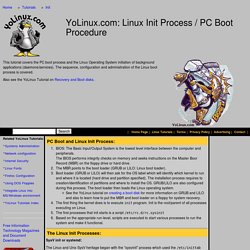
The BIOS performs integrity checks on memory and seeks instructions on the Master Boor Record (MBR) on the floppy drive or hard drive. The MBR points to the boot loader (GRUB or LILO: Linux boot loader). Boot loader (GRUB or LILO) will then ask for the OS label which will identify which kernel to run and where it is located (hard drive and partition specified).
The installation process requires to creation/identification of partitions and where to install the OS. The Linux Init Processes: SysV init or systemd: The Linux and Unix SysV heritage began with the "sysvinit" process which used the /etc/inittab configuration file to drive the execution of init scripts and configuration of terminal and GUI interfaces. Launching processes: The init process is the last step in the boot procedure and identified by process id "1". System Processes: Systemd init: #! #! Interactive map of Linux kernel. Linux Directory Structure (File System Structure) Explained with Examples. By Ramesh Natarajan on September 8, 2010 Have you wondered why certain programs are located under /bin, or /sbin, or /usr/bin, or /usr/sbin?
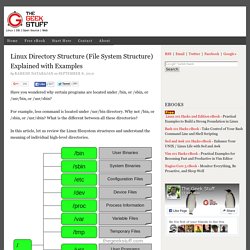
For example, less command is located under /usr/bin directory. Why not /bin, or /sbin, or /usr/sbin? What is the different between all these directories? In this article, let us review the Linux filesystem structures and understand the meaning of individual high-level directories. 1. / – Root Every single file and directory starts from the root directory.Only root user has write privilege under this directory.Please note that /root is root user’s home directory, which is not same as /. 2. Contains binary executables.Common linux commands you need to use in single-user modes are located under this directory.Commands used by all the users of the system are located here.For example: ps, ls, ping, grep, cp. 3. 4.