
Catering to Multiple Intelligences with Technology. Recently, a colleague and I made a presentation to the faculty about catering to students’ multiple intelligences by using technology.
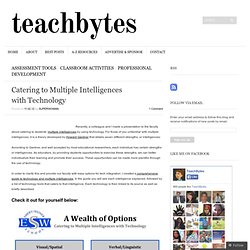
For those of you unfamiliar with multiple intelligences, it is a theory developed by Howard Gardner that details seven different strengths, or intelligences: According to Gardner, and well accepted by most educational researchers, each individual has certain strengths or intelligences. As educators, by providing students opportunities to exercise these strengths, we can better individualize their learning and promote their success. These opportunities can be made more plentiful through the use of technology. Allan's Blog. Powered by Translate DOWNLOAD THE LATEST VERSION: V4 published Mar 2015.
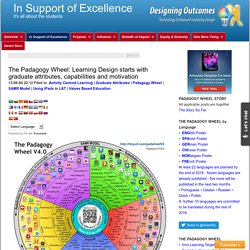
This PDF Poster has links to 122 of the latest and most popular educational apps. Now these resources are available in 19 different languages. The poster also has app selection criteria according to Blooms taxonomy. I am still a little numb at the amazing interest in, and discussion about, the Padagogy Wheel from teachers and educators around the world. So why yet another version only one week later? Flexible Learning Paths. Is not available. Basic Ingredients for Blended Learning Success. As blended learning implementation managers, we feel the same anxiety as a sprinter on the starting block.
We know that once upright with our legs under us, we will have the opportunity to realize an accelerated learning experience, greater efficiency, and teacher and student empowerment. At the same time, we are acutely aware that the stumble of a defunct login credential--or worse, Internet outage--can sap enough teacher buy-in from our blended programs to kill their momentum. As with any new system, a strong start is critical to every blended program’s success. Here are some of the common stumbling blocks and how to avoid them. Provisioning: Even if your rosters aren’t finalized, create your teachers’ and students’ online content accounts at least a week before school starts. Above all, be open and honest. Graphite Review. What's It Like?
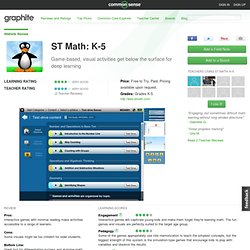
ST Math: K-5 is a standards-linked collection of games and activities that teach and reinforce elementary-level math concepts using a visual method of instruction. Every major component of the K-5 Common Core math curriculum is covered, with a focus on arithmetic, geometry, and measurement. The activities are visual and interactive, with a focus on teaching math without language. EdSurge. The philosophy behind ST Math’s spatial-temporal approach to teaching math concepts is rooted in research that has shown that visual learning can be an effective alternative to traditional classroom learning.
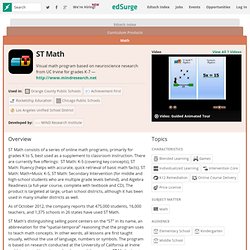
The idea is that all students, especially those who struggle with language, have the ability to do spatial-temporal reasoning--in other words, to use visual images over time to reason through problems. By introducing all math concepts visually--without any text whatsoever--ST Math programs clear the language hurdle and can be more stimulating to young children. Once a student has acquired a visual understanding of fundamental concepts, then symbolic representations of math are layered in. A demo video illustrates this nonverbal teaching method. Every student receives a visual-based, 13-picture login rooted in neuroscience. The games are 2-D, and consist of the student solving puzzles to navigate a penguin named Jiji across the screen.
ST Math is only available for schools. Edshelf. Developed by the nonprofit MIND Research Institute, the ST Math instructional software is designed to help all students reach math proficiency through self-paced, language-independent, mastery-based objectives.
Aligned to state and Common Core standards, ST Math uses a blended learning approach of 1:1 online instruction through the software and teacher-guided instruction integrating the software games into classroom lessons. ST Math software games incrementally increase in difficulty and provide immediate feedback. Educators are able to access real-time student learning data, allowing for differentiation based on each students' level of understanding. Most recently, MIND introduced touch functionality to the software. Ed Tech Map. Hanushek.stanford.edu/sites/default/files/publications/hanushek 1999 EEPA 21%282%29.pdf. MODEL. WBT: Powered by Funtricity! WBT: Powered by Funtricity! ‘How Children Succeed,’ by Paul Tough. Ccsr.uchicago.edu/sites/default/files/publications/Noncognitive Report.pdf.
What Education Can Learn From Kung Fu. ‘How Children Succeed’ — Q&A with Paul Tough. Here is a conversation I had by email with Paul Tough about his new book, “How Children Succeed: Grit, Curiosity, and the Hidden Power of Character.”
Tough is an author and speaker who worked as an editor for both The New York Times Magazine and Harpers Magazine and as a reporter and producer for the public-radio program “This American Life.” Tough’s also wrote “Whatever It Takes: Geoffrey Canada’s Quest to Change Harlem and America.” Both books were well-received. Q) Thanks for agreeing to talk about the book. Briefly, what is it about? A) The book is about two things: first, an emerging body of research that shows the importance of so-called non-cognitive skills in children’s success; and second, a new set of experimental interventions that are trying to use that research to help improve outcomes for children, especially children growing up in disadvantage.