
Les ouvriers boudés par la fiction. LE MONDE TELEVISION | • Mis à jour le | Par Hélène Delye Il est des engouements, des tendances, qui mettent paradoxalement en lumière la carence de ce qu'elles délaissent, et en suscitent l'appétit. C'est le cas des fictions ancrées dans le monde de la politique ("Les hommes de l'ombre", sur France2, ou "Borgen", sur Arte), particulièrement en vogue ces temps-ci. Sans bouder le plaisir de suivre ces programmes et leurs protagonistes, on rêve aussi d'autres types de fictions aussi réalistes, créatives et contemporaines.
Les héros de celles-ci seraient issus des classes populaires, ils seraient ouvriers, employés, citoyens. Préoccupés par leur travail, mais embarqués dans des histoires romanesques palpitantes et exigeantes. Partout, l'argument est le même. Désormais comédien, on l'a vu dans le film de Cédric Klapisch Ma part du gâteau (2011) et récemment dans Avec mon p'tit bouquet, un court-métrage de Stéphane Mercurio sur Canal+. Article paru dans le supplément. Scene Questionnaire – The Scene. The importance of asking questions to develop character and explore story is often quite helpful, but question asking should never be limited to people and plot alone.
The scene is just as important and essential to movie making. After all, a film is just a bunch of scenes strung together to create a comprehensive whole. Fr - CeltxWiki. Hi there!
Please sign in help Expert Exchange tags people badges. Initiations au vocabulaire de l’analyse filmique [cours de cinéma en ligne ] Lists of Note. Séries françaises : "TF1" n'a décidément rien pigé à la fiction. Au cours d'un entretien à "TéléObs", l'ancien directeur des programmes de "TF1" et actuel président de TF1 Production, Laurent Storch, a aligné des contre-vérités incroyables pour expliquer les raisons de l'échec de la fiction française.

Son interview démontre clairement qu'on n'est pas prêt de sortir de ce marasme. Un épisode de "Joséphine ange gardien" (CHOGNARD ETIENNE/TF1/SIPA) Laurent Storch : "Nous en sommes à 16 [épisodes] pour “R.I.S”, 14 pour “Section de recherches”… Pourquoi pas plus ? Je ne remets pas en cause notre droit social mais la raison majeure est évidente : on ne peut pas travailler plus de trente-cinq heures. " Faux. Le problème des 35 heures est inexistant si vous copiez les Anglais : au lieu de vouloir faire des séries de 24 épisodes qui demandent une façon très particulière de s'industrialiser, adaptez-vous ! Writers: still holding back on using social media? Read this. - Time to Write. This is a guest post from Dave Thomas, Business.com: Some authors are reluctant to use the social media to promote their craft.

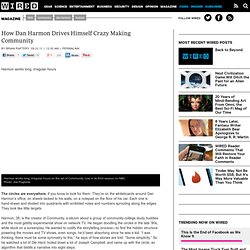
The reasons can be include the notion that not much is gained from the time expenditure, there is no perfect way to track a return on investment (ROI), and social media is essentially a fad that will come and go. If those are your concerns, take a minute to consider these benefits: Je suis réalisateur. The Neuroscience of Your Brain On Fiction. How Dan Harmon Drives Himself Crazy Making Community. Harmon works long, irregular hours on the set of Community, now in its third season on NBC.Photo: Joe Pugliese The circles are everywhere, if you know to look for them.
The Bitter Script Reader. Show, don't tell - Buffy the Vampire Slayer. I was thinking yesterday of good examples of "show, don't tell" and one instance that stuck out in my mind comes from the second season of Buffy the Vampire Slayer.

L'actu du scénario des 2 côtés de l'Atlantique. Où trouver des scénarios sur Internet ? Si le scénario n’a pas vocation d’œuvre littéraire, sa lecture n’est pas forcément réservée aux intervenants d’un futur film.
Ce texte est aussi un outil d’apprentissage pour les aspirants scénaristes, une source de plaisir pour les cinéphiles. Voici quelques adresses où trouver des scripts portés à l’écran. Outre-Atlantique, les scénarios connaissent une seconde existence après les sorties en salles et les diffusions télévisées. En France, à moins de connaître personnellement l’auteur d’un film, il est quasiment impossible de consulter son scénario. Quant au choix proposé par les éditeurs, il reste mince et concerne la plupart du temps un découpage après tournage, pas le scénario initial. Internet est sans doute à ce jour la meilleure opportunité de lire des scénarios, même si les ressources dans notre langue sont très limitées. Scripts cinéma Screenplays for you : Un site russe qui a le mérite de proposer des scripts rares, même si la navigation est un peu laborieuse. Cours ecrire un scenario. À la question“que vois-je sur l'écran ?”.
Il vaut beaucoup mieux écrire que”Rocky, boxeur autour de la trentaine monte sur le ring d'une salle de sportminable de banlieue, des gants en piteux état aux poignets”. A présent nousavons là une action qui peut être filmée et qui évoque le concept de “raté”. Acause de cela nous ne pouvons pas non plus, dans un scénario, nousétendre sur la vie intérieure de nos personnages . By Ken Levine. Ken Levine Answers 20 Questions About Writing TV Sitcoms.