
Personalization and Responsibility. George Siemens wrote the Duplication theory of educational value about higher education, but I am going to share a quote from this with a couple adaptations for K-12 public education: “Let me posit a duplication theory of education value: if something can be duplicated with limited costs, it can’t serve as a value point for [public education].
Content is easily duplicated and has no value. What is valuable, however, is that which can’t be duplicated without additional input costs: personal feedback and assessment, contextualized and personalized navigation through complex topics, encouragement, questioning by [an educator] to promote deeper thinking, and a context and infrastructure of learning. Basically: human input costs make education valuable. We can’t duplicate personal interaction without spending more money. In The Global Transformation in Education (Updated) Mark Treadwell discusses the ‘perfect storm’ in education which includes the intersection of 3 storms:
Literacy. Mathematics. High achievers. Australian Curriculum. Pedagogy. Know your learners. Web literacy. 3 turbulent decades that are changing education forever. By Beth Bacon The first three decades of the twenty-first century will go down in history as the years that changed education forever.
And the transition is full of turbulence. Will lecture-style classes disappear as digital learning rises? Right now, in 2013, the United States is just about in the middle of this thirty-year transition period from a low-tech to a digitally-integrated K-12 environment. How has digital learning affected education so far—and what will K-12 schools look like in the future? Reframing and Refining the Worksheet. Worksheets matter!
Tip of the Week: 5 TED Talks Every Teacher Should See. I love TED talks.
They’re like the perfect educational appetizer. All of them are quick and easy to digest, they look great, and they make you hungry to learn more. The problem? There are just so darn many of them. And it’s too easy getting sucked into the TED talk black hole where you end up watching for hours. Changing Pedagogy vs. Teacher Identity. Those who watch my Twitter stream closely may understand that I cycle through two very different approaches to the night - either I stay awake "working" through the dark hours, fighting my way, or I hide as I did as kid, still mostly awake, just waiting for dawn when sleep can come...
Anyway, that's not the point... But awake one late night I watched The Story of Louis Pasteur on Turner Classic Movies. Blended Learning: We Are All New Teachers. The challenges facing a new teacher are clear: how to write a strong lesson plan, how to master the fine art of lesson delivery and how to keep kids engaged in a positive classroom environment are all high on the list.
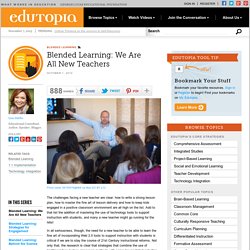
Add to that list the addition of mastering the use of technology tools to support instruction with students, and many a new teacher might go running for the hills! In all seriousness, though, the need for a new teacher to be able to learn the fine art of incorporating Web 2.0 tools to support instruction with students is critical if we are to stay the course of 21st Century instructional reforms. Not only that, the research is clear that strategies that combine the use of traditional face-to-face classroom methods with computer-mediated activities are here to stay. Enter the blended learning model. Five Characteristics of Learner-Centered Teaching. August 8, 2012 By: Maryellen Weimer, PhD in Effective Teaching Strategies, Teaching Professor Blog In May I finished a second edition of my Learner-Centered Teaching book.
Revising it gave me the chance to revisit my thinking about the topic and look at work done since publication of the first edition ten years ago. It is a subject about which there is still considerable interest. The learner-centered label now gets attached to teaching strategies, teachers, classes, programs, departments and institutions. 10 Things in School That Should Be Obsolete. Flickr: Corey Leopold By Greg Stack So much about how and where kids learn has changed over the years, but the physical structure of schools has not.
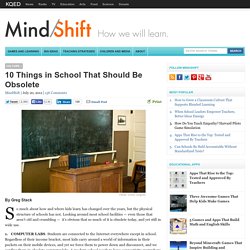
Looking around most school facilities — even those that aren’t old and crumbling — it’s obvious that so much of it is obsolete today, and yet still in wide use. 1. COMPUTER LABS. 5 Things Every Teacher Should Know. About Technology Integration. Differentiating Instruction: Meeting Students Where They Are, Teaching Today. Personalization and Responsibility. It's Time to Disrupt the System - Getting Smart by Alison Anderson -
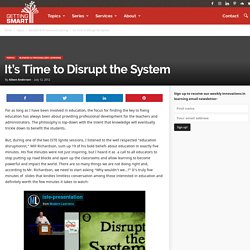
For as long as I have been involved in education, the focus for finding the key to fixing education has always been about providing professional development for the teachers and administrators.
How Twitter can be used as a powerful educational tool. Think Twitter is just a waste of time? Think again. Its organizational structure makes it an effective tool for connecting with students and others online By Alan November and Brian Mull Read more by Contributor July 13th, 2012 Days later, at yet another game, Mrs. What Are 21st-Century Skills? Learning to collaborate with others and connect through technology are essential skills in a knowledge-based economy.
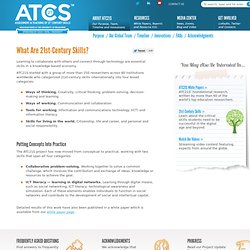
ATC21S started with a group of more than 250 researchers across 60 institutions worldwide who categorized 21st-century skills internationally into four broad categories: Ways of thinking. Creativity, critical thinking, problem-solving, decision-making and learningWays of working. Gen Y shuts door on open-plan century. "People are increasingly conscious about the quality of the space they work in" ... the new offices of law firm Clayton Utz.
Photo: Lee Besford Here's something new for the ''prairie dog'' office workers with their heads up over the partition, sniffing the workplace wind. The open plan office is on the way out, falling victim to dramatic shifts in the way people work and better understanding of the relationship between built environments and behaviour. ''I think the so-called open plan office has seen its heyday,'' says James Grose, national director of BVN Architecture. Pearson Global Research Conference – 2012. 13.30pm-Keynote_4-Greg_Whitby-Its_about_the_teacher_not_the_tools. Checkbox® 4.4. Framework for 21st Century Learning. Eric Sheninger April 2012.
Edtalks.org. Our Visit to St Thomas’s Sustainable Garden. The 21st Century Teacher. The 21st century pedagogy teachers should be aware of. 2iswgnm.jpg 615×430 pixels. New roles for teachers. 21st-Century Learning Creates New Roles for Students. About Greg Whitby. Sydney school embraces new teaching model. Blog. Bluyonder. SCIL – Lead the change. Student-Centered Learning. Designing Schools for 21st Century Learning, Randall Fielding Randall Fielding, AIA, is the Chairman and Founding Partner of Fielding Nair International, LLC (FNI), an award-winning school planning and design firm with offices in Minneapolis, Tampa, Madison and Melbourne, Australia. The firm has consultations in 23 states around the U.S. and 26 countries.