
Raising Money On AngelList: 21 Tips From Two Active Angels. The following is the result of a collaboration between Ty Danco and Dharmesh Shah.
Ty is an angel investor and startup mentor (you should be reading his blog). Dharmesh is founder and CTO of HubSpot, runs OnStartups.com and is an advisor to AngelList. Startups: How to Hustle with AngelLis... by Brendan Baker. How do we set the valuation for a seed round? A reader asks: “My question is how do we value a company with no sales?
I understand it’s an arbitrary valuation but is there anything we can possibly base it on? Is there a “default” valuation for companies in a seed round?” How to Pitch to Angel Investors. Mission accomplished. You have found what seems like an ideal match. You are ready for that first meeting with an angel investor where you get to present your business concept. How do you ensure your pitch is a turn on and not a turn off so that you get a second date or opportunity to close the deal with a written check in hand? A Primer on Equity Dilution - Dilution - Equity Financing. When the founders of a company bring in new equity money, they are typically concerned that they may be giving away the store -- reducing their percentage ownership by too large an amount.
The culprit is typically something called "dilution. " The concept of dilution is a major factor to consider in deciding upon a financing strategy. How do we set the valuation for a seed round? The Age Of Relevance. Editor’s note: This is a guest post submitted by Mahendra Palsule, who has worked as an Editor at Techmeme since 2009.
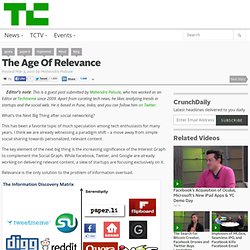
Apart from curating tech news, he likes analyzing trends in startups and the social web. He is based in Pune, India, and you can follow him on Twitter. What’s the Next Big Thing after social networking? This has been a favorite topic of much speculation among tech enthusiasts for many years. I think we are already witnessing a paradigm shift – a move away from simple social sharing towards personalized, relevant content. DYING FOR INFORMATION? A REPORT ON THE EFFECTS OF INFORMATION OVERLOAD IN THE UK AND WORLDWIDE (Beyond the Beginning: The Global Digital Library) To Hear What You Need, Stop Listening To Everything.
Startup Metrics for Pirates (Lean Startup Circle, Jan 2010. How to Assess the Market Potential of Your New Business Idea. The facts are sobering: the majority of small businesses fail within five years of starting up.

While there are many reasons that businesses fail, including some that have nothing to do with an owner's skills, it’s also possible that many of those same businesses collapsed simply because they couldn’t get enough customers to buy their product or service. In other words, the owners founded their business on a strategy of “build it and they will come” where, unfortunately, the customers never came. In fact, a recent study undertaken by the Blackbox seed accelerator found that many tech start-ups failed because they focused more on their product than on their potential customers. The good news is that there are a variety of ways you, as an entrepreneur, can conduct some market research to assess the potential demand for your product or service without spending a lot of money or hiring an expensive market research team.
Ask the Right Questions Google It Collect Feedback Sell Something, Anything. 12 Social Media Monitoring Tools Reviewed. After several months of researching, testing, and using various tools for social media monitoring and response, I thought it might be helpful to share some of my findings.
The Negative Effects of Information Overload on the Workforce. Recovering from information overload - McKinsey Quarterly - Organization - Talent. For all the benefits of the information technology and communications revolution, it has a well-known dark side: information overload and its close cousin, attention fragmentation.
These scourges hit CEOs and their colleagues in the C-suite particularly hard because senior executives so badly need uninterrupted time to synthesize information from many different sources, reflect on its implications for the organization, apply judgment, make trade-offs, and arrive at good decisions. The importance of reserving chunks of time for reflection, and the difficulty of doing so, have been themes in management writing for decades. Look no further than Peter Drucker’s 1967 classic, The Effective Executive, which emphasized that “most of the tasks of the executive require, for minimum effectiveness, a fairly large quantum of time.”
Yet they are devilishly difficult to implement, and getting more so all the time. Better solutions exist, and they aren’t rocket science. Institute for the friendship of competitive intelligence - HEVI. How our bits shape us: James Gleick’s “The Information” 1.
Circumscribing information, or words as things God is an intelligible sphere, whose center is everywhere and circumference is nowhere.— Alain de Lille, 12th century, glossing the Corpus Hermeticum One of the more poignant sections of James Gleick’s The Information: A History, A Theory, A Flood concerns the history of attempts to identify, count, and define every word in a natural language.
In other words, treating words as things — as information. An early effort — Robert Cawdrey’s 16th century Table Alphabeticall, only one copy of which has survived — defined 2500 English words. What you need to know about the HITECH Act. What is Meaningful Use? Watch our 5-minute overview on Meaningful Use What is "Meaningful Use"?
The 2009 HITECH Act made physicians eligible to receive up to $44,000 in total incentives from Medicare for "Meaningful Use" of a certified Electronic Health Record (EHR) starting in 2011. (Note: Physicians reimbursed by Medicaid can receive up to $63,750 starting in 2011 based on state-defined guidelines.) Medicaid payments have been coming in for some time and beginning in late May our first physician clients began receiving their year one Medicare Meaningful Use checks for up to $18,000. The Art of the Executive Summary. Several people have asked me for a blog entry about executive summaries. My colleague at Garage, Bill Reichert, wrote this explanation, and it's as good as it gets.
Writing a Compelling Executive Summary By now, you’ve probably already read several articles, web pages—even books—about writing the perfect executive summary. Most of them offer a wealth of well-intended suggestions about all the stuff you need to include in the executive summary. They provide a helpful list of the forty-two critical items you should cover—any entrepreneur worth his or her salt should be able to address these points in less than 100 pages—and then they tell you to be concise. Most guides to writing an executive summary miss the key point: The job of the executive summary is to sell, not to describe. Index Ventures.