
Western philosophy. Origins[edit] The scope of philosophy in the ancient understanding, and the writings of (at least some of) the ancient philosophers, were all intellectual endeavors.

This included the problems of philosophy as they are understood today; but it also included many other disciplines, such as pure mathematics and natural sciences such as physics, astronomy, and biology (Aristotle, for example, wrote on all of these topics.) Stoicism. School of Hellenistic Greek philosophy Stoicism is a school of Hellenistic philosophy which was founded by Zeno of Citium, in Athens, in the early 3rd century BC.
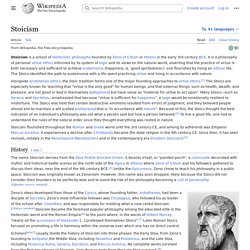
Stoicism is a philosophy of personal ethics informed by its system of logic and its views on the natural world. According to its teachings, as social beings, the path to eudaimonia (happiness) for humans is found in accepting the moment as it presents itself, by not allowing oneself to be controlled by the desire for pleasure or fear of pain, by using one's mind to understand the world and to do one's part in nature's plan, and by working together and treating others fairly and justly. Stoicism flourished throughout the Roman and Greek world until the 3rd century AD, and among its adherents was Emperor Marcus Aurelius. It experienced a decline after Christianity became the state religion in the 4th century AD. Epicureanism. Epicureanism is a system of philosophy based upon the teachings of Epicurus, founded around 307 BC.
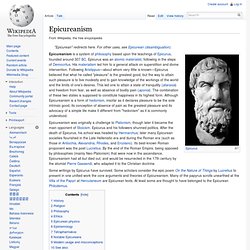
Epicurus was an atomic materialist, following in the steps of Democritus. His materialism led him to a general attack on superstition and divine intervention.