
Lost Viking Military Town Unearthed in Germany? A battle-scarred, eighth-century town unearthed in northern Germany may be the earliest Viking settlement in the historical record, archaeologists announced recently. Ongoing excavations at Füsing (map) , near the Danish border, link the site to the "lost" Viking town of Sliasthorp—first recorded in A.D. 804 by royal scribes of the powerful Frankish ruler Charlemagne. Used as a military base by the earliest Scandinavian kings, Sliasthorp's location was unknown until now, said dig leader Andres Dobat , of Aarhus University in Denmark. Whether it proves to be the historic town or not, the site offers valuable insights into military organization and town planning in the early Viking era, according to the study team. Some 30 buildings have been uncovered since excavations began in 2010. Aerial photographs and geomagnetic surveys indicate about 200 buildings in total. Chief among them is a Viking longhouse measuring more than a hundred feet (30 meters) long and 30 feet (9 meters) wide.
Popular Archaeology. Genetic study finds that First Americans were of Asian origin, but arose from multiple migrations of people across Beringia.

An international team of researchers, led by Professor Andres Ruiz-Linares from the University College London (UCL) and Professor David Reich of the Harvard Medical School have found that Native American populations originally arose, not from one single migration of people, but at least three. Calls to Destroy Egypt’s Great Pyramids Begin. Pages: 1 2 According to several reports in the Arabic media, prominent Muslim clerics have begun to call for the demolition of Egypt’s Great Pyramids—or, in the words of Saudi Sheikh Ali bin Said al-Rabi‘i, those “symbols of paganism,” which Egypt’s Salafi party has long planned to cover with wax.

Most recently, Bahrain’s “Sheikh of Sunni Sheikhs” and President of National Unity, Abd al-Latif al-Mahmoud, called on Egypt’s new president, Muhammad Morsi, to “destroy the Pyramids and accomplish what the Sahabi Amr bin al-As could not.” This is a reference to the Muslim Prophet Muhammad’s companion, Amr bin al-As and his Arabian tribesmen, who invaded and conquered Egypt circa 641.
Under al-As and subsequent Muslim rule, many Egyptian antiquities were destroyed as relics of infidelity. "Frankenstein" Bog Mummies Discovered in Scotland. In a "eureka" moment worthy of Dr. Frankenstein, scientists have discovered that two 3,000-year-old Scottish "bog bodies" are actually made from the remains of six people. According to new isotopic dating and DNA experiments, the mummies—a male and a female—were assembled from various body parts, although the purpose of the gruesome composites is likely lost to history. The mummies were discovered more than a decade ago below the remnants of 11th-century houses at Cladh Hallan, a prehistoric village on the island of South Uist (map), off the coast of Scotland. The bodies had been buried in the fetal position 300 to 600 years after death. (See bog body pictures.) 'Britain's Atlantis' found at bottom of North sea - a huge undersea kingdom swamped by a tsunami 5,500 years ago.
Divers have found traces of ancient land swallowed by waves 8500 years agoDoggerland once stretched from Scotland to DenmarkRivers seen underwater by seismic scansBritain was not an island - and area under North Sea was roamed by mammoths and other giant animalsDescribed as the 'real heartland' of EuropeHad population of tens of thousands - but devastated by sea level rises By Rob Waugh Published: 23:32 GMT, 2 July 2012 | Updated: 10:49 GMT, 3 July 2012 'Britain's Atlantis' - a hidden underwater world swallowed by the North Sea - has been discovered by divers working with science teams from the University of St Andrews.

Scientists announce discovery of world’s oldest pottery — 20,000 years old. Working in southern China, a team of scientists have reportedly discovered pieces of ancient pottery that could redefine the history of mankind and his relationship with food.

The shards of pottery, which date back 20,000 years, make them the world’s oldest known pottery — 2,000 to 3,000 years older than examples found in East Asia and elsewhere, say scientists. Mohenjo Daro: Could this ancient city be lost forever? 26 June 2012Last updated at 19:06 ET By Aleem Maqbool BBC News, Mohenjo Daro, southern Pakistan Aleem Maqbool looks around the archaeological site at Mohenjo Daro Pakistani officials say they are doing their best to save one of the most important archaeological sites in south Asia, Mohenjo Daro.
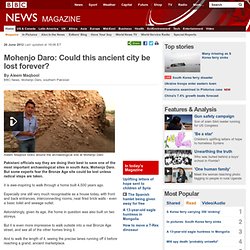
But some experts fear the Bronze Age site could be lost unless radical steps are taken. Dogs Find 100s of Bodies In Ghost Town. The groundbreaking female archaeologist. 'We're not port-swigging freeloaders': Prof Mary Beard challenges myths about Cambridge academics - but says divide between town and gown has become 'more obvious' in recent years Classics professor and TV presenter writes exclusively for the Cambridge News ANALYSIS: How wide is the town and gown divide in Cambridge today?

Published: Tue 15 Apr 2014 One community leader said it is here to stay - accusing some academics of being like MPs in ‘not understanding the real world’ Graduates will still be paying off loans into their early 50s, says Sutton Trust report - and Cambridge group claims it makes no financial sense Published: Fri 11 Apr 2014 Most students will be still be paying back university tuition fee loans until they are in their early 50s - and many will never repay the debt, research has found. Scientists are accused of distorting theory of human evolution by misdating bones. Ancient Suburb Near St. Louis Could Be Lost Forever. Across the Mississippi River from St.

Louis' famous Gateway Arch is a part of Illinois that's a post-industrial wasteland. Some hope the construction of a new bridge across the Mississippi River will help revitalize the area. Five hundred new fairytales discovered in Germany. A whole new world of magic animals, brave young princes and evil witches has come to light with the discovery of 500 new fairytales, which were locked away in an archive in Regensburg, Germany for over 150 years.

The tales are part of a collection of myths, legends and fairytales, gathered by the local historian Franz Xaver von Schönwerth (1810–1886) in the Bavarian region of Oberpfalz at about the same time as the Grimm brothers were collecting the fairytales that have since charmed adults and children around the world. Last year, the Oberpfalz cultural curator Erika Eichenseer published a selection of fairytales from Von Schönwerth's collection, calling the book Prinz Roßzwifl.
The 7 Most Terrifying Archaeological Discoveries. No professional position, aside from perhaps police officer and horny pizza delivery boy, is more frequently misrepresented in film than archaeologist.

Eisp. Easter island heads have bodies!?? Excavations of the bodies have been going on for many years, you can find out more from the Easter Island Statue Project.

It’s generally accepted that the statues were made sometime between 1250 and 1500 AD. There is controversy surrounding why the bodies are buried. Was it time and erosion, or were they buried on purpose? Aliens? Ten top tips for getting into archaeology. Apr 30, 2012 Getting started, Slider 6 Joe Flatman, author of the award-winning book ‘Becoming an archaeologist: a guide to professional pathways’, tells us his 10 top tips for getting into archaeology. Archaeology offers tremendous opportunities for involvement, whether a lifelong interest alongside another career, or a career in itself.
It is never too early or too late to become involved in archaeology, and archaeology transcends borders, cultures, languages and social and economic divisions. Anyone anywhere can become involved in archaeology if they wish, and the opportunities to become involved improve all the time. Archaeologist investigates legend of mythical ruler of ancient Peru. A figure from a mural that was discovered on the interior wall of an open courtyard on the north side of Huaca Chornancap, a truncated pyramid. Long before the Spanish arrived in Peru in 1530 and brought with them a written language with which to record history, legends about ancient Peru were passed down through generations by oral “historians” who were trained to flawlessly recount these stories of mythical heroes and villains.
Among the most colorful of these stories was the legend of Naymlap, the fearless founder of a centuries-old dynasty that supposedly ruled the Lambayeque Valley in northern Peru. Achaeologists Say Ancient South American Farmers Provide Example of Sustainability. So suggests a team of researchers studying an ancient farming system discovered in the Amazonian savannas of French Guiana. 5 Baffling Discoveries That Prove History Books Are Wrong.