
Novel Study Tic-Tac-Toe Menu Choice Board by Kasey Bell. I Can Read — Hubbard's Cupboard. Sifting and Sorting Through the 4-Blocks Literacy Model. Cheryl Sigmon's Website. This "fun stuff" section will be a changing page, offering you games, activities, and ideas to try in your school and classroom.
Hope you'll enjoy experimenting! For those of you looking for ideas for displaying student work, here's 5th grade teacher Dana Amaker's room at Webber Elementary School, Eastover, SC in Richland District One. She has created this whimsical display in a corner of her room. Students take pride in their work when they know others will view what they've written. Teachers at this school have all pledged to have their publishing centers up and running after the winter holidays. This idea comes from Deena Fuller, a teacher at Southlawn Elementary School in Liberal, Kansas: Evaporation - Each cooperative group of kids has one sheet of lined paper and all kids have pencils at their disposal. Trading Card Creator. Home › Parent & Afterschool Resources › Games & Tools Tool Why Use This Tool Here’s What To Do More Ideas To Try Send Us Feedback.
Center For Teaching Through Children's Books, Social Media Event - Lessons. IPAD APPS FOR INTERNATIONAL DOT DAY - Erintegration. INTERNATIONAL DOT DAY WEBSITES & CHROMEBOOK ACTIVITIES - Erintegration. Reading bookmarks. Create and share visual ideas online. Into the Book: Teaching Reading Comprehension Strategies. Into the Book: Teaching Reading Comprehension Strategies. Current events, lesson plans, quizzes, assessments. The Solution to Reading Comprehension.
Community Club Home. Community Club Firefighter Level A, Community Club What happens when the fire alarm rings?
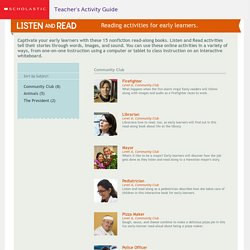
Early readers will follow along with images and audio as a firefighter races to work. Librarian Librarians love to read, too, as early learners will find out in this read-along book about life at the library. Mayor What's it like to be a mayor? Pediatrician Listen and read along as a pediatrician describes how she takes care of children in this interactive book for early learners. Pizza Maker Dough, sauce, and cheese combine to make a delicious pizza pie in this fun early-learner read-aloud about being a pizza maker.
Police Officer A police officer's most important duty is keeping people safe, as early readers will learn through the words, images, and audio in this interactive book. Utility Worker Follow along with images and sounds as a utility worker climbs down into manholes and up high on electric poles in this exciting read-aloud book. Veterinarian Animals Animal Moves. Educational Literacy Apps. How to Improve Reading Comprehension with Apps. September is national literacy month.
For the past ten years, U.S. illiteracy rates have remained troublingly high. According to a study conducted by the U.S. Department of Education, 21% of U.S. adults can't read at a 5th grade level, and 19% of students graduate from high school without being able to read. Students with difficult living conditions, learning disabilities, or limited exposure to books have a high risk of illiteracy and may need more academic support than their peers. THE Journal June 2013 Page 10. 21 Cool Anchor Charts To Teach Close-Reading Skills. Storynory, Free Audio Stories for Kids. Reading Goes Digital – 6 Ways Technology Enhances Reading Practices — Digital Rhetoric Collaborative. Over the past several years, we at Subtext have talked to and observed teachers in schools at all different stages of technology integration.
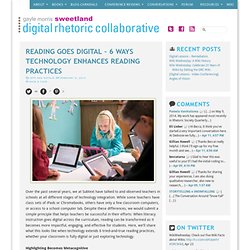
While some teachers have class sets of iPads or Chromebooks, others have only a few classroom computers, or access to a school computer lab. The International Dyslexia Association Promoting literacy through research, education and advocacy. Reading Journals — Jimmie's Collage. I’ve started using reading journals with Sprite.

It’s a way to encourage her independent interactions with the novels she’s reading. Lincoln Novel, Bookmark, and Journal I printed and laminated these bookmarks and made a simple single fold book for her Abraham Lincoln biography (shape template). It seems that the bookmarks linked there have disappeared from the web. Here is another, less colorful, option from Busy Teacher Cafe. Children's Literature arranged by Book Title - FREE Presentations in PowerPoint format, Free Interactives and Games.
Digital Booktalk. Printables. Improving literacy outcomes for individuals with autism spectrum disorders and limited speech – Webcast. Magic Spoons. Why hello there my fellow blogger buddies!
Were you wondering if I fell off the face of the Earth? If I did not, in fact, survive the madness of the holiday season? If a pack of rabid kindergarteners ate me alive??!! DON'T FRET!! I'm back. :) Not only am I back, but I have a great little somethin' to share! So this little phonemic awareness activity is called Magic Spoons. All4mychild. Reading Journals — Jimmie's Collage. The 2011 CYBILS Literary Awards – Seven iPad Book Apps to Make the Cut. Improving literacy outcomes for individuals with complex communication needs. Challenge Literacy skills are tremendously important in today’s society; they provide a means to enhance education, improve employment opportunities, develop social relationships, access the Internet, foster personal expression, and provide enjoyable leisure activities.
Literacy skills are even more important for individuals who have complex communication needs and have limited speech. Literacy skills allow individuals who require AAC a means to communicate anything they want. Unfortunately most of literacy curricula require students to provide oral responses; these programs are not appropriate for individuals with autism spectrum disorders, cerebral palsy, Down syndrome, and other special needs who have limited speech. There is an urgent need to develop effective, research-based interventions to teach literacy skills to individuals with complex communication needs.
Download Word Shape Worksheet Maker 1.07f Free - Easily create work sheets to help with handwriting skills. Make your own printable word shapes worksheets. Word Wall Shapes - Printable Word Walls from TheInspiredInstructor.com. Big Ideas in Beginning Reading.