
8 Core Beliefs of Extraordinary Entrepreneurs. Execution Machine: Doron Kempel's Six Keys To Getting Stuff Done. I Banned All Internal E-Mails at My Company for a Week. Assistants for Everyone - Fancy Hands. As a member of Fancy Hands, you're always supported by a team of assistants, but with our Personal Touch feature, you can give the whole team one name.

Carl Jung: Face to Face [FULL INTERVIEW] An Anatomy of Inspiration circa 1942. By Maria Popova “The true novelist, poet, musician, or artist is really a discoverer.”
Such is the labyrinth of literature: Some time ago, Dancing About Architecture: A Little Book of Creativity led me to the 1939 gem A Technique for Producing Ideas, through which I discovered one of the best things I’ve ever read, The Art of Scientific Investigation, which has in turned led me to An Anatomy of Inspiration (public library). Written by music historian Rosamund E. M. Harding (1899-1982) in 1942, this slim but potent volume sets out to reverse-engineer the mechanisms of creativity through the direct experiences of famous creators across art, science, and literature. Originality depends on new and striking combinations of ideas. Success depends on adequate knowledge: that is, it depends on sufficient knowledge of the special subject, and a variety of extraneous knowledge to produce new and original combinations of ideas.
Turns any surface into a whiteboard. Simian Mobile Disco - A Species Out Of Control. Questions you and your co-founder need to have answered before you start (or ASAP) 7 Things I Learned from Failing. Like any juicy breakup from our adolescence, entrepreneurs also crawl their way through similar stages of grief when faced with startup failure.
It’s been four months since we discontinued work on Bidzuku and until now, I was unable to string together my thoughts into a coherent and helpful message despite my best efforts. Time has since passed and grief has turned into that burning desire to do something worthwhile again. So, in an attempt to thwart other very eager entrepreneurs from making the same mistakes I did, here are 7 things I learned from my most recent of tragic startup failures. 1. Shut up about equity and build something. How to Choose Your Startup Idea. Index Ventures Blog – Secrets to Success in a Complex Enterprise Market. 90 Things I've Learned From Founding 4 Technology Companies. On October 27, 2010 I wrote a blog post about the “57 Things I Learned Founding 3 Tech Companies.”

Four traits of successful non-technical solo founders via Sandi MacPherson - QUIBB. This is the story of three solo founders who have either achieved millions in revenue or received millions in investment.
I was lucky to be able to chat with all three of them as I work on Quibb - a new product I'm working on to reinvent professional news, starting with the tech & startup vertical. How I’m Making Five-Figures A Month Off Bootstrapped Products. For most startups, the natural course is to raise money.
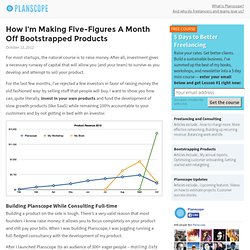
After all, investment gives a necessary runway of capital that will allow you (and your team) to survive as you develop and attempt to sell your product. For the last few months, I’ve rejected a few investors in favor of raising money the old fashioned way: by selling stuff that people will buy. I want to show you how can, quite literally, invest in your own products and fund the development of slow growth products (like SaaS) while remaining 100% accountable to your customers and by not getting in bed with an investor. Building Planscope While Consulting Full-time. Compassion meditation may boost neural basis of empathy, study finds. (Medical Xpress)—A compassion-based meditation program can significantly improve a person's ability to read the facial expressions of others, finds a study published by Social Cognitive and Affective Neuroscience.
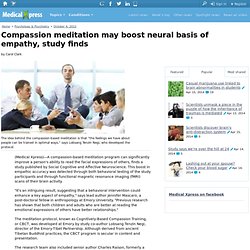
This boost in empathic accuracy was detected through both behavioral testing of the study participants and through functional magnetic resonance imaging (fMRI) scans of their brain activity. "It's an intriguing result, suggesting that a behavioral intervention could enhance a key aspect of empathy," says lead author Jennifer Mascaro, a post-doctoral fellow in anthropology at Emory University. "Previous research has shown that both children and adults who are better at reading the emotional expressions of others have better relationships.
" The meditation protocol, known as Cognitively-Based Compassion Training, or CBCT, was developed at Emory by study co-author Lobsang Tenzin Negi, director of the Emory-Tibet Partnership. Ship: Risks You Need to Consider (Infographic) While entrepreneurs come in all shapes and sizes, one commonality binds them all together: the willingness to take a risk.
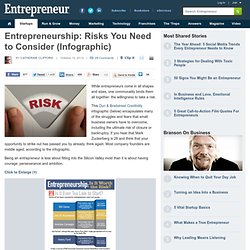
This Dun & Bradstreet Credibility infographic (below) encapsulates many of the struggles and fears that small business owners have to overcome, including the ultimate risk of closure or bankruptcy. If you hear that Mark Zuckerberg is 28 and think that your opportunity to strike out has passed you by already, think again: Most company founders are middle aged, according to the infographic. The Product is the Byproduct. 10 team building actions that are louder than words - National Startup Business. Success in a startup is not possible as a “one-man show.”
An entrepreneur has to engage with team members, partners, investors, vendors, and customers. In my experience, the joy of positive engagement is sometimes the only pay you get in an early startup. Amazingly, many successful startups are built on this basis alone, with almost no money. I will talk here primarily about building the internal team of a startup, but the same principles apply outside to your “extended team” and customers. I like the ten practical and transformative steps outlined by Bob Kelleher, in his book “Louder Than Words,” from his many years of experience in corporate environments.
Link high engagement to high performance. Riding the Consumerization Wave. October 7, 2012 | Leave a Comment Rather than resist it, organizations should embrace Consumerization to unlock its business potential.

This requires a strategic approach, flexible policies and appropriate security and management tools. Strategy or Execution: Which Is More Important? This article was written with Evan Hirsh and Kasturi Rangan. I once heard a business leader say, “Strategy is results.” He meant that strategy doesn’t matter as long as you are producing results. Regulatory hacks. A common way to think of business regulations is by analogy to sports: the rules are specified up front, and the players follow the rules. But real regulations don’t work that way. Regulations follow business as much as business follows regulations. Sometimes the businesses that change regulations are startups. Startups: As a startup CEO what is your favorite productivity hack. Building the Global Startup // John O'Farrell. This is the first in a series on building a global company from the ground up. In browsing Quora recently, I was struck, but not surprised, by how many people sought advice on how to expand a startup internationally.
Not surprised, because for many young companies international expansion ranks with M&A as something that’s easy in concept, but difficult to execute well. (See the many Quora responses, including my own, to Why do companies often fail at international expansion? ) 8 Little AWS Billing Oddities You Might Want to Know. As part of working on a purchasing and scenario planner for CloudVertical, I’m going over all the EC2 pricing variables – instances types, cost by region, cost by life cycle (on demand, reserved type and time, or spot), and I noticed a few small oddities I thought were interesting. 1.
US West Oregon and US East Virginia regions share the exact same pricing (Virginia doesn’t offer Cluster compute though). Y Combinator growth benchmark. Back in September Y Combinator founder Paul Graham wrote an essay about growth. The central point of his essay is that startups are all about growth and that is the one thing they measure at Y Combinator. According to Paul most startups should look at revenue growth, but active users is a good proxy for companies that aren’t charging their customers (yet). Because the Y Combinator program is short (3 months) they measure growth weekly.
Here are the benchmarks: When is a Startup Non-Disclosure Really Required? Published Oct 08, 2012. How To Scale Yourself as a One-Man Band. LEAN GTD #2 - Defining customer value - Poder.dk : Poder.dk. 7 tips for bootstrapping a (profitable) Internet company. Don’t Quit Before You Reach the Tipping Point. The great Aikido master, Ikeda Sensei, says: “Aikido works. A Swedish/British entrepreneur in Berlin, trying to make it happen — Alexander Ljung. Spencer Fry — Harnessing Entrepreneurial Manic-Depression: Making the Rollercoaster Work for You.
The OODA Loop: Playing chess with half the pieces. Nivi · November 20th, 2008. How To Create A Brand With Values. Brands That Are Born With Values The great stories of the oral tradition have always contained lessons encouraging people to pursue their higher values. How to Create a Distribution Strategy ...That Banks. 8 Steps to Establishing a Performance Culture. Lessons Learned. Mark Cuban's 12 Rules for Startups. Leading From The Front Lines. A Simple Tool You Need to Manage Innovation - Bansi Nagji and Geoff Tuff. Chief Innovation Officer’s Agenda. The Real Leadership Lessons of Steve Jobs. What To Do When You Don't Know What To Do - Leonard A. Schlesinger, Charles F. Kiefer, and Paul B. Brown. 6 Habits of True Strategic Thinkers. How Priorities Make Things Happen.
Start-Ups Keep Revenue at Zero to Cash In on Acquisition - Disruptions. Going from $0 to $500k in 1 Year with no VC Money. TalentBin: Source the Web.