
Free source code hosting — Bitbucket. Sage - Tour. Sage is built out of nearly 100 open-source packages and features a unified interface.
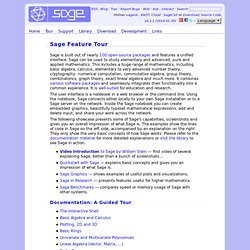
Sage can be used to study elementary and advanced, pure and applied mathematics. This includes a huge range of mathematics, including basic algebra, calculus, elementary to very advanced number theory, cryptography, numerical computation, commutative algebra, group theory, combinatorics, graph theory, exact linear algebra and much more. It combines various software packages and seamlessly integrates their functionality into a common experience. It is well-suited for education and research. The user interface is a notebook in a web browser or the command line. The following showcase presents some of Sage's capabilities, screenshots and gives you an overall impression of what Sage is. Schema. Welcome to Jenkins CI! Google Commands - Using Google Operators to Uncover Link Opportunities.
Using Google commands to find link building opportunities Google commands for link building How can you used Google commands in your everyday searching?

It’s well know that Google puts a lot of emphasis on how many and what quality back links you have coming into your website when determining how much authority your site has and ultimately how relevant your site is for keyword searches. Put simply – more quality links = more relevance = more traffic = more leads = more sales! Getting more quality links to your website is a challenge and there are numerous ways to achieve, but in this article I’m going to look at some very simple Google Operators, or Google commands that you can use to find those link partners. Priming Kanban: A 10 Step Guide.
Book Description Kanban represents a unique way of catalyzing the application of Lean product development principles to software development, maintenance and operations.

Being a method for driving change Kanban does not prescribe specific roles, practices or ceremonies but instead offers a series of principles to optimize value and flow in your software delivery system. As such, Kanban’s focus on context and adaptability has made it increasingly popular for teams working in contexts where traditional Agile methods are not an easy fit and mature Agile teams looking for ways to further optimize their development process. This mini-book offers an easy to follow 10 step guide to taking the initial plunge and start using Lean principles to optimizing value and flow in your system.
Each step consists of a section explaining “why” followed by examples of specific tools, practices and rules that have helped other teams better understand and optimize their system. About the AuthorsN/A. Home. Apache OpenNLP - Welcome to Apache OpenNLP. Deploy your own "cloud" with Debian "Wheezy" April 25th, 2012 The Debian Project produces an entirely Free operating system that empowers its users to be in control of the software running their computers.

These days, more and more computing is being moved away from user computers to the so-called cloud – a vague term often used to refer to Software as a Service (SaaS) offerings. We are concerned that, without the needed care, this trend might put in jeopardy most of the freedoms that users enjoy when running (on their computers) software that is Free according to the Debian Free Software Guidelines. We encourage Debian users to prefer cloud offerings where the SaaS infrastructure is entirely made of Free Software and can be run under their control. We encourage Debian users to deploy their own clouds, as the ultimate way to retain all the freedoms that Debian stands for.
To help our users with these tasks, we are proud to announce the availability of several new technologies that would ease the deployment of Debian-based clouds. HCE - Hierarchical Clustering Explorer. How We Build Features. X Access to videos, talks, and worksheetsInvitation to private Google Plus CommunityJoin in on live Q&A webinars and fireside chats.

Graph Theory with Applications. 3 Rules for Building Features in a Lean Startup. 20 Flares370010--×20 Flares x.

WebSequenceDiagrams.com - Draw and Edit Sequence Diagrams in seconds. Astronomy Software - picture identification - plate-solving - astrophotography - integrated telescope-camera control. The application is written in C++/wxWidgets (cross platform GUI library), OpenGL, OpenCV, Boost and other portable libraries so that it can be compiled/released on other platforms such as Linux/MacOSX/etc.

Current pre-alpha release is only for windows, to follow with a Linux and MacOSx release as soon as I pass the beta test. The project is to be released as a pre-alpha (concept proof) state and in order to test the the main functionality. Anyone interested in helping me to test and optimize it please contact me. Also, I am working to add translation in twenty different languages to start with, so if you are willing to help on this please let me know.
I am looking for sponsorship to support this free software. The Miso Project.